Mercedes-Benz GLE Towing Capacity: What the Rating Means and How It Varies
The short answer
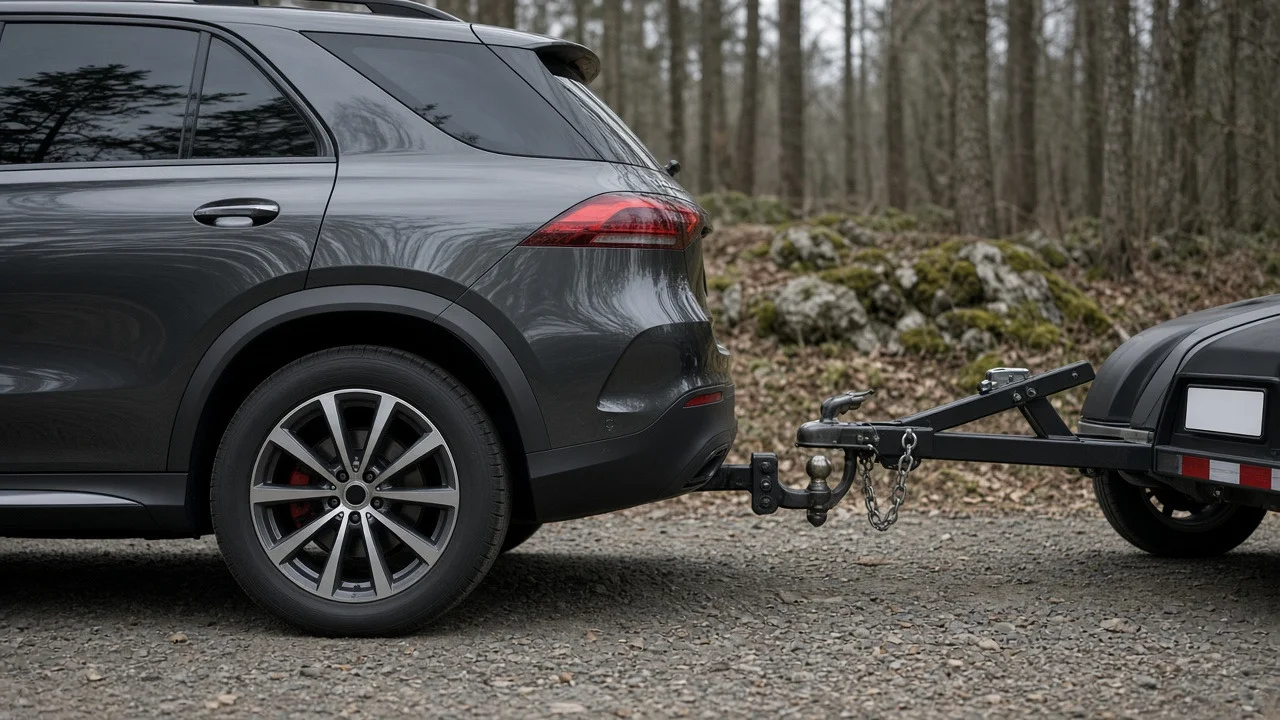
For the current-generation Mercedes-Benz GLE sold in the US, Mercedes-Benz has commonly advertised a maximum towing capacity of up to 7,700 pounds when the SUV is properly equipped. That figure is a ceiling, not a guarantee for every vehicle. The rating a specific GLE can safely use depends on its model year, generation, powertrain, factory towing equipment and how heavily the vehicle itself is loaded. Treat 7,700 pounds as the upper bound for a correctly equipped conventional GLE. Then confirm the exact rating for a particular vehicle from its owner's documentation and the door-jamb labels.
Why the 'up to' qualifier matters
Manufacturers publish towing capacity as the best case for a model line. Several conditions sit behind that number. The trailer must have its own brakes, the vehicle needs the factory or approved trailer hitch, and the SUV usually carries only a driver and minimal cargo. Once passengers, luggage and accessories are added, the safe trailer weight shrinks. The combined weight of the vehicle, its load and the trailer cannot exceed the manufacturer's limits.
What changes the rating from one GLE to another
Generation and model year: the GLE name has covered more than one generation, and ratings and equipment have changed over time. A figure quoted for a newer model may not apply to an older one. Powertrain: gasoline, mild-hybrid, AMG and plug-in hybrid versions differ in weight, cooling and drivetrain. Plug-in hybrid variants in particular may carry a different rating from conventional models, so check them individually. Body style: the GLE SUV and the GLE Coupe share much of their engineering, but don't assume identical towing figures without confirming. Factory equipment: a trailer hitch package, wiring and the vehicle's trailer-related software settings are typically part of what makes the full rating usable. Market: ratings, hitch hardware and legal limits differ between regions. A figure quoted for Europe or another market should not be applied to a US-spec vehicle.
Key towing terms explained
Term | What it means | Why it matters; Towing capacity | The maximum trailer weight the manufacturer rates the vehicle to pull under specified conditions | Your loaded trailer should stay below it, ideally with margin; Braked vs. unbraked rating | Separate limits for trailers with and without their own brakes | The headline figure normally assumes a braked trailer; unbraked limits are much lower; Tongue weight | The downward force the trailer coupler places on the hitch ball | Too little causes sway; too much overloads the rear axle and hitch; GVWR | Gross Vehicle Weight Rating, the maximum allowed weight of the vehicle including passengers, cargo and tongue weight | Tongue weight counts against payload, not just the trailer; GCWR | Gross Combined Weight Rating, the maximum allowed weight of vehicle and trailer together | A heavily loaded GLE may hit this limit before the trailer reaches the towing capacity; Payload | How much weight the vehicle can carry in people, cargo and tongue weight | Often the first limit families run into
How to work out a safe trailer weight for your GLE
Find the specific ratings for the vehicle: towing capacity, maximum tongue weight, GVWR and GCWR, from the owner's manual and the labels on the driver's door jamb. Estimate the loaded trailer weight, not the empty or 'dry' weight from a brochure. Water, gear, batteries and propane add up quickly. Plan for tongue weight of roughly 10 to 15 percent of the trailer's loaded weight, a common rule of thumb for conventional trailers. Check that this stays under the vehicle's maximum tongue weight and that it fits within payload alongside passengers and cargo. Add the loaded vehicle and loaded trailer together and confirm the total stays below GCWR. Leave a margin. Towing near the maximum leaves little room for steep grades, hot weather, crosswinds or emergency maneuvers.
What a GLE suits as a tow vehicle
With a rating in the 7,700-pound class, a properly equipped GLE fits the towing needs of many luxury midsize SUV owners: small to mid-size travel trailers, boats on single- or tandem-axle trailers, utility trailers and car haulers carrying lighter vehicles. It is a car-based, unibody SUV rather than a body-on-frame truck. Buyers who regularly tow near the limit over long distances, or who plan to move up to a larger camper later, may want to compare it with vehicles rated well above their expected loads. For occasional or moderate towing, the GLE's rating is competitive within its class. The real constraint is usually payload and how the vehicle is loaded, not the headline number.
Equipment and setup considerations
Hitch: use the Mercedes-Benz factory hitch or one approved for the specific vehicle, rated for the trailer you intend to tow. Trailer brakes and controller: braked trailers are required to use the higher rating. Confirm how the vehicle supports trailer brake control and whether an aftermarket controller is needed. Weight-distribution hitches: some manufacturers restrict or specify how these can be used with vehicles that have air suspension. Check the owner's manual before fitting one to a GLE. Wiring and lighting: make sure trailer lights, turn signals and brake lights work through the vehicle's trailer connection before every trip. Tires: inflate to the pressures recommended for towing or heavy loads, as given in the vehicle documentation.
Buying a used GLE for towing
If towing is a reason to buy, confirm that the vehicle actually has a factory or properly installed hitch and working trailer wiring. Ask whether it has towed regularly, and look at maintenance records for the transmission, cooling system and brakes. Check the model year and powertrain against the ratings for that exact configuration. A towing figure from a current brochure may not match an older or differently equipped example.
Bottom line
Mercedes-Benz markets the current US GLE as able to tow up to 7,700 pounds when properly equipped. For a particular vehicle, the usable limit depends on its generation, powertrain, hitch equipment and how much weight it already carries. Confirm the ratings for the exact configuration, then size the trailer by its loaded weight with a sensible safety margin.