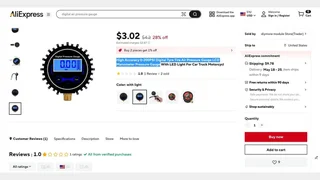
Master Tire Pressure Gauge

A tire pressure gauge is only useful if its readings can be trusted at the valve stem. When researching a master tire pressure gauge, the practical question is whether the tool will consistently repeat a measurement and display it in units you can act on. Drivers often see uneven tread wear, a dashboard warning light, or a slow leak and want a gauge that removes guesswork. The purchase decision therefore turns on the connection seal, the display readability, the measurement range, and how the gauge behaves across repeated checks rather than on a single advertised number.
The direct answer
Choose a gauge that seals cleanly on the Schrader valve, gives a stable reading in your preferred units, and covers the inflation range your vehicle specification calls for. A good purchase is less about a brand label and more about repeatability: pressing the chuck squarely onto the stem should produce the same number on a second and third check. If you cannot get a consistent reading, the gauge is not serving its purpose, regardless of how precise its dial or digital screen may look. Condition changes this answer, however. A gauge with a damaged sealing gasket, a cracked housing, or moisture inside the display cannot be relied on until corrected.
Accuracy and calibration also shape the direct answer. Even a clearly marked face can drift after being dropped or left in a hot glovebox. Before relying on any reading, compare the gauge against another known-stable instrument at a mid-range pressure such as a typical passenger-car inflation level. If the values disagree by more than a small margin, real-world uncertainty is larger than the printed scale suggests. For most drivers, the best immediate step is to select a gauge with a rigid chuck, a defined measurement range, and a display that holds briefly after the connection is released.