Mack MP7 oil pressure sensor location
Finding the Mack MP7 oil pressure sensor location usually starts with knowing which circuit you need. The engine uses more than one pressure-sensing point, and the piston cooling oil pressure sensor is easily confused with the main engine oil pressure sensor. MP7 owners often chase a warning light or low reading without realizing the switch or sender they unplugged feeds a different signal. Using the correct location prevents misdiagnosis, unnecessary parts swapping, and false low-pressure conclusions. This guide explains the two most common locations, how to recognize each sensor, and why circuit identity matters before you remove a connector or replace a component.
Essential answer
The Mack MP7 engine oil pressure sensor location is not a single universal spot. On typical MP7 installations, the main engine oil pressure sensor or switch is found on the left side of the engine block, often forward of the oil filter housing or near the oil cooler area. However, the exact position shifts with chassis packaging, aftertreatment placement, and model year. The piston cooling oil pressure sensor is a separate component, usually mounted lower or nearer the oil rifle that feeds the under-piston cooling nozzles. Treating both as the same sensor is a common source of incorrect readings.
A piston cooling oil pressure sensor monitors the dedicated circuit that sprays oil against the underside of each piston. This oil jet flow helps control piston temperature under load. The main engine oil pressure sensor reports general gallery pressure used by bearings and the valvetrain. Because the two circuits can have separate senders, connectors, and harness routing, identifying which one the engine controller is reading matters. If the fault code or gauge concern references piston cooling pressure, the main gallery sender will not answer that question.
Identification and location
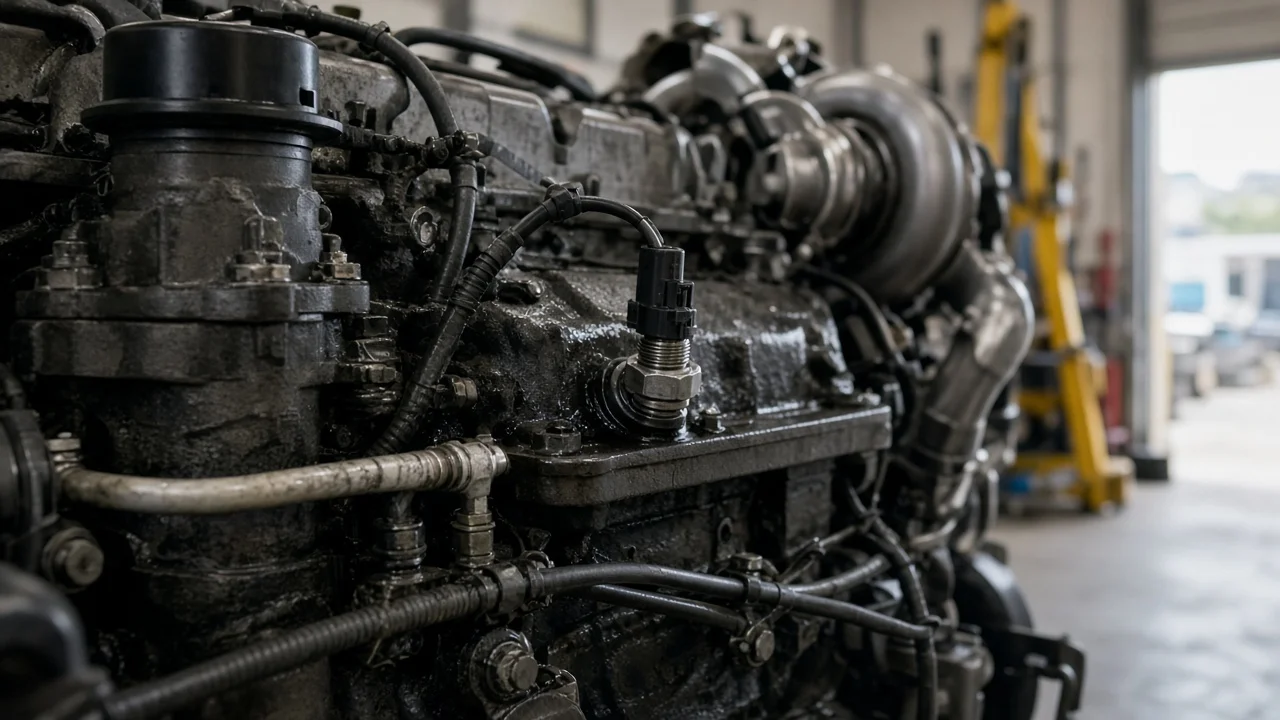
The main engine oil pressure sensor on an MP7 is typically a small cylindrical sender with either one or three wires, depending on whether it is a switch or a pressure transducer. It threads into a port on the oil cooler housing, the block oil gallery, or a nearby adapter. A three-wire sensor usually supplies a variable voltage signal for the gauge or engine control module. A single-wire switch typically closes a ground path at a preset pressure. Look for a component with a hex body and an electrical connector pointing outward from the block, often wrapped in the same harness branch as the crank position sensor or cam sensor.
The piston cooling oil pressure sensor is often lower on the oil rifle, closer to the line feeding the piston cooling nozzles, or mounted on the block near the oil transfer tube. It may use a similar two-pin or three-pin weatherproof connector, which is why wire color and harness branch tracing are more reliable than appearance alone. Before probing or removing anything, confirm the connector type and trace the harness gently away from heat shields and moving belts. Manufacturer-dependent codes require vehicle-specific confirmation, but the physical routing usually separates the piston cooling sender from the main gallery sender enough to avoid removing the wrong one.