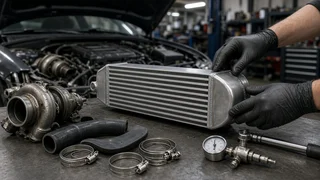
LS turbo intercooler

An LS turbo intercooler is a heat exchanger placed between the turbocharger compressor outlet and the intake manifold on an LS V8 build. Its job is to remove the heat created when the compressor squeezes air to boost pressure, because hot charge air is less dense and more likely to trigger knock under load. Whether you are choosing an air-to-air core for a front-mount setup or a water-to-air brick for a twin-turbo package, the intercooler works with the plumbing rather than changing the engine’s displacement. The right selection depends on boost level, available airflow, hose connection routing, and how the vehicle will actually be driven.
Essential answer
An LS turbo intercooler cools the pressurized intake charge before it reaches the cylinders. As the turbo’s compressor wheel compresses air, the temperature at the compressor outlet rises enough to reduce charge density and raise the risk of detonation. Passing the air through the intercooler rejects that heat, which helps preserve power and lets the tune use timing more safely. The core is not a power adder by itself; it is a supporting component that makes the boost the turbo already produces more usable.
For an ls twin turbo intercooler setup, the same principle applies, but the plumbing is more complex because two compressors may merge into a single core or feed separate cores. Some builders use one large air-to-air unit, while others choose a water-to-air intercooler mounted close to the intake to reduce piping volume. The essential answer is consistent in both cases: the intercooler is a charge-air temperature control device. The correct size and style depend on boost pressure, packaging room, and whether low pressure loss or low heat soak matters most.