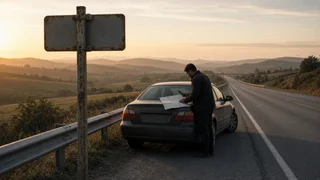
Kilometer Marker: What It Is and How to Use It to Report Your Location
The Short Answer
A kilometer marker is a small roadside sign, usually a post or plate along the shoulder or median, that shows the distance in kilometers from a fixed starting point on that route. Its main practical use for drivers is to pin down an exact position on a long road. If your vehicle breaks down, the route name, your direction of travel and the number on the nearest km marker give responders a reliable location even when there are no exits, towns or landmarks nearby.
In the United States, most highways use mile markers rather than kilometer markers, so the sign you see is more likely counting miles. Kilometer markers are standard in Canada, Mexico and most other countries, and a few US routes use metric-based signage. Knowing which unit the sign uses matters when you relay your location, because a number in kilometers and a number in miles point to different places on the same road.
Kilometer Markers vs. Mile Markers in the US
Both types of sign work the same way: they count distance along a single route from a reference point, often a state line or the route's beginning. The difference is only the unit. US highway signage follows the MUTCD (Manual on Uniform Traffic Control Devices), the federal standard for road signs, which allows reference location signs in either miles or kilometers. In practice, miles dominate nationwide.
Interstate 19 in Arizona is the best-known US example of metric signage, with distances and exit numbers based on kilometers. Outside cases like that, if you are driving in the US and see a small green post with a number, treat it as a mile marker unless the sign or local information indicates otherwise. Near the borders with Canada and Mexico, or after crossing them, expect kilometer markers.
Feature | Kilometer marker | Mile marker; Unit counted | Kilometers from a route reference point | Miles from a route reference point; Where common | Canada, Mexico, most countries; a few US routes | Most US highways; Distance between consecutive markers | About 0.62 miles | About 1.61 kilometers; Typical use | Locating breakdowns, crashes and maintenance work | Same
How to Read a Km Marker
The large number on the sign is the distance from the route's starting point. Some markers also show the route number or a direction letter. In many areas, enhanced reference markers appear at shorter intervals and show decimal values, such as tenths of a unit, which lets you report position even more precisely.
Numbering direction varies by country and jurisdiction. On many US routes, numbers typically increase from south to north and from west to east, but this is a convention rather than a guarantee, and it does not necessarily apply abroad. The simplest check is to note two markers in a row: if the numbers are going up, you are traveling in the direction the count increases.
Exit numbers are often tied to marker values on routes that use distance-based exit numbering, so the last exit you passed is a useful cross-reference. This is not universal; some roads number exits sequentially instead.
Using a Kilometer Marker to Report a Breakdown
When you call emergency services or a roadside assistance provider, a marker number alone is not enough because the same number exists on every route. Combine it with the details below so the dispatcher can place you on the correct road and side.
Route name or number, for example the highway or interstate designation. Direction of travel, such as northbound or eastbound, or the destination city you were heading toward. The nearest marker number, and whether it is in kilometers or miles. Which side of the road you are on: right shoulder, left shoulder or median. The last exit or interchange you passed and any visible landmarks, bridges or overpasses. Your vehicle's make, color and whether hazard lights are on.
If you did not catch the nearest marker, give the last one you remember and estimate how far you traveled after it. Do not walk along a live highway to read a sign. Your phone's map or location-sharing feature can provide coordinates that most dispatchers can use, and stating both the marker and the coordinates reduces the chance of confusion.
Converting Between Kilometers and Miles
One kilometer is about 0.62 miles, and one mile is about 1.61 kilometers. When reporting a location, give the number exactly as printed on the sign and say which unit it uses rather than converting it yourself. Responders locate you by the marker on the road, not by a calculated distance, and a conversion can introduce errors.
Habits That Make Your Location Easier to Report
On long trips, especially on rural roads or in another country, glance at markers and exit numbers periodically so you always know roughly where you are. If you notice a warning light, an unusual noise or a change in how the vehicle drives, note the next marker before pulling over if you can do so safely. That single number can shorten the time it takes for help to find you.