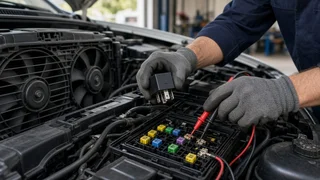
How to Test a Car Relay with a Multimeter
A car relay is an electrically controlled switch that lets a low-current circuit operate a high-current component such as a fuel pump, cooling fan, or headlamp. When a relay becomes intermittent or fails, the accessory may not work even though fuses and wiring look fine. Testing with a multimeter gives you a clear way to separate a failed relay from a control-circuit or load problem. The process checks the coil, the switch contacts, and the way the relay behaves when energized.
Direct answer
Use a digital multimeter to measure resistance across the relay control coil and across the switched contact terminals, then confirm continuity changes when the coil is energized. A relay that shows an open coil, fixed high resistance across the contacts, or contacts that do not change state has failed. The measurement only interprets electrical behavior, so an unusual reading means the relay is not functioning correctly in that circuit.
The practical value of this test is separating relay trouble from issues in the socket, fuse, switch, or powered component. Because vehicle relays come in normally open and changeover layouts, terminal positions can differ even when the relay body looks similar. Always identify the control and load pins from the diagram printed on the housing or the vehicle information before drawing a conclusion from the readings.
How to proceed
Begin with the vehicle off and the relay removed from its socket. Set the multimeter to a low resistance range and identify the two coil terminals. A typical reading may be several tens to a few hundred ohms depending on the relay, while an open reading means the coil winding is broken. Next measure the normally closed and normally open contact pair according to the printed diagram, if both are present.
After the resting checks, connect the meter across the high-current contact pair and briefly energize the coil with the vehicle battery or a suitable supply. The reading should change from open to near zero, or from a normally closed path to open, as the armature moves. If the contact resistance stays high or the switching is unsteady, the relay is suspect. Reinstall or replace parts only with the circuit de-energized and the vehicle configuration confirmed.