How to install a powered subwoofer in a car
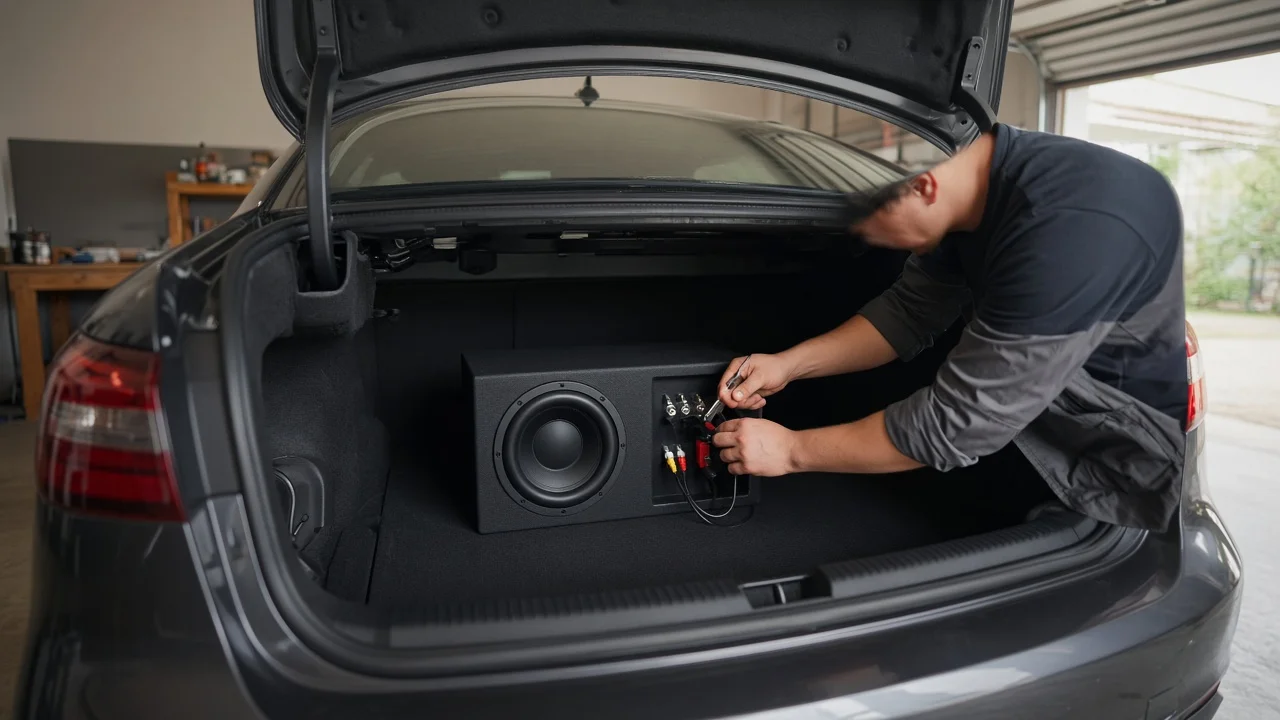
Adding a powered subwoofer gives a factory or aftermarket audio system the low-frequency impact that small door speakers cannot produce. A powered enclosure combines a driver and amplifier in one unit, simplifying the installation compared with separate components. The job requires connecting power, ground, a turn-on signal, and an audio signal from the head unit. Correct source wiring and vehicle integration matter because noise, weak output, or a drained battery often trace back to those connections rather than the subwoofer itself.
Direct answer
To install a powered subwoofer in a car, connect its fused power lead to the battery positive terminal, secure the ground to clean chassis metal, and supply a remote turn-on signal from the head unit or a switched circuit. The audio source reaches the enclosure through RCA preamp outputs or speaker-level inputs, depending on the radio and the powered enclosure design. The unit should be mounted where it will not shift, overheat, or contact wiring under the seats or in the cargo area.
The essential answer is that a powered subwoofer needs a stable high-current circuit, a low-resistance ground return path, a trigger that turns the amplifier on with the radio, and a clean input signal. Because the amplifier is built into the enclosure, you avoid running separate amplifier power and speaker wiring across the car. Installations vary by the vehicle integration method, but the core electrical and signal path remains consistent for most powered bass solutions.
How to proceed
Begin by disconnecting the negative battery cable so the high-current connections cannot short during the job. Plan the cable route from the battery through an existing firewall grommet and along the sill away from pedals, seat tracks, and sharp edges. Mount the powered enclosure where airflow can reach its heat sink and where cargo or passenger movement will not pull the cables. Use a grommet where the power wire passes through metal and keep the inline fuse near the battery rather than near the amplifier.
Run the power and signal cables on opposite sides of the car where possible to reduce induced noise, then make the ground lead short and secure it to sanded bare metal. For the audio connection, use low-level RCA cables from a subwoofer or rear output, or splice the speaker wiring into high-level inputs if the factory head unit lacks preamp outputs. Reconnect the battery, set the gain so the bass blends without distortion, and confirm the unit turns off when the ignition or radio shuts down. Verify that no wire is pinched and that the subwoofer remains secure before returning the interior panels to place.