How Regenerative Braking Works in Hybrids and Plug-In Hybrids
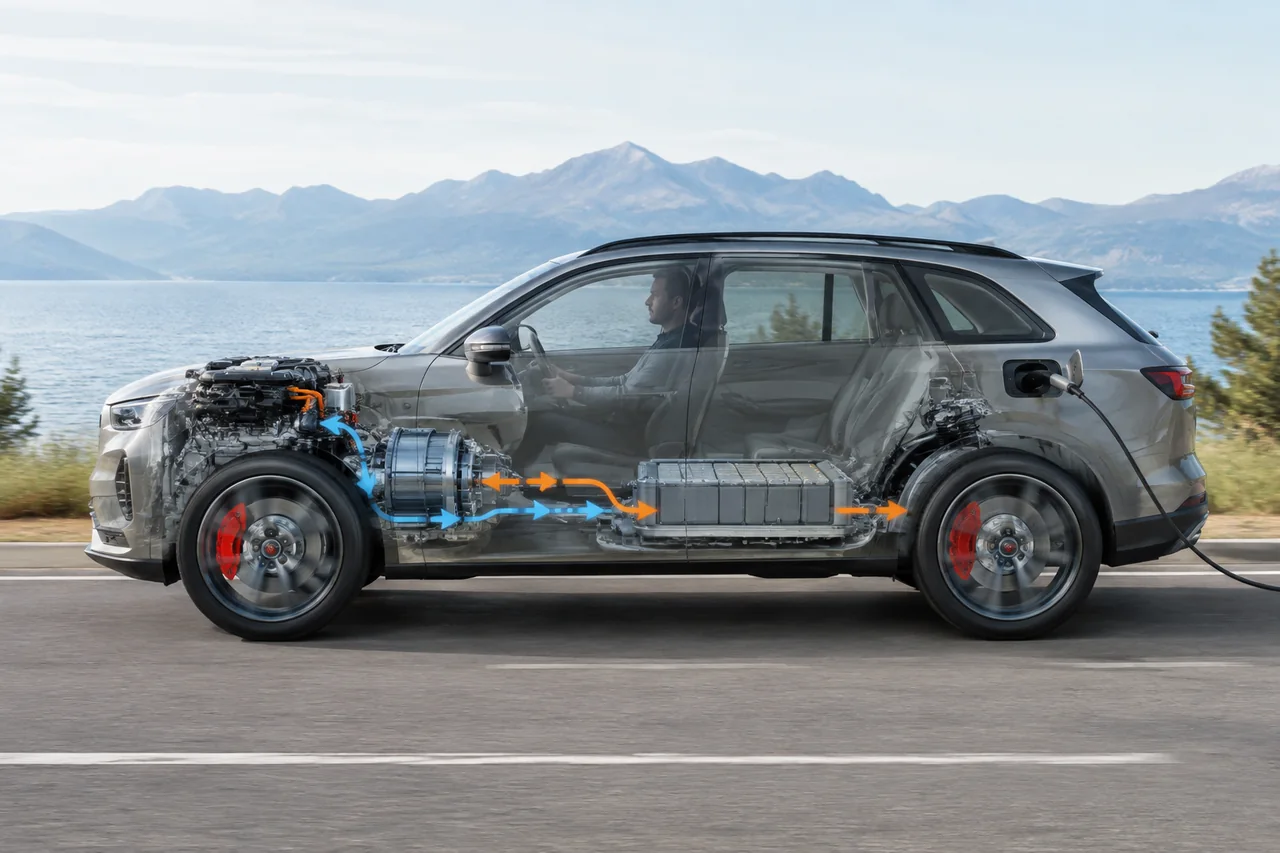
Hybrid regenerative braking recovers some of a vehicle's kinetic energy during deceleration and stores it in the traction battery. In a hybrid electric vehicle or plug-in hybrid, that energy can later support electric propulsion. Many hybrids with regenerative braking, including Kia PHEVs, the Mitsubishi Outlander PHEV, and the Pacifica Hybrid, use this recovery, though a hybrid system coordinated with an engine is not identical to regeneration in a battery-electric car.
What Regenerative Braking Does in a Hybrid
A regenerative braking system for a hybrid electric vehicle converts some of the vehicle's motion into electrical energy as the car slows. Instead of relying only on friction brakes to dissipate kinetic energy as heat, a motor-generator captures a portion of that energy. The recovered electricity enters the traction battery for later electric propulsion. That is how regenerative braking works in a hybrid vehicle: deceleration becomes energy recovery rather than a complete loss.
The conversion is incomplete. Generation, power electronics, and battery charging consume some of the energy originally spent to accelerate. Aerodynamic drag, rolling resistance, and accessory loads remain as well. Because of those losses, regenerative braking in hybrid vehicles cannot return every watt used to get the car moving. What it can do is reduce how much remaining kinetic energy is wasted as heat, then reuse stored charge to assist propulsion when the powertrain next calls for electric torque.
How the Motor-Generator Recovers Braking Energy
How hybrid regenerative braking works at the hardware level starts at the wheels. As the vehicle decelerates, rotating wheels feed mechanical energy through the drivetrain to a motor-generator. Acting as a generator, that machine converts kinetic energy into electricity for the traction battery. Generating current produces resisting torque that travels back to the wheels and slows the vehicle, so energy recovery and braking force appear together in a regenerative braking system in hybrid vehicles.
Power electronics and powertrain controls decide how much generator torque is allowed. They keep recovery inside the motor-generator's torque and thermal limits, the battery's charge-acceptance window, and available traction. If those limits tighten, the strategy reduces regeneration rather than overrunning a component. Layouts vary: a transaxle machine, multiple electric motors, or extra plug-in capacity. The energy path still runs from wheel motion through generation to the battery, independent of packaging.
How Regeneration and Friction Brakes Work Together
Brake blending coordinates regenerative braking and conventional friction brakes so the vehicle can meet requested deceleration. Regeneration can handle much of a moderate slowdown, but it has limits. Near a stop, generator output typically falls as wheel speed drops, and the motor-generator may not produce enough torque for a firm halt. Friction brakes remain necessary for those demands, high-energy stops, and moments when the traction battery cannot accept more charge. The two systems share the work.
Pedal feel or a dashboard energy display cannot by itself establish how much braking each system supplies. Powertrain controls vary the mix continuously, and a smooth pedal can hide a shift from regeneration to hydraulic friction. Regenerative braking also differs from engine braking. Engine braking uses compression and driveline drag to slow the vehicle, but it does not store recovered electrical energy in the traction battery. Only the motor-generator path performs that electrical energy recovery, even if both effects occur in the same deceleration.
Why Available Energy Recovery Changes
Available energy recovery is not fixed in a regenerative braking hybrid. Battery state of charge is a primary constraint: a traction battery already near a full charge has limited charge acceptance, so controls may cut generator torque. Battery temperature works the same way. A cold or overly warm pack may accept charge more slowly, reducing how much kinetic energy can be converted. Those limits are normal operating conditions managed by powertrain controls, not independent proof that a part has failed.
Vehicle speed, requested deceleration, and traction-control interventions also change available recovery. At very low speed the motor-generator produces less useful generating torque. A strong stop request can exceed what regeneration can deliver, so friction brakes take a larger share. If a wheel slips, traction control may reduce regenerative torque to restore grip. Reduced recovery in those cases is expected. Brake warnings, unexpected stopping behavior, or persistent abnormal pedal feel warrant professional assessment rather than an assumption that one part has failed.
Where Regeneration Fits in a Plug-In Hybrid
Plug-in hybrid regenerative braking sits beside another energy path that many hybrids lack: external charging. A PHEV can add energy to the traction battery from the grid and still recover kinetic energy during deceleration. PHEV regenerative braking therefore contributes to the energy supply rather than serving as the only way to replenish the pack. That contribution does not promise a particular range gain or a full recharge after a trip, and recovered energy returns only a portion of what slowing made available.
Powertrain controls decide when the engine runs, when electric propulsion carries the load, and how much generator torque is applied during a slowdown. Those functions are coordinated. If the strategy is holding a charge target, protecting the battery, or meeting a demand that exceeds electric capability, engine operation and energy recovery can overlap. Plug-in hybrid regenerative braking still follows the motor-generator principle used in a hybrid electric vehicle, with the added fact that the traction battery may already hold charge from the plug when deceleration begins.
Regenerative Braking in Kia Niro, Sorento, and Sportage PHEVs
Kia Niro PHEV regenerative braking applies the same recovery idea in that plug-in hybrid: wheel motion drives a motor-generator, electricity returns to the traction battery, and brake blending adds friction braking when regeneration cannot meet the stop. That describes the function, not a particular calibration. Regeneration settings, paddle functions, energy displays, or operating modes on a given Niro PHEV depend on model year and market and should be confirmed in that vehicle's documentation before they are treated as present.
Kia Sorento PHEV regenerative braking and Kia Sportage PHEV regenerative braking likewise recover kinetic energy into a traction battery, then use brake blending for the rest of the stop. Each model is its own application. Controls, instrumentation, and braking behavior should not be assumed to match across the Niro, Sorento, and Sportage plug-in hybrids, or even across years of the same nameplate. A verified feature's purpose is to let powertrain controls manage generator torque and friction-brake contribution within that vehicle's limits.
Outlander PHEV and Pacifica Hybrid Applications
Mitsubishi Outlander PHEV regenerative braking is another application of the same path. During deceleration, a motor-generator converts some kinetic energy to electricity for the traction battery, while friction brakes complete the stop when regeneration is limited. Outlander PHEV regenerative braking still depends on charge acceptance, battery state of charge, and powertrain controls. Claims about selectable regeneration, gauges, or mode behavior require model-year and market verification. The example shows plug-in hybrid energy recovery, not a recovery rate.
Pacifica hybrid regenerative braking belongs in the same group even though the nameplate omits the word plug-in. The Pacifica Hybrid is a plug-in hybrid: it can charge from an external source and still recover braking energy through a motor-generator into its traction battery. As with other hybrids with regenerative braking, available recovery changes with battery condition, speed, and requested deceleration, and brake blending remains part of a complete stop. Selectable regeneration, cluster messages, or mode-specific behavior on a given Pacifica Hybrid also need model-year and market confirmation.