How Regenerative Braking Works in Hybrid Cars, Including Toyota and Lexus
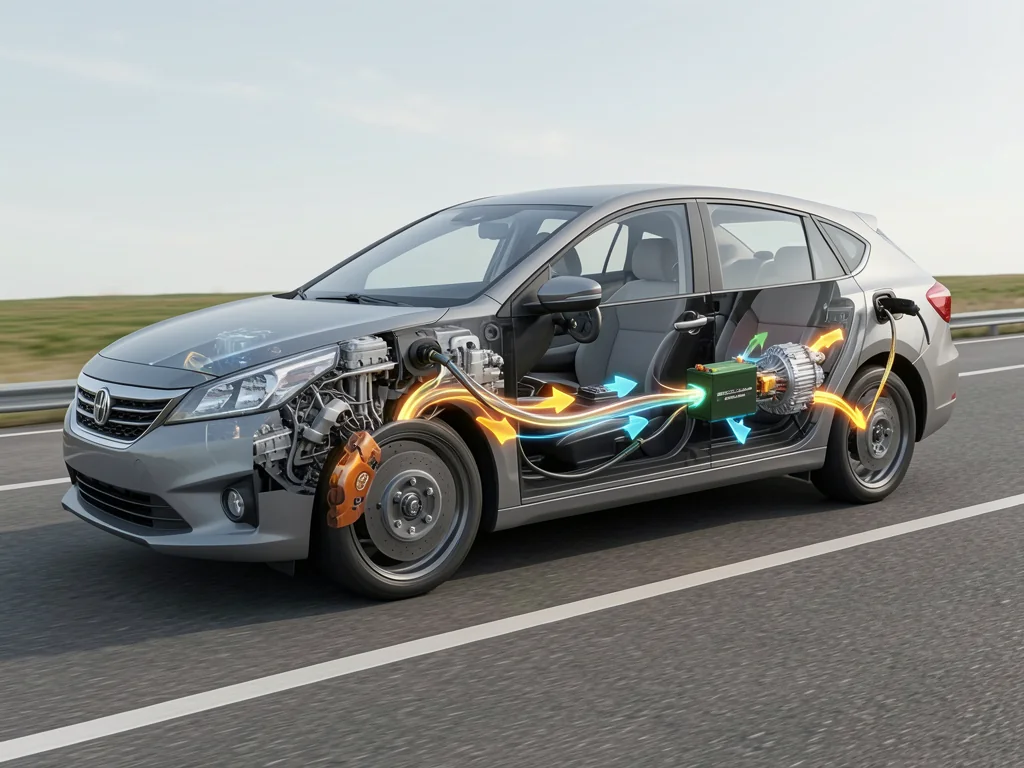
Hybrid car regenerative braking uses a motor-generator to recapture kinetic energy while slowing, sending electricity to the traction battery instead of wasting all of it as heat in the friction brakes. Toyota and Lexus hybrids, including Prius and RAV4 families, typically blend regeneration with conventional braking. How the pedal feels, how much energy is stored, and which settings exist depend on the exact model, year, and powertrain.
How a Hybrid Recovers Energy While Slowing Down
Regenerative braking in hybrid cars is easiest to picture as a motor-generator working in reverse while you slow down. Instead of only rubbing pads on rotors, the electrical machine resists wheel rotation and converts some of the vehicle's motion into electrical energy. That slowing force is regeneration. Hybrid cars with regenerative braking still rely on friction brakes, but the motor-generator can supply part of the requested deceleration whenever the powertrain and battery can accept the current.
The energy path starts at the driven wheels. As they try to keep spinning, the motor-generator produces electrical current that the hybrid system routes toward the traction battery. Later, that stored energy can assist propulsion, so some of the kinetic energy spent accelerating is reused. Conversion, wiring, and charging losses mean you never recover all of the energy used to get up to speed. Accelerator lift and brake-pedal input can both request regeneration, but how strongly the system responds is a vehicle-design choice.
Regenerative Braking in Conventional and Plug-In Hybrids
Most hybrid powertrains are designed around a motor-generator that can recapture energy, so regenerative braking on hybrid cars is a common feature. That does not mean every vehicle wearing a hybrid badge recovers energy the same way, or that the badge itself proves the hardware. Whether a given hybrid has regenerative braking depends on the exact model, year, and powertrain. The owner's manual is the right place to confirm equipment and how the system is supposed to behave in that car.
Plug-in hybrids recover braking energy into their traction batteries as well. A genuine plug-in hybrid powertrain typically includes that recovery, but regeneration does not replace plugging in. External charging still supplies the larger electric range those batteries are built to store. Battery-electric vehicles likewise use motor-generators for energy recovery. One-pedal driving, regeneration strength, and whether lift-off can bring the car to a complete stop are separate, vehicle-specific features, not something implied by hybrid or electric branding.
How Toyota Hybrids Blend Regeneration With Friction Brakes
How Toyota hybrid regenerative braking works in everyday driving comes down to blending, not a choice between electric slowing and conventional pads. The braking controller reads the driver's braking request and coordinates regenerative torque from the motor-generator with hydraulic friction braking so the pedal still feels like a brake. When demand exceeds what regeneration can supply, or as the vehicle approaches a stop and electrical slowing becomes less useful, friction brakes take on more of the job.
Energy recovery is also limited by conditions the driver cannot see from pedal feel. A high battery state of charge, an out-of-range battery temperature, low traction, or internal system limits can reduce how much current the traction battery will accept. More of the work then shifts to friction brakes. Pedal pressure and the rate of deceleration cannot reveal the exact share supplied by regeneration, because brake blending still meets the requested slowdown.
Regenerative Braking in the Prius, Prius c, and Prius Prime
The Prius hybrid uses regenerative braking during routine slowing and pedal braking. The motor-generator helps decelerate while feeding the hybrid system. How Prius regenerative braking works follows the same blending idea as other Toyota hybrids: lift-off and brake input can request recovery, and friction brakes cover what regeneration cannot. Prius c and Prius Prime also recover energy that way, but their controls and displays belong to each model year and should not be treated as identical across generations.
On Prius Prime, recovered energy supports the hybrid system and can charge the traction battery that also accepts plug-in energy, which is still not a substitute for external charging. An available charge indicator or energy flow display can show current moving toward the battery during deceleration. It is not a precise meter of recovered energy or of how much braking came from the motor versus the pads. Prius regenerative braking settings, when present, are model-year specific.
Regenerative Braking in the RAV4 Hybrid and RAV4 Prime
The Toyota RAV4 Hybrid uses regenerative braking, and RAV4 Prime does as well. During routine deceleration, the motor-generator can return energy to the traction battery while the braking system manages the requested slowdown. RAV4 hybrid regenerative braking therefore feels like ordinary braking even while some kinetic energy is being stored. That recovery belongs to the hybrid and plug-in hybrid powertrains; a gasoline-only RAV4 is a different vehicle and should not be assumed to recapture energy the same way.
Having regeneration does not establish selectable regeneration levels or one-pedal stopping. RAV4 hybrid regenerative braking settings, including any shift position, paddle, or display related to deceleration, must be read from the manual for that model year and powertrain. A stronger slowing sensation after lift-off is not proof of a driver-adjustable regeneration menu. Keep control names and operating details tied to the exact RAV4 Hybrid or RAV4 Prime rather than treating every generation as identical.
Camry, Corolla, Highlander, and Lexus Hybrid Applications
US-market 2025 Camry regenerative braking belongs with the hybrid powertrain used in that model year. The motor-generator can recapture energy during slowing, and friction brakes still complete the stop. Unverified adjustment settings, paddle maps, or one-pedal stopping should not be attributed to that Camry without the owner's manual. Toyota Corolla hybrid regenerative braking works on the same principle, but mentioning Corolla alone is incomplete until the powertrain is identified. A non-hybrid Corolla does not share the hybrid motor-generator path.
Toyota Highlander hybrid regenerative braking recovers energy and blends it with friction brakes on Highlander Hybrid powertrains, not on other Highlander engines that lack the hybrid motor-generator. Lexus hybrid regenerative braking follows the same idea: a motor-generator slows the car and can charge the traction battery while hydraulic brakes remain ready. Lexus regenerative braking selectors, energy flow displays, and driver adjustments are specific to the model and year. Toyota hybrids as a group are designed around that recovery, confirmed in each vehicle's manual.
Understanding B Mode, Settings, and Everyday Braking
Prius and RAV4 controls vary by generation and powertrain, so neither nameplate should be assumed to offer a menu for adjusting regeneration. Toyota regenerative braking settings that do exist, such as shift positions, paddles, or deceleration selectors, must be interpreted with that vehicle's manual. B mode on applicable Prius models is a descent-related braking function that can involve engine braking. It is not a setting that guarantees maximum battery charging. A stronger slowing sensation in B, or in any other position, does not quantify how much energy reached the traction battery.
Hybrid regenerative braking is meant to work during ordinary commuting, not as a separate driving mode that replaces the brake pedal. Anticipate stops, keep a safe following distance, and press the brake pedal whenever the situation requires a firm, predictable slowdown. Regeneration happens in the background of that request; it does not replace attention or friction brakes. An energy flow display can help a driver notice recovery during coasting, but it is a teaching tool, not permission to follow too closely or to treat lift-off as a complete stopping strategy.