How EV Batteries Are Made: The Manufacturing Process From Cell to Pack
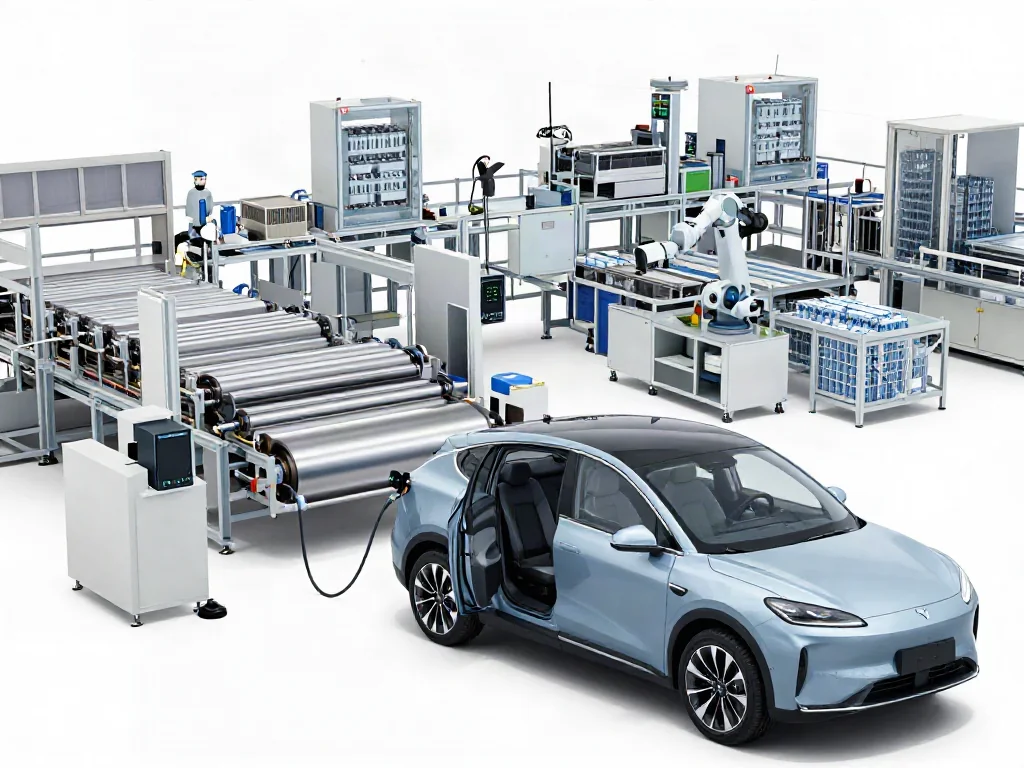
How an EV battery is made begins on the factory floor. EV battery manufacturing turns coated electrodes, separators, and electrolyte into sealed cells, then groups those cells into modules or packs. An EV battery plant may produce cells, assemble packs, or do both. The EV battery manufacturing process depends on chemistry and cell format, yet the path from electrode work through cell formation and pack assembly remains the core of EV battery production.
How Cell Production Fits Into EV Battery Manufacturing
EV battery production typically follows electrode preparation, cell assembly, formation, testing, and then pack assembly. Inside a rechargeable cell, the anode and cathode store and release lithium ions, the separator keeps the electrodes from touching while allowing ion flow, and the electrolyte carries those ions. Thin metal current collectors gather electrons and connect the active layers to the cell terminals. Those five parts, arranged with tight dimensional control, are what later pack hardware has to protect, cool, and monitor.
A cell is the smallest sealed electrochemical unit. Battery modules group cells with shared structure and connections, while a pack is the vehicle-ready assembly that includes electrical hardware, thermal management, and a battery management system. Some pack designs skip separate modules and mount cells directly into the pack structure. Cylindrical, prismatic, and pouch formats, plus different cathode and anode chemistries, change stacking, winding, filling, and fixturing. Those choices also reshape an EV battery factory, because equipment, dry-room needs, and line layout follow the cell design rather than a single universal route.
Preparing and Coating the Battery Electrodes
In a common slurry-based electrode process, active materials are mixed with binders, conductive additives, and solvent until the mix is uniform enough to coat. That slurry is applied to metal current collectors, typically copper for the anode and aluminum for the cathode, then dried to remove solvent and leave a bonded coating. Rollers compress the dried electrodes to the intended thickness and density, after which the foil is slit or punched to the widths and lengths needed for cell assembly. Electrode coating is therefore both a materials step and a dimensional step.
Coating consistency, material loading, and contamination control matter because uneven thickness or trapped particles create local hot spots, weak adhesion, or short-risk sites once the cell is filled and formed. Dust, metal flakes, and moisture can travel from mixing through coating into later dry-room operations, so electrode rooms are treated as quality-critical. Processing methods still vary. Dry coating, alternative binders, and other routes exist, and slurry coating is not a universal requirement. An EV battery factory chooses the electrode method that matches its chemistry, throughput, and quality targets.
Assembling, Filling, and Sealing Each Cell
Prepared electrodes and separators are stacked in layers or wound into a jelly roll to form the internal cell assembly. Alignment of anode, cathode, and separator determines whether the cell can charge evenly and whether the separator fully isolates the electrodes. Tabs or other collectors are joined to create the electrical path, then the electrode stack or roll is placed into a can, pouch, or prismatic housing. Joining methods and housing geometry follow the cell format; the shared goal is a mechanically stable assembly with a clean, continuous electrical connection.
Electrolyte filling comes next under tightly controlled conditions. Liquid electrolyte is introduced so it can wet the electrodes and separator; vacuum, soak time, and fill sequence depend on the cell design and are not interchangeable across formats. The cell is then sealed to keep electrolyte in and moisture out. A dry room or other moisture-controlled environment is used because water degrades electrolyte and electrode surfaces. In-process checks look for misalignment, particle contamination, incomplete wetting, and sealing defects before the cell moves to formation.
Formation and Testing Before Cells Leave Production
Cell formation is the first controlled charging and discharging after sealing. Those cycles grow important electrode interfaces, including the surface films that help the cell operate stably later. Formation is monitored because gas generation, voltage behavior, and temperature response can already show whether a cell is abnormal. After formation, cells often rest or age under defined conditions so residual reactions can settle and measurements can be repeated. Aging is not idle storage; it is a diagnostic window before cells are graded for pack use.
Quality checks then look at capacity, internal resistance, leakage, and self-discharge. Acceptance limits are plant- and product-specific, so a measurement that flags one cell as out of family is evidence of abnormal behavior, not a universal proof of a named part failure. Cells that meet the program's windows are graded into groups with similar electrical characteristics so later modules stay balanced. Production traceability records lot, process, and test data with each cell. Cells that fail quality requirements are isolated from pack assembly rather than mixed into vehicle hardware.
Building the Finished EV Battery Pack
The EV battery pack manufacturing process starts with qualified cells. Those cells may be arranged into battery modules or integrated directly into a pack structure, depending on the design. Electrical interconnections join cells in series and parallel to reach the voltage and capacity the vehicle needs. Insulation, structural supports, and thermal management components are added so heat can be removed or distributed and so the assembly can survive crash loads and vibration. Coolant plates, pads, or air paths are design choices, not a single factory standard.
A battery management system, sensors, contactors, and protective devices turn the pack into a controlled high-voltage unit rather than a simple box of cells. The BMS tracks voltage, current, and temperature and commands contactors; fuses or similar devices provide additional protection. After the enclosure is sealed, end-of-line electrical, communication, and leak checks confirm that this unit was built correctly. Those checks are not the same as pack validation, which is design-level testing of a product family. High-voltage pack assembly and testing require controlled industrial equipment and trained personnel.
What Happens Inside an EV Battery Plant
Inside an EV battery plant, incoming materials move from receiving and inspection into mixing, coating, cell assembly, formation, and pack lines, then into tested storage and shipment. Automation handles coating, stacking or winding, filling, and much of the joining work, while technicians intervene on exceptions, changeovers, and equipment care. Quality teams set sampling, review out-of-family data, and keep manufacturing records so production traceability can follow a cell or pack back to lots and process windows. Consistent EV battery production depends on that combination of machines, people, and records.
An EV battery factory may produce cells, assemble packs, or perform both; cathode powders, foils, and other upstream materials are often processed at other sites. EV battery plants in the US follow the same split of roles, from cell plants to pack assembly plants and mixed campuses. Announced capacity is a planning figure, not proof of actual output or operating status. Ventilation, moisture control, process waste handling, and worker protection are part of everyday plant operation. Those controls hold humidity within process limits, contain leftover solvents and scrap, and protect people working around high voltage and industrial equipment.