What Is an EV Battery? How Cells, Modules and Packs Work
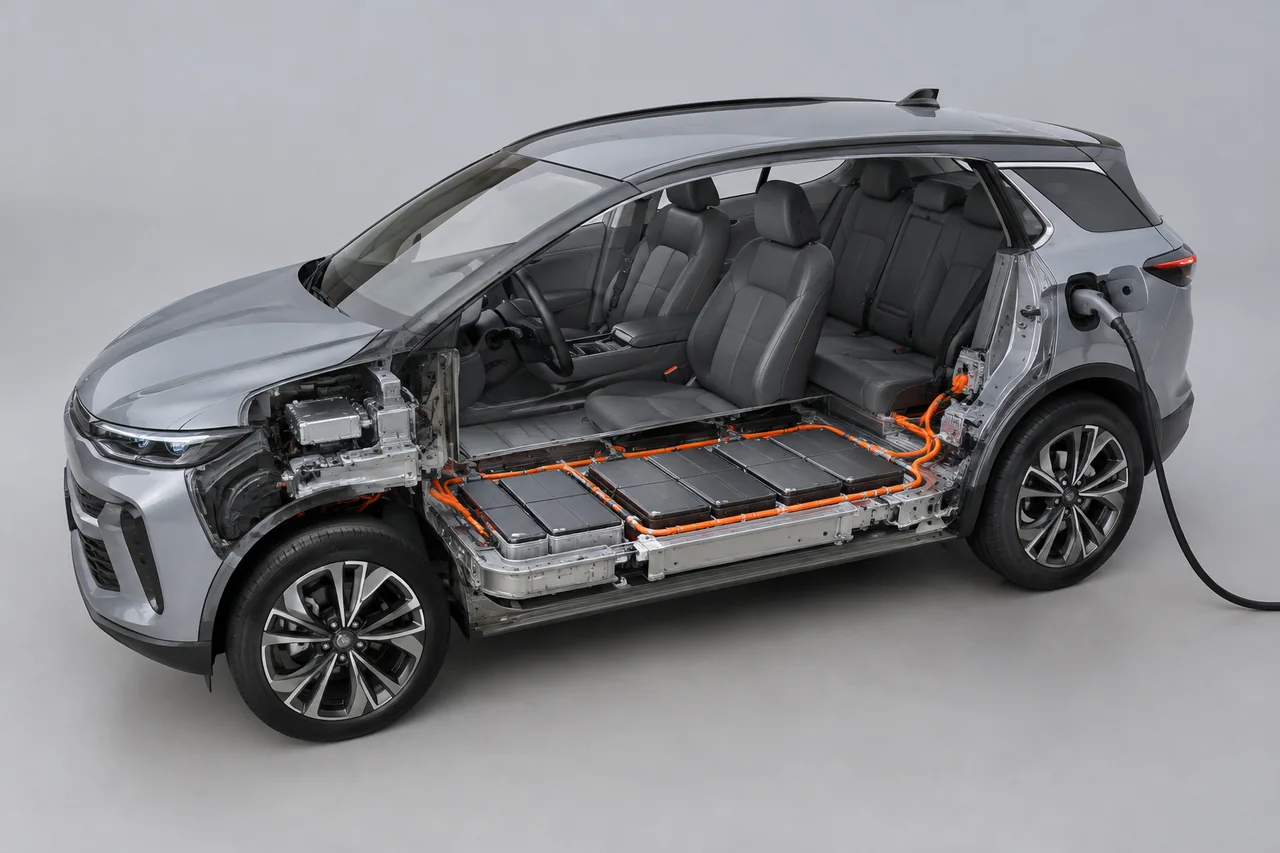
An EV battery is far more than a bigger version of a gasoline car's 12-volt battery. It is a high-voltage assembly of many cells, surrounded by electronics, cooling hardware and a protective enclosure. Knowing how these layers fit together helps you read specification sheets and understand range and charging behavior. It also explains why work on the pack belongs with trained technicians.
What an EV Battery Is and Where Its Energy Goes
The traction battery is the rechargeable high-voltage energy store that moves an electric vehicle. It holds energy in chemical form, releases it as electricity when the driver asks for power, and takes energy back in during charging. Unlike a small accessory battery, it runs at voltages high enough to need dedicated insulation, controls and trained service staff. Through power electronics such as a DC-DC converter, it also usually supplies the low-voltage system that runs the lights, infotainment and control modules.
The complete installed unit is called the battery pack. Many manufacturers place it as a flat assembly beneath the cabin floor, but its shape and location depend on the vehicle's platform, body style and packaging goals. Some packs are shaped around a tunnel or the rear seat, and others form part of the vehicle's structure. Chemistry, cell count, voltage and capacity also differ between models and sometimes between trim levels, so no single layout describes every battery-electric car.
How Charging and Driving Move Energy Through the Battery
Inside each cell, lithium ions and electrons take separate paths. During discharge, ions travel from the anode through the electrolyte to the cathode. Electrons flow through the external circuit instead, doing useful work along the way. Charging uses energy from outside to drive both back in the opposite direction. Battery controls oversee this process, setting how much charging current and discharge power the pack can handle at any moment so the cells stay within safe voltage and temperature limits.
From the pack, direct current travels through high-voltage connections to the vehicle's power electronics. An inverter converts that current into the form the traction motor needs. Depending on the design, the inverter may sit in its own housing or be built into the drive unit. When the driver lifts off the accelerator or brakes, the motor can work as a generator, and regenerative braking sends energy back to the battery. A pack that is nearly full or very cold accepts less, so the friction brakes then do more of the stopping.
How Cells, Modules and Packs Fit Together
A cell is the basic electrochemical unit. It contains its own electrodes, separator and electrolyte inside a sealed case. Many pack designs group connected cells into modules, which add mounting, wiring and sensing in a manageable subassembly. Cells or modules are then combined with structural frames, busbars, thermal hardware and electronics to form the complete pack. Wiring cells in series adds their voltages together. Wiring them in parallel adds amp-hour capacity and shares the current, which raises how much current the group can supply.
Cells come in three common formats. Cylindrical cells use a rigid round metal can. Prismatic cells use a rectangular hard case that stacks neatly. Pouch cells wrap their layers in a flexible laminated film and rely on the surrounding structure for support. Each format involves different tradeoffs in packaging, cooling and manufacturing. Some manufacturers skip the module layer entirely and place cells directly into the pack, an approach called cell-to-pack construction. A separate module layer is therefore not universal.
Materials Inside the Cells and Pack
Every lithium-ion cell relies on the same basic set of parts. The anode and cathode are the electrodes that hold lithium as the cell charges and discharges. The electrolyte carries lithium ions between them. A thin porous separator keeps the electrodes from touching and shorting while still letting ions pass through. Current collectors, typically copper foil on the anode side and aluminum foil on the cathode side, carry electrons to the cell terminals. Anodes are commonly graphite-based, though some designs blend in other materials.
Cathode chemistry varies more. Lithium iron phosphate contains no nickel or cobalt, while nickel manganese cobalt cathodes blend those metals in varying proportions, so not every EV battery uses nickel or cobalt. Outside the cells, copper and aluminum can form busbars and conductors, and steel or aluminum can form the casing and structural members. Polymers and insulating layers separate live parts and help seal the enclosure. An exact material inventory for any pack requires the manufacturer's documentation for that specific design.
Controls, Cooling and High-Voltage Connections
The battery management system supervises the pack. It monitors the voltage of individual cells or cell groups, reads temperature sensors, estimates state of charge and sets charging and discharge limits. It can also balance the cells so they stay closely matched. Thermal management supports this work. Depending on the vehicle, it may use liquid coolant plates, airflow, heaters or a connection to a heat pump. These systems cool the pack during hard driving or fast charging and warm it in cold weather.
Inside the pack, busbars carry current between cells and modules, and sensors report to the controller. Fuses protect against excessive current. Contactors are heavy-duty switches that connect the pack to the vehicle or isolate it. High-voltage cables link the pack to the inverter, charging hardware and other high-voltage equipment. Orange insulation commonly marks these circuits, but color or appearance cannot prove a cable is safe. Damaged cables, insulation warnings and suspected internal faults should go to qualified high-voltage technicians.
Understanding Battery Voltage, Capacity and Weight
Pack specifications combine several units. Volts describe electrical pressure, and amp-hours describe charge capacity. Kilowatt-hours describe stored energy, which is roughly the voltage multiplied by the amp-hours, divided by one thousand. Kilowatts describe power, the rate at which the pack can deliver or accept energy. Nominal pack voltage is a reference value. Actual voltage rises during charging, falls during discharge and dips briefly under heavy load, so live readings rarely match the headline figure.
Capacity figures need the same care. Gross capacity is the total energy the cells can hold. Usable capacity is the portion the vehicle actually lets the driver use, with buffers held back to protect the cells. Check which figure a specification sheet lists before comparing vehicles. Weight depends on cell count, chemistry, enclosure, cooling hardware and structural integration, so there is no single EV battery weight. When reading a documented mass or voltage, confirm it applies to your exact battery option and whether the mass covers the complete assembly.
What the Battery Pack Looks Like Inside Its Enclosure
On many battery-electric cars, the pack is a broad, shallow enclosure bolted beneath the floor between the axles. Some vehicles use stepped, T-shaped or rear-mounted packs instead. Inside, the packaging has to hold the cells firmly, route busbars and sensing wires, and provide paths for coolant or air. It also has to seal out water and dust and carry structural loads. The enclosure shields these parts from road debris and moisture, but it cannot prevent every impact, leak or electrical hazard.
A representative, generalized layout would show rows of cells or modules across the floor of the enclosure. Cooling plates would sit beneath or between them, busbars would link the groups, and a junction area at one end would hold the contactors, fuses and high-voltage connectors, all under a sealed lid. Real vehicles vary considerably from this picture. A clean exterior reveals nothing about internal condition, so opening a pack or inspecting its components is work for trained professionals with proper high-voltage equipment.