How DC Fast Charging Works and What Makes an EV Charge Quickly
Fast charging an electric car uses a DC fast charging station to push energy into the battery far more quickly than a typical home outlet. How quickly a session proceeds depends on the vehicle, the charger, the battery's state of charge and temperature, and how the station shares power. Understanding those limits explains both peak charging power and the time a real stop actually takes.
How DC Fast Charging Delivers Energy to an EV
DC fast charging starts at the station, not inside the car. Grid electricity arrives as alternating current, and the charger converts it to direct current before it reaches the vehicle. That DC path feeds the fast charging electric car battery directly, bypassing the smaller onboard AC charger used at home. Power is measured in kilowatts, while energy delivered or stored is measured in kilowatt-hours. A high kilowatt figure describes how quickly energy can flow; kilowatt-hours describe how much energy the pack actually receives.
The vehicle and station exchange messages before and during the session to agree on allowable current and voltage. Those messages can raise or lower charging power as conditions change. A fast charging electric car charger may advertise a large maximum, but that rating is a capability ceiling, not a guarantee for every visit. Connector compatibility, the car's DC charging hardware, and the station's available output all have to line up before fast electric car charging can begin at a meaningful rate.
Why Charging Power Changes as the Battery Fills
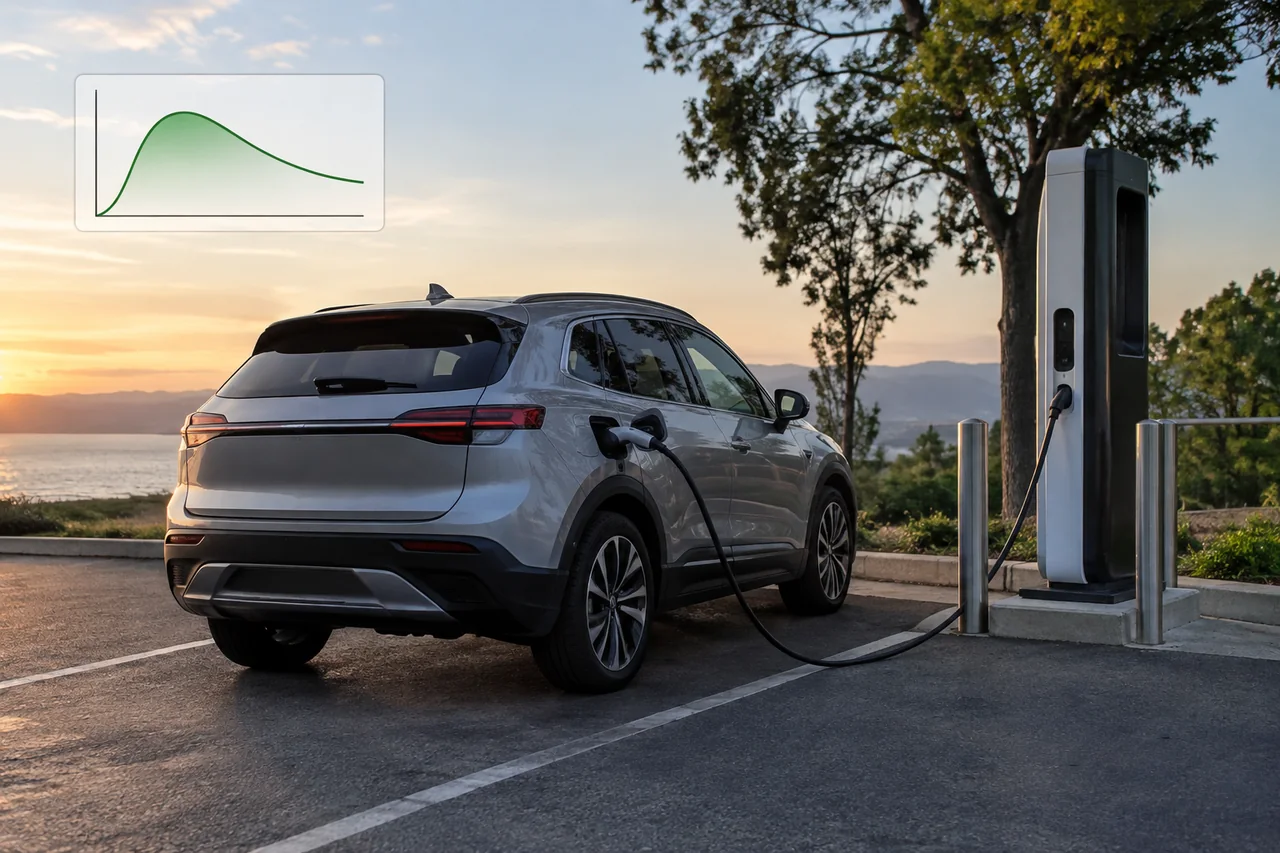
A charging curve plots charging power against battery state of charge. Peak charging power often appears near the lower end of that curve and may last only a short time. As the pack fills, the battery management system typically reduces current to protect cells, manage heat, and keep voltage within limits. That taper is why a brief high-power burst does not describe the whole stop. Average charging power over a defined window is what actually sets elapsed charging time.
Published 10–80% times are useful only when the test conditions and energy added are known. That window is a common comparison slice, not a universal operating rule for every trip. The energy added is a share of usable battery capacity, so a larger pack needs more kilowatt-hours to cover the same percentage. Fastest electric car charging in marketing language often highlights the steepest part of the curve; real duration still follows the average power across the portion you actually charge.
Battery Conditions That Set Charging Limits
Accepted power depends on battery temperature, starting state of charge, cell chemistry, and how well the thermal system can move heat. A cold pack or a pack already near full typically accepts less current. Charging protections can also limit power even when the station still has headroom. Usable battery capacity determines how much energy a given percentage increase requires, so two cars at the same power can still take different times to add the same share of a full charge.
Battery preconditioning warms or cools the pack so it can accept higher power at a DC stall. How and when it starts is vehicle-specific, so the owner's manual is the place to confirm whether navigation to a charger, a driver command, or both is required. Electrical power is voltage multiplied by current; a high-voltage architecture can support high power, but a voltage label alone does not guarantee a short stop. Current limits, temperature, and state of charge still govern what the fast charging electric car battery will accept.
What a Fast-Charging EV Specification Actually Tells You
People looking for the fastest charging electric car want a single winner, but charging speed is a set of measures rather than one rank. Peak charging power, average charging power over a stated window, time through that window, and usable energy added each answer a different question. Conditions and measurement methods must be stated, so no figure by itself proves what is the fastest charging electric car in every situation. An electric car with fastest charging in one test can look ordinary if the pack is cold, already high in state of charge, or attached to a weaker stall.
For a particular model year and configuration, check DC charging capability, documented charge times, battery preconditioning behavior, and connector support. Range added per minute depends on vehicle efficiency and the range measurement method, so it is not a direct reading of charging power. Asking for the fastest charging electric car 2022 is a request for that model year's documentation, not a current ranking. Historical published times should stay attached to their year and test conditions rather than being mixed with later hardware as if they were still the field.
Station Details That Determine Available Charging Power
Before arriving, confirm that the site offers DC fast charging, that the connector matches the car, and that any vehicle-authorized adapter is actually supported. Fast charging electric car stations vary in voltage and current, and those station limits interact with the vehicle's own charging limits, so the lower of the two sets the ceiling. A stall advertised as the fastest electric car charging station still cannot exceed what the car's DC path will accept on that visit.
Station power sharing, equipment temperature, and reduced-power operation can cut the output at a stall even when the nameplate rating looks high. Practical listing details still matter, including access hours, operational status, stall availability, payment method, and any access restrictions. Fast electric car charging stations with the highest advertised kilowatts do not establish the charging speed a particular vehicle will receive. Shared cabinets, busy sites, and thermal derating all explain why two neighboring stalls can behave differently during the same stop.
Planning a Charging Stop and Understanding Slow Sessions
Plan arrival charge and departure needs with the vehicle's route planner, keeping an appropriate reserve for the next leg and for unexpected delays. Supported battery preconditioning, when the car provides it, is most useful when the navigation target is a known DC stall. Choose a departure state of charge that covers the coming miles without insisting on a full pack every time, because the last portion of the charging curve is usually the slowest. That planning is what makes a fast charging stop predictable rather than a race to a full battery.
If a session is unexpectedly slow, note battery percentage, displayed power, weather, vehicle messages, and any station notices. One slow stop cannot establish battery degradation or a hardware fault; repeated unexplained behavior is a reason to contact station support or seek qualified vehicle diagnostics. Do not use visibly damaged cables, connectors, or cabinets, and follow the operator's instructions if a charging fault appears. Do not open equipment or attempt electrical repairs. A fault indication is evidence to interpret, not proof that a particular part has failed.