Honda Accord PCV Valve: Location, Symptoms, and Replacement
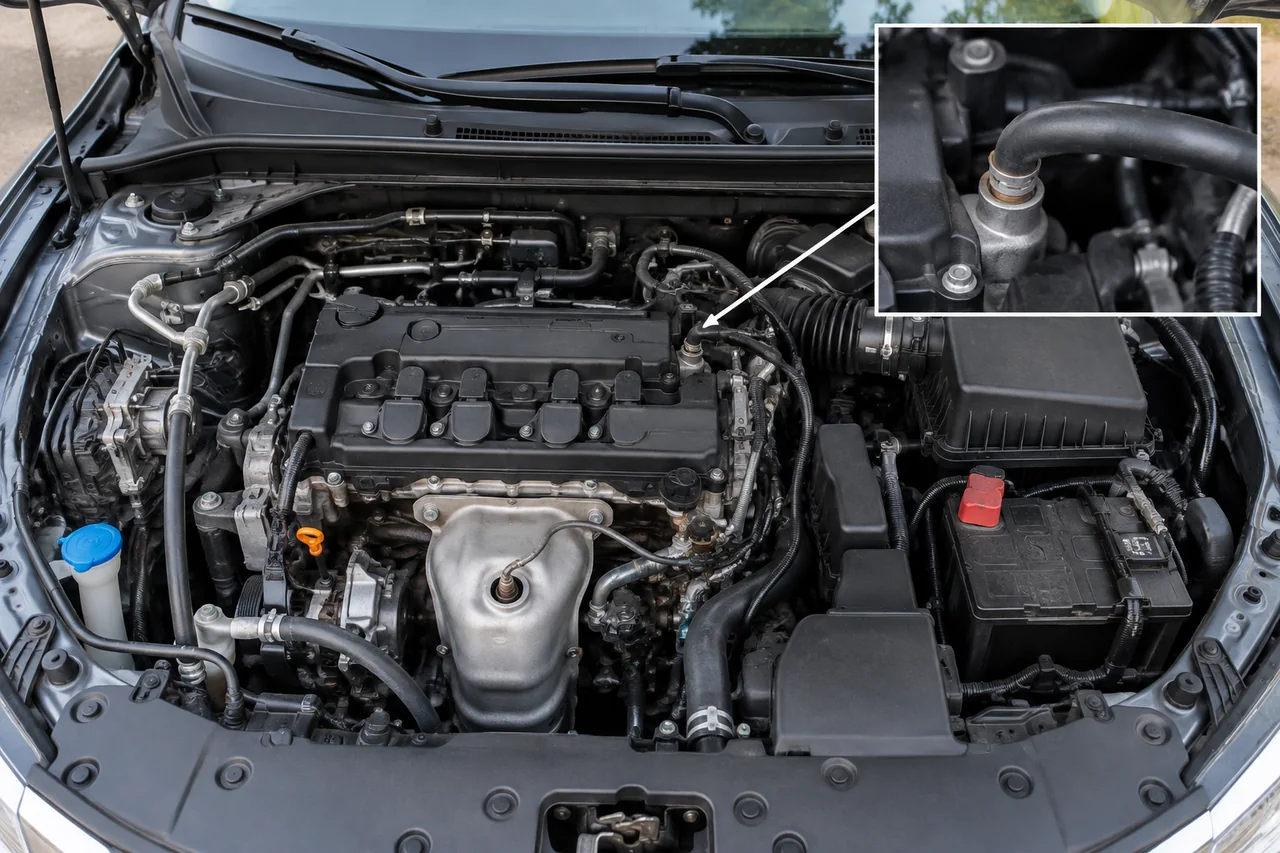
The Honda Accord PCV valve is a small but important part of positive crankcase ventilation on 2003 through 2014 Accords. Whether you are hunting a PCV valve for a Honda Accord, comparing a 2005 Honda Accord PCV valve with a later part, or diagnosing Honda Accord PCV valve symptoms, year and engine together decide location, hose layout, and fit. A restriction or vacuum leak in this circuit can disturb crankcase pressure and idle quality.
Identify Your Accord’s Engine Before Choosing a PCV Valve
Positive crankcase ventilation pulls blow-by gases from the crankcase into the intake so they can be burned rather than vented. On a Honda Accord, that path typically includes the PCV valve, a PCV hose, and a valve seal at the mounting point. If the valve sticks closed or a hose collapses, crankcase pressure can rise and oil may be forced past gaskets. If the valve sticks open or a hose splits, unmetered air can enter as a vacuum leak and upset idle. Those effects are reasons to inspect the circuit, not proof that one part has failed.
A PCV valve for Honda Accord use from 2003 through 2014 is not a single shared part. Four-cylinder and V6 engines, and later hybrid powertrains, place the valve differently and use different attachment styles. Model year alone does not fix location, hose routing, or replacement-part fit, so engine identification comes first. Confirm the engine and powertrain from the vehicle identification number, underhood labels, and door-jamb data before opening a parts listing. Treat the valve, ventilation hose, and associated seal as separate items; each can leak, crack, or fit poorly even when the others look sound.
Locating the PCV Valve on a 2003–2007 Accord
On a 2003 Honda Accord, 2004 Honda Accord, 2005 Honda Accord, 2006 Honda Accord, or 2007 Honda Accord, start with the confirmed engine code rather than the model year. A PCV valve Honda Accord 2003 four-cylinder layout is not interchangeable with the V6 arrangement from the same years. After you match the engine, use that powertrain's component diagram to find the valve on the crankcase-ventilation path, typically where a dedicated hose leaves the valve cover or a related housing and joins the intake.
Nearby fittings can look similar: a fresh-air inlet, a vacuum port, or a plain hose nipple is not the PCV valve. The diagram for the verified engine shows which fitting contains the valve and which is only a PCV hose connection. Make those identification checks on a cool, stopped engine so you can see hose routing without moving parts or hot surfaces. If intake plumbing, engine covers, or the firewall side of the cylinder head blocks a clear view, a technician's inspection is the safer next step rather than forcing access around heat shields and harnesses.
Finding the PCV Valve on a 2008–2010 Accord
A 2008 Honda Accord PCV valve, a 2009 Honda Accord PCV valve, and a 2010 Honda Accord PCV valve depend on which engine is installed. After you verify the layout for that vehicle, look for the valve at its mounting point on the ventilation circuit and follow the connected hose toward the intake. Do not treat one engine configuration as representative of every 2008, 2009, or 2010 Accord; four-cylinder and V6 packages use different valve locations and hose paths even when the body looks the same.
What an owner can inspect safely is limited. With the engine cool and off, check accessible joints for a loose PCV hose, visible hose damage, and oil residue that may point to seepage at the valve or its seal. Confirm attachment style and any separate sealing components before you select a PCV valve for 2008 Honda Accord service, or for a 2009 or 2010 twin, and before you gather tools. Some valves press into a grommet; others use a threaded body. Guessing that style from the year alone is how the wrong part gets chosen.
Confirming PCV Valve Location and Fit on a 2013–2014 Accord
A 2013 Honda Accord PCV valve and a 2014 Honda Accord PCV valve must be matched to the exact engine and powertrain before any location description is useful. These years include multiple four-cylinder, V6, and hybrid configurations, and a catalog line that names only Accord and year is not a fit check. Confirm the engine code and transmission type from vehicle identification information, then use the matching diagram for landmarks and access on that configuration. Visual cues that belong to one layout, such as a valve-cover mount versus a remote housing, do not transfer to the others.
Access information is configuration-specific as well. Some 2013 and 2014 layouts leave the valve and PCV hose in plain view after a cover is removed; others bury the circuit behind intake parts. Because those access paths are not shared, follow the procedure written for the engine you confirmed. On hybrid configurations, apply the applicable shutdown precautions before any underhood work. If reaching the valve or its connections involves high-voltage components, covers, or orange cabling, stop and obtain professional assistance rather than improvising a path around the hybrid system.
PCV Valve Symptoms and What They Can Tell You
Honda Accord PCV valve symptoms are clues about the ventilation circuit, not a diagnosis of a failed valve. Rough idle, an unusual whistle, rising oil consumption, or oil leakage around the valve or PCV hose can appear when the valve sticks, a hose leaks, or a seal is displaced. A restriction can leave crankcase pressure poorly controlled; an unintended air leak can lean the idle mixture. Those mechanisms overlap with intake leaks, worn valve seals, and other oil-control problems, so the same complaint can have several causes.
Record when the symptoms occur at cold start, hot idle, or under load, and inspect accessible hoses and connections with the engine cool and off. A rattling valve, a film of oil at a joint, or a single running complaint cannot establish that positive crankcase ventilation is working correctly, because a valve can rattle and still stick under vacuum, and oil residue can come from a hose or cover leak. Persistent symptoms, substantial oil loss, or severe running problems call for professional leak, crankcase-pressure, or engine testing instead of repeated part swapping.
Planning a Safe PCV Valve Replacement
Honda Accord PCV valve replacement is only a DIY job when access is safe, the replacement valve matches the confirmed engine, required seals are on hand, and you have the engine-specific service procedure. A PCV valve replacement Honda Accord listing that omits engine code is not enough. Document hose routing before anything is disturbed, follow the verified removal method for that attachment style, inspect the PCV hose and ports, then install the specified valve and seal. Use the fastening method and torque value given for that engine; there is no shared specification, and not every valve threads into place.
Stop if hoses are brittle, a fitting is seized, threads are damaged, or reaching the valve would require substantial disassembly you cannot reverse. After Honda Accord PCV valve replacement, confirm that connections are fully seated and that the new valve seal is not pinched, then watch for the same idle or oil issues. Replacing the valve does not guarantee that oil consumption or rough idle will clear, because those complaints can continue if a hose still leaks, crankcase pressure is affected elsewhere, or another engine fault remains.