Honda Accord and Civic Tire Pressure and TPMS Reset Guide
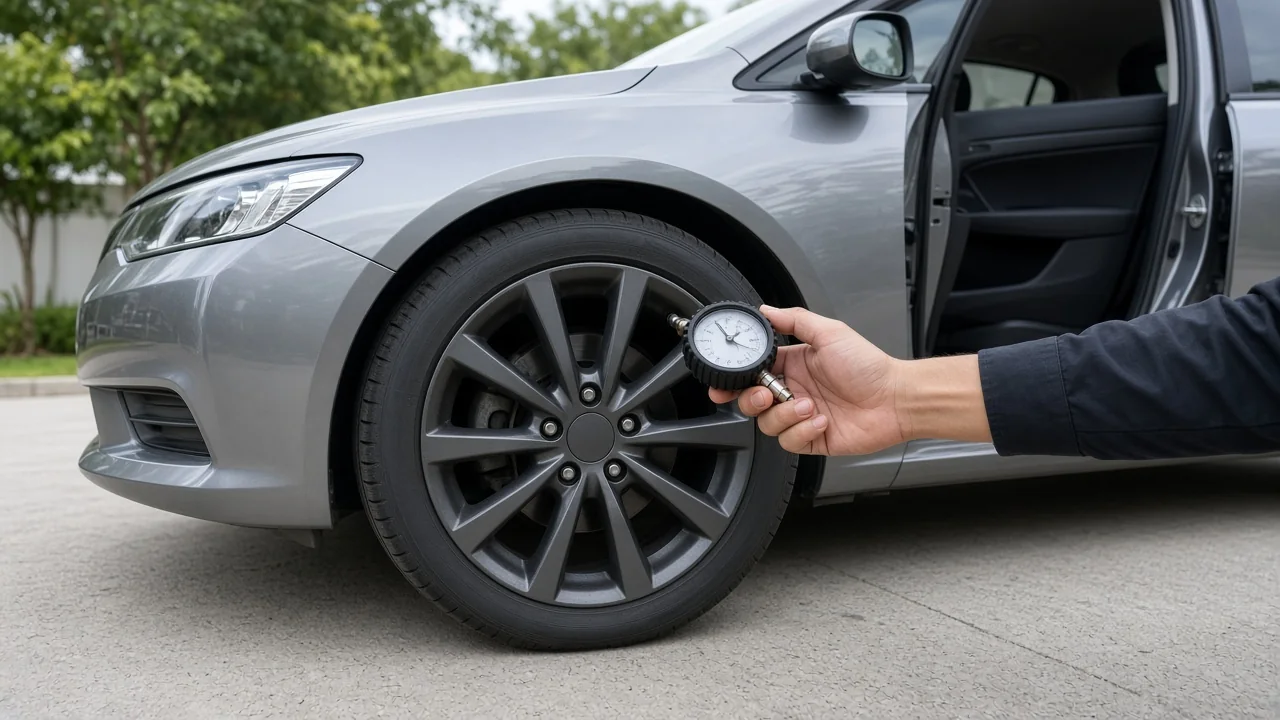
Honda Civic and Honda Accord tire pressure starts with the vehicle's own cold specification, not a shared Civic or Accord number. Recommended PSI is printed on the driver-door tire placard and should be confirmed against model year, configuration, and listed tire size. Checking with a gauge, understanding how the tire pressure monitoring system behaves, and calibrating or resetting a warning after inflation are separate steps from finding the correct air pressure.
Find the Recommended Tire Pressure for Your Civic
The recommended Honda Civic tire pressure is the cold inflation value on the tire information placard in the driver-door opening, not a single Civic-wide PSI. Civic nameplates cover many years, trims, and tire sizes, so Honda Civic car tire pressure still has to be read from that specific vehicle's label. Confirm the model year, configuration, and the tire size printed on the placard before treating any number as the correct tire air pressure for Honda Civic.
Read the front and rear recommended PSI separately, because tire pressure on a Honda Civic is not always the same at both axles. Note any load guidance on the same placard so a heavier condition is not confused with the everyday cold setting. The number molded into a tire sidewall is a maximum for that tire, not the vehicle's recommended inflation setting. If fitted sizes differ from the placard listing, do not guess a substitute PSI; seek qualified guidance for that combination.
Locate the Correct Accord PSI and Tire Information
The Honda Accord tire pressure specification is the cold inflation value on that Accord's driver-door tire placard. Open the driver's door and read the labeled values rather than borrowing a Civic number or a remembered Accord figure. Tire pressure for Honda Accord, and Honda Accord tire air pressure in that car, still depend on model year, configuration, and the tire size shown on the label. Treat no numeric recommendation as correct until those identifiers match the car in front of you.
Accord front and rear entries can differ, so tire pressure on Honda Accord should be read axle by axle instead of assuming one PSI fills every wheel. The vehicle-specific owner's manual restates how to interpret the placard and any load notes that accompany the everyday setting. If the label is missing or illegible, obtain the correct specification from Honda documentation that matches the VIN, year, and fitted size rather than copying another Accord. That confirmation is what makes the pressure in a Honda Accord the recommended cold value for that car.
Check Cold Tire Pressure With a Gauge
To check tire pressure on Honda Civic or Accord, measure cold after the car has been parked at least three hours so heat from driving has not raised the reading. On a stationary vehicle, remove the valve cap, seat a tire pressure gauge squarely on the stem, record each road tire, and replace the cap. Compare those numbers with the applicable placard specification for that axle. If a tire is low, add air and recheck with the same gauge rather than relying on compressor markings.
Do not bleed a warm tire down to the cold specification, because the reading will drop further once the tire cools and may then sit below the recommended PSI. A low tire pressure warning or an available dashboard reading does not replace routine gauge checks, and some Honda Civic and Honda Accord vehicles do not display individual PSI at each wheel. Temperature swings can change cold tire pressure from day to day. Repeated loss, a slow air leak, visible damage, or a substantially deflated tire warrants assistance before driving rather than another top-off.
Identify How Your Accord or Civic TPMS Works
A Honda Civic tire pressure monitoring system and a Honda Accord tire pressure monitoring system are not one design across every year and market. Check the model year, market, and owner's manual before describing a Honda Civic tire pressure sensor, a Honda Accord tire pressure sensor, or any reset behavior. Direct systems use a wheel-mounted pressure sensor and may need a vehicle-specific recognition procedure after sensor service. Indirect systems infer inflation changes from wheel behavior and require TPMS calibration as specified in that manual rather than assuming every wheel contains a sensor.
Wheel-mounted hardware is a Honda Civic tire pressure sensor or Honda Accord tire pressure sensor; an indirect system does not place a tire pressure sensor on Honda Accord or Civic wheels. A Honda Civic tire pressure monitor or Honda Accord tire pressure monitor may still be either architecture. TPMS cannot establish why air was lost, confirm tire condition, or guarantee every tire is at the recommended pressure. Treat the monitor as a prompt to measure with a gauge, not as a completed diagnosis of the tire or the sensor.
Respond to an Accord Tire Pressure Warning
A Honda Accord tire pressure light is identified by the exact warning symbol or message, then confirmed in the vehicle-specific manual rather than a generic icon description. The first response to the tire pressure light on Honda Accord is to stop somewhere suitable, observe tire condition, and measure pressures with a gauge before considering calibration. Inflate to the cold placard values when the tires are cold enough for a valid reading. A tire pressure light in a Honda Accord is evidence to interpret, not proof that a sensor has failed.
A steady warning can indicate low pressure, while a flashing light or a separate system message can indicate a malfunction; confirm that pattern for the specific Accord rather than assuming every Honda behaves the same way. If the Honda Accord tire pressure monitor returns after inflation, record cold readings and arrange inspection for a recurring leak instead of repeatedly clearing the warning. When pressures are correct but the light persists, or the vehicle reports a system fault, professional testing is the next step. Do not diagnose a failed Honda Accord tire pressure sensor from the light alone.
Calibrate or Reset TPMS After Correcting Tire Pressure
A Honda Civic tire pressure reset is not one button sequence across every Civic. Resetting tire pressure on a Honda Civic may mean indirect-system calibration, automatic warning clearance after inflation, or recognition of a Honda Civic tire pressure sensor, depending on the fitted design. Establish the model year and system first, then follow the matching owner's manual procedure rather than a universal sequence. Apply the same verification to Accord calibration and identify a menu or button only when that specific vehicle supports it.
Correct cold inflation and attention to leaks come before TPMS calibration. Calibration does not add air, seal a slow air leak, or repair a wheel-mounted pressure sensor, so resetting with a low tire still leaves the condition that set the warning. Completion may require the driving conditions in the manual. If calibration will not finish or the warning returns, recheck each tire with a gauge and seek appropriate testing rather than restarting the procedure until the light simply goes out.