Ford Super Duty Differential Fluid Capacity and Type: F-250 to F-550 Guide
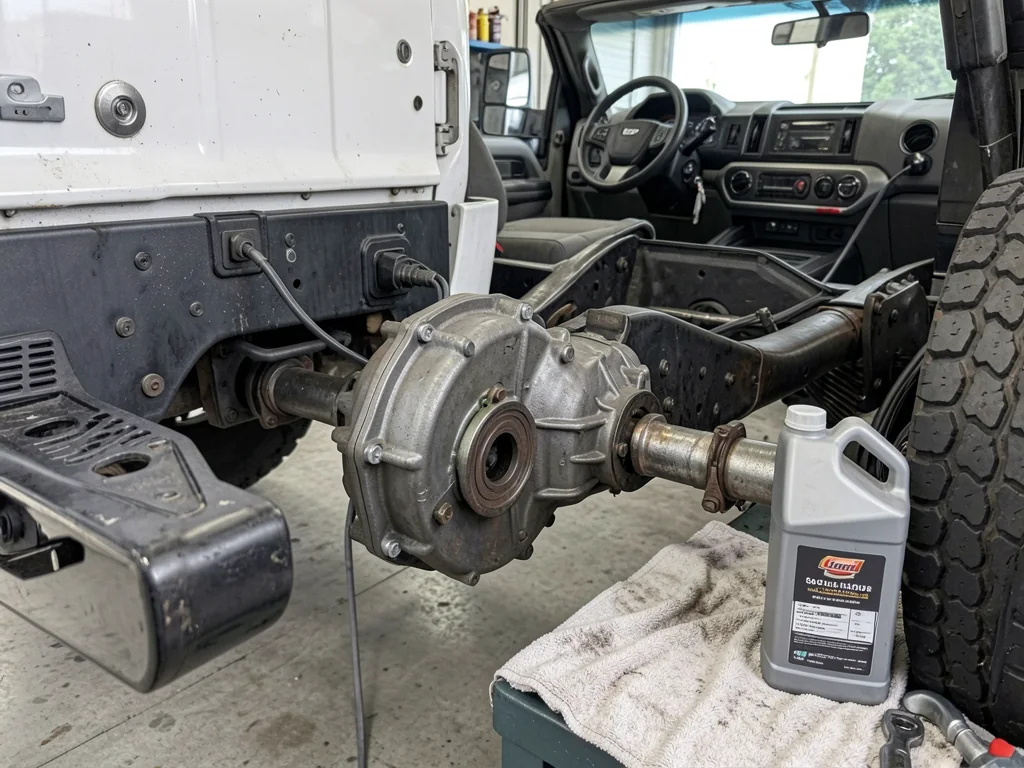
Finding the correct Ford F-250 rear differential fluid capacity is not a single number, because Super Duty trucks from F-250 to F-550 use several axle designs across generations, cab styles, and drivetrains. The right gear oil amount and type depends on the exact axle code and whether you have a limited-slip, electronic locking differential, 4x4 front axle, or dual rear wheel chassis cab. This guide explains how to identify your axle and interpret fluid requirements for models like the 2017, 2019, and 2022 F-250 without guessing.
Identify Your Super Duty Axle Before Looking Up Any Capacity
Differential fluid capacity is set by the specific axle housing, ring gear size, and cover depth installed in your Super Duty, not simply by the badge on the fender. For example, a 2000 F-250 with a Sterling 10.5-inch rear axle and a 2022 F-250 with a Dana M275 have different internal volumes. The same applies to F-350, F-450, and F-550 models: a dual rear wheel chassis cab may use an axle never fitted to a pickup. Before adding gear oil, you must confirm which axle is under your truck.
Every Super Duty has an axle code printed on the Safety Compliance Certification label on the driver door jamb. This two-character code corresponds to a specific ratio and differential type, and can be decoded in the owner's manual or Ford service information. A second identification point is a stamped metal tag under one differential cover bolt. The tag lists ring gear diameter, ratio, and limited-slip status. Older trucks may have lost this tag, so the door jamb code becomes primary. Wheelbase, cab style, 4x2 or 4x4, and single or dual rear wheels all affect which axle was installed.
F-250 and F-350 Rear Differential Fluid Capacity by Generation
Across Super Duty generations, rear axle designs and fill volumes have changed markedly. Early 2000s trucks often used a Sterling 10.25 or 10.5 axle, while 2011-and-later models introduced larger Dana axles. A 2017 F-250 typically has a different rear differential fluid capacity than a 2000 model, and even within the same year, a base truck and a high-capacity towing package may not share the same axle. Rather than searching for one universal number, confirm your generation and then look up the specification for your exact axle code in the owner's manual or Ford service data.
The listed capacity for any axle is approximate for a dry, clean housing. In normal service, you fill through the fill plug until gear oil just begins to drip out, with the truck parked on level ground. This level check is the true final measurement. Buy at least one extra quart beyond the listed figure, because partially drained axles or absorbed fluid can require more. Overfilling can force gear oil past seals and cause aeration, while underfilling starves the ring and pinion and accelerates wear.
Rear Differential Fluid Type for 2017, 2019 and 2022 F-250 Trucks
For 2017, 2019, and 2022 F-250 trucks, the rear differential fluid type is defined by three printed values: the SAE viscosity grade, whether it is synthetic or conventional, and the Ford WSS material specification number. Many late-model Ford axles call for SAE 75W-85 synthetic gear oil meeting WSS-M2C942-A, while heavy-duty towing packages may specify SAE 75W-140. The Ford spec number on the product label is the key to compatibility; brand name alone means little. Always verify the requirement for your exact model year.
The front and rear axle fluid can differ on the same truck. For example, a 2019 F-250 4x4 might require one viscosity in the rear axle and another in the front. If you use the truck for heavy towing or snow plowing, the manual may recommend a heavier viscosity or more frequent changes. Do not mix viscosity grades or use a gear oil that lacks the required WSS number. Incorrect fluid can promote gear whine, chatter from limited-slip clutches, or accelerated component wear, though no exact failure rate is stated.
F-350 Front Differential Fluid Capacity on 4x4 Models
Only 4x4 Super Duty trucks have a front differential, and its capacity is always less than the rear axle because the front housing is smaller and the ring gear diameter is reduced. The front axle on a 2017 or newer F-350 is typically a Dana Super 60 or similar heavy unit, while older models used Dana 50 or 60 axles. These front differentials have their own fill volume and fluid spec, often different from the rear. Confirm the front axle model through the axle code or the tag on the differential cover, then look up the correct amount in Ford service information before draining.
You can safely inspect the front axle without opening it. Look for seepage at the differential cover, the inner axle seals near the steering knuckles, and the pinion seal where the driveshaft enters. After deep water crossings, check whether fluid has turned milky or foamy, which indicates water contamination. A strong burnt smell on the fill plug or evidence of glittery metal in fluid drips suggests severe heat or wear. These observations are not a diagnosis but are a clear reason to have the axle professionally inspected and the fluid changed.
F-450 and F-550 Rear Axle Fluid Capacity for Heavy-Duty and Chassis Cab Trucks
F-450 pickups and F-450/F-550 chassis cab trucks are built for higher gross axle weight ratings, so they use heavier rear axles than F-250 or F-350 models. A typical F-550 chassis cab may carry a Dana S110 or S130 axle with a large ring gear and correspondingly larger fluid volume. Never copy a capacity from a lighter Super Duty, even if the model year is identical. Confirm the exact axle using the door jamb code or the metal tag, and for chassis cabs also check the body builder documentation and any upfitter modifications.
Commercial duty cycles—dump bodies, tow trucks, or service bodies—almost always place the truck in the severe-service maintenance category. Under severe service, Ford's maintenance schedules call for more frequent differential fluid changes and inspections. If your F-450 or F-550 has an incomplete service history or was modified after delivery, have a qualified shop verify axle identity before any fluid service. Using the wrong gear oil quantity or type on a heavily loaded commercial axle can lead to overheating and gear distress.
Limited-Slip Friction Modifier: When Your Axle Needs It
A limited-slip differential uses clutch packs to transfer torque to the wheel with traction, and those clutches can chatter or grab during tight, slow turns if the gear oil lacks the proper friction modifier. Some Super Duty axles use clutch-type limited-slip, while others have an electronic locking differential that mechanically locks the side gears without clutch plates. Electronic locking units generally do not require an additive, but many clutch-type units do. The axle tag or axle code will identify the differential type, and the owner's manual will state whether the recommended gear oil already contains friction modifier or if a separate additive must be poured in.
Common signs of a friction modifier deficiency include a rhythmic chattering, shuddering, or groaning from the rear when turning at parking lot speeds. These sounds can also come from worn clutch plates, incorrect gear oil viscosity, a failing carrier bearing, or brake hardware problems, so they are not proof of the cause. Use only the additive type and amount specified by Ford for your axle; guessing can worsen chatter or reduce the limited-slip effectiveness. If the gear oil bottle already says "friction modifier included" and meets the Ford spec, adding more is usually unnecessary.
Differential Fluid Change Intervals and When to See a Professional
Ford publishes different differential service intervals for normal and severe service. Normal service may allow extended intervals, while towing, plowing, off-road driving, water exposure, and continuous high-speed driving all shorten the recommended change period. Always follow the maintenance schedule in your owner's manual for your model year and axle. Do not rely on online interval figures. Between services, you can safely note new gear whine or howl under load, clunks when shifting, seeping at seals or the cover, and any metallic sheen on the drain plug magnet during a routine oil change.
What you cannot see during a visual inspection is just as important. Noise can originate from worn bearings, incorrect backlash, damaged ring and pinion teeth, or a failing pinion seal, and metal particles on a magnet may be normal break-in residue or evidence of a failing bearing. Diagnosing these conditions requires measuring backlash, checking bearing preload, and inspecting gear contact patterns—work best left to a professional. If you cannot safely lift and support the truck level, if leaks are coming from seals, or if noise remains after a proper fluid change, have a qualified technician inspect the axle.