Find FJ40 engine oil capacity
The short answer
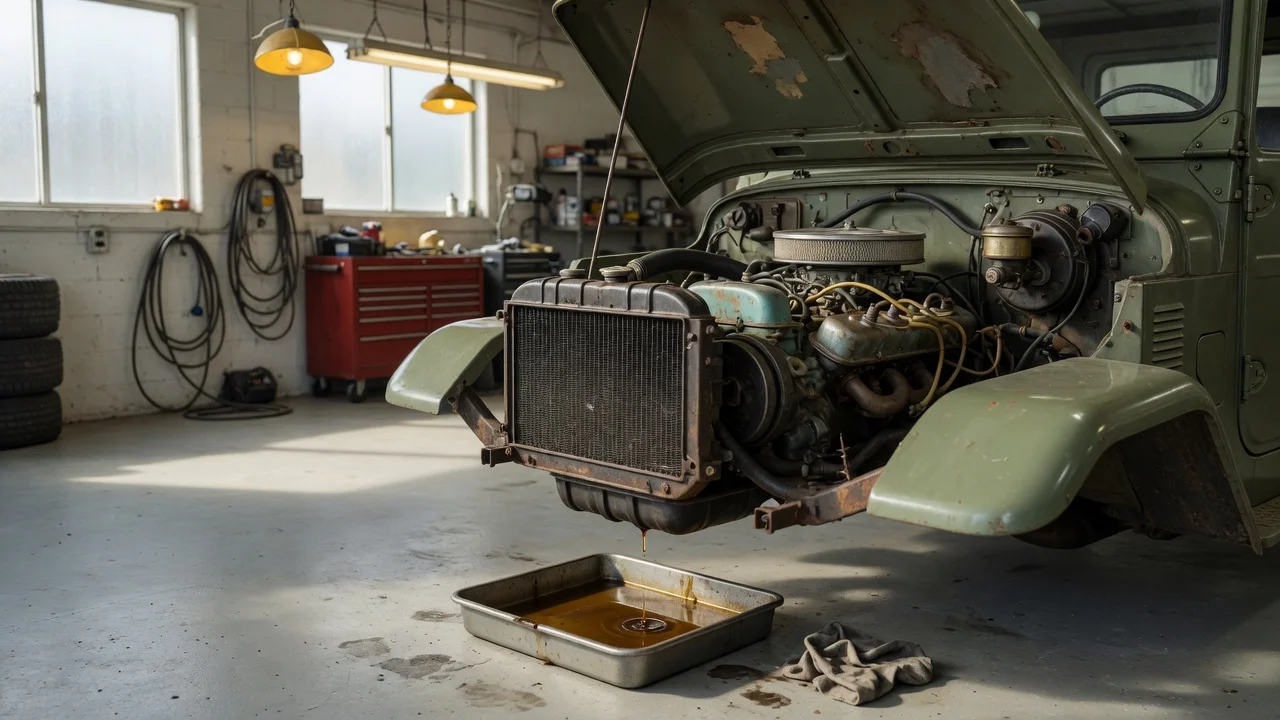
The Toyota Land Cruiser FJ40 uses a gasoline inline-six from Toyota's F family: the original 3.9-liter F engine in earlier trucks and the 4.2-liter 2F from the mid-1970s onward. For either engine, the oil capacity most often quoted for a drain and refill with a new filter is roughly 7.5 to 8 US quarts, or about 7 to 7.6 liters. A change without replacing the filter takes somewhat less.
That range is a commonly published working figure, not a value checked against a factory document for this article. Exact capacity can differ by model year, market and filter type. The owner's manual or factory service manual for your specific truck is the authoritative source. The dipstick reading after refilling is the practical final check.
What changes the answer
Engine type: an FJ40 should have an F or 2F gasoline six. Diesel Land Cruisers of the same body style are sold under different designations, such as BJ40 or HJ45, and do not share the gasoline figure. Engine swaps: many FJ40s now run replacement engines, often non-Toyota V8s. A swapped truck takes the capacity of the installed engine, not the original spec. Filter changes: replacing the filter adds the filter's volume to the refill, which is why figures with and without a filter differ. Aftermarket parts: deeper or modified oil pans, remote filter mounts, oil coolers and bypass filtration systems all increase the oil the system holds. Model year and market: specifications can vary within the production run, so match the figure to your truck's year and market.
How to confirm which engine you have
Identify the engine before you rely on any capacity figure. The model prefix on the vehicle identification or frame number shows how the truck left the factory. FJ indicates an F-series gasoline engine. BJ or HJ prefixes indicate diesel variants. A factory prefix does not prove the original engine is still installed, so also check the engine itself.
Toyota F-family engines carry a stamped engine code and serial number on the block. Reading F or 2F there confirms the gasoline six. If you cannot find a Toyota code, or the engine is clearly a different design such as a V8, treat it as a swap and use that engine's specifications. The exact stamping location varies, so check it against documentation for your truck's configuration.
Filling it correctly
Park on level ground and drain the old oil fully, replacing the filter if you are changing it. Add about a quart or liter less than the expected capacity. Run the engine briefly to fill the filter and oil passages, then shut it off and wait for the oil to settle back into the pan. Check the dipstick and top up in small amounts until the level reaches the full mark, without going over it. Check for leaks at the drain plug and filter, then recheck the level after the next drive.
Filling to the dipstick rather than pouring in a fixed quantity matters especially on these older trucks. Previous owners may have changed the pan or filter setup, and the dipstick itself could be a replacement. If a newly filled engine reads well above or below full, confirm that the dipstick is correct for the engine.
Gaps to be aware of
This article could not verify three details against factory documentation: • separate official capacities for the F versus the 2F; • the exact difference between refills with and without a filter change; • recommended oil viscosity for different climates; Confirm these in the owner's manual or factory service manual for your model year and market before relying on a precise number.