Find a brake fluid leak
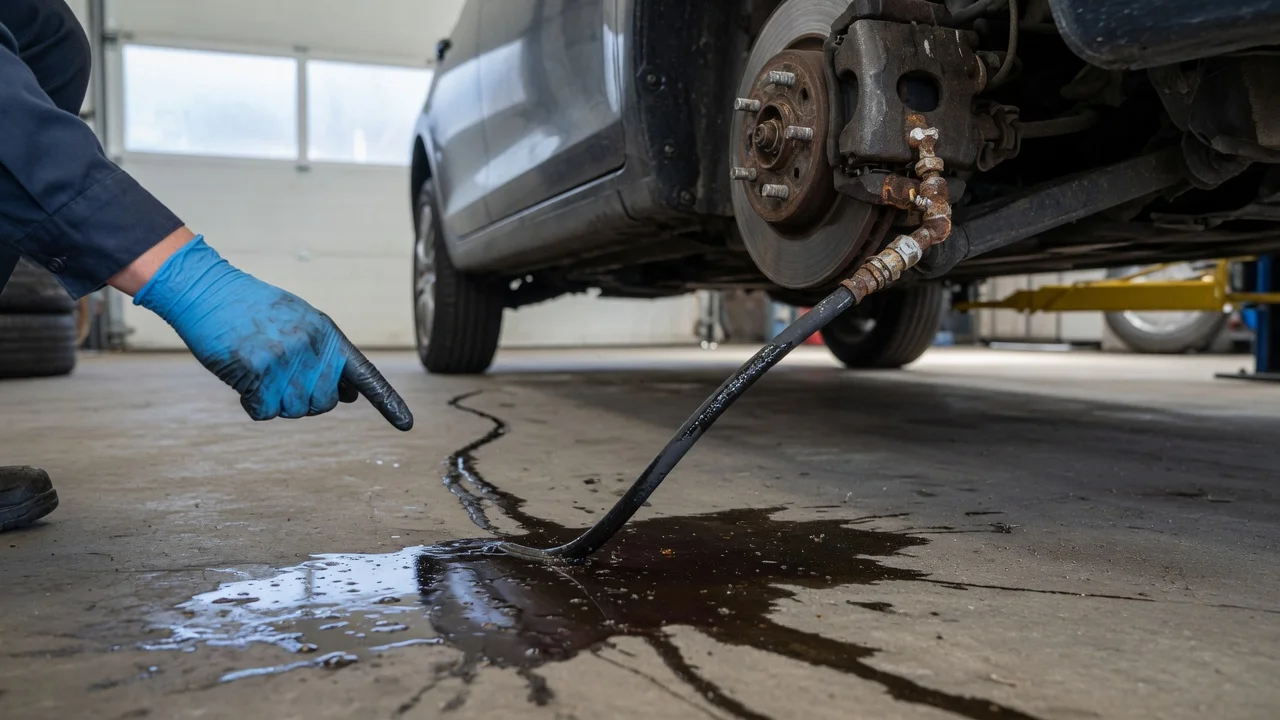
What a brake fluid leak is
A brake fluid leak is hydraulic fluid leaving the closed brake circuit. You find it by confirming the level in the brake-fluid reservoir is falling, or that wet or crusted residue appears along the hydraulic path, then tracing that wetness from the reservoir and master cylinder out to the lines, hoses, valves, and wheel brakes. This guide covers an external leak you can see or feel. Fluid bypassing worn seals inside the master cylinder can cause a sinking pedal with a dry engine bay; that is a different fault and may leave no puddle.
How to recognize brake fluid
Brake fluid is usually clear, straw, or amber when relatively fresh and can darken with age and heat. It feels oily. Fresh spills can look wet and slightly glossy; older leaks often dry to a sticky film or a light crust around a fitting, hose end, bleeder, or rubber boot. The fluid is hygroscopic, meaning it absorbs moisture from air, so an open reservoir or a long-standing wet patch can look cloudy. Exact color and viscosity vary by fluid type and age, so treat appearance as a clue, not a laboratory identification.
The reservoir is the usual starting landmark: a translucent plastic tank on top of the master cylinder in the engine bay, often marked for brake fluid, with MIN and MAX level lines. The master cylinder itself is the metal hydraulic pump body under that tank, typically bolted to the brake booster (the large round or square housing behind it). From there, rigid metal lines and flexible hoses carry pressure to each wheel. Exact layout, which side of the bay the unit sits on, and whether an anti-lock braking system (ABS) hydraulic control unit sits in the line all depend on the vehicle, so confirm those points in the owner’s manual or a workshop diagram for that model, year, and brake package.
Where leaks usually show up
Follow the wet path rather than guessing a single part. Gravity and airflow pull fluid downward and rearward, so a drip on a subframe, control arm, or inner wheel face may originate higher up. Common leak sites, in a useful search order, are:
Reservoir cap, tank seams, and the rubber seals where the reservoir sits on the master cylinder; Master-cylinder body, outlet ports, and the joint to the brake booster; fluid can also seep into the booster and stay hidden until the unit is inspected; Flare fittings and unions on rigid brake lines, including junction blocks and any proportioning or combination valve; Flexible hoses at each end fitting, along the hose body, and at caliper or axle banjo bolts; ABS hydraulic control unit (the modulator or pump-and-valve block) and the lines attached to it; Disc-brake calipers: piston dust boots, slide-pin boots on some designs, bleeder screws, and banjo or inlet fittings; Drum-brake wheel cylinders, usually visible as wetness on the backing plate, drum edge, or inner tire sidewall; Bleeder screws and recently disturbed fittings after a pad, hose, or bleed service
Lookalikes that are not brake fluid
Several other fluids collect under a vehicle and can be mistaken for a brake leak. Use location and nearby reservoirs together, because color alone is unreliable.
What you are seeing Typical clues Where it usually sits; Engine oil Often darker and thicker; may smell of hot oil Around the engine, filter, pan, or valve cover, then dripping to the mid-sump area; Power-steering fluid Oily, similar sheen to brake fluid Along steering lines, the steering gear or rack, and the power-steering reservoir, not the brake tank; Automatic transmission fluid Often red or pink when fresh; darkens with age Near the transmission, cooler lines, or the transmission dipstick or sealed fill area; Coolant Often dyed; can feel thinner and slightly sticky when dry At the radiator, hoses, water pump, or expansion tank; Water or condensation No oily film; evaporates Air-conditioning drain, exhaust, or weather
If wetness is only at a wheel and the brake reservoir is dropping, treat it as brake-related until proven otherwise. If the brake reservoir is stable and another tank is low, search that system first.
A practical way to trace the source
Park on level ground, shut the engine off, and set the parking brake if it is safe for the inspection. Do not drive the vehicle if the pedal is soft, the brake warning lamp is on, or the reservoir is empty or nearly empty. Read the brake-fluid reservoir at the MIN and MAX marks. A falling level with pads that are not badly worn is a strong leak clue. Do not add fluid just to mask the drop until you know where it is going; topping up can hide the rate of loss and overflow if the leak is intermittent. Look under the vehicle for fresh drips, then inspect the inner face of each wheel, the tire sidewall, and the backing plate or caliper. A wet inner rim or a spray pattern on the tire often points to that corner’s caliper, hose, or wheel cylinder. In the engine bay, inspect the reservoir, master cylinder, nearby inner-fender and booster faces, and any ABS unit and its fittings. Wipe a suspected area dry with a clean rag so you can tell old residue from a fresh weep. Follow each hard line and hose as far as you can see, paying attention to crimps, clips, and places the line rubs a bracket or subframe. A crusted fitting that is wet again after a firm pedal application (engine off, vehicle stationary) is a useful confirmation. If the reservoir drops and the engine bay looks dry, consider seepage into the brake booster or a leak that appears only when the system is under pressure. Those cases need closer inspection than a quick under-hood glance.
Brake fluid can damage paint, so wipe spills off finished surfaces. Opening lines or bleeders introduces air and requires a correct bleed procedure for that vehicle; skip that step unless you are prepared to restore a firm pedal. A confirmed leak is a safety defect: the circuit can lose pressure, one end of the split system can fail, and a soaked friction lining can reduce braking at that wheel. Have the leaking part repaired before regular driving. Connector assignments, line routing, and which corner is fed by which master-cylinder port are vehicle-specific; verify them against documentation for the applicable model year, market, and brake equipment rather than assuming a layout from another car.