Exhaust Manifold Gaskets: Choosing the Correct Replacement
The short answer
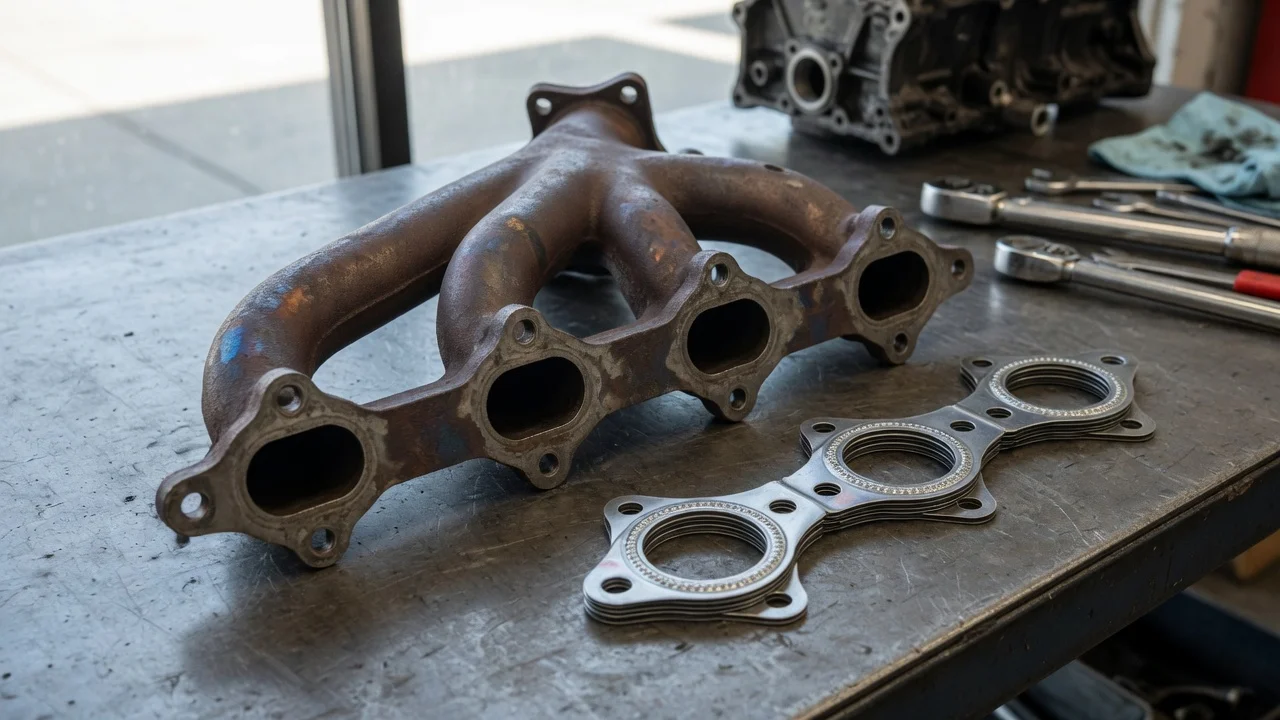
For most vehicles, the correct exhaust manifold gasket is a direct-fit replacement matched to the engine, model year, and exhaust manifold design. A gasket that is too generic may fit the bolt pattern but fail to seal the individual ports, especially if the manifold uses nonstandard port shapes, raised sealing rings, or a pressure-sensitive turbocharger connection. The main condition that changes the recommendation is forced induction: turbocharged engines generally demand a higher-temperature gasket material and more careful surface preparation than a conventional naturally aspirated replacement.
What the gasket actually seals
The exhaust manifold gasket sits between the cylinder head and the exhaust manifold. It must seal hot exhaust gas at the port openings while accommodating the small amount of movement that occurs as the manifold and cylinder head expand at different rates. A poorly matched gasket can allow exhaust leaks that produce noise, lower oxygen-sensor accuracy, or allow hot gas to reach nearby wiring and components.
Check compatibility before buying
Engine code and displacement: several engines in one body style may share a chassis but use different manifolds. Model year and market: emissions equipment and manifold castings can change between model years. Number of ports and bolt layout: confirm that every port opening and fastener location matches the manifold being installed. Turbo or naturally aspirated: turbo engines often use a dedicated turbine-inlet gasket with different dimensions. Manifold material and condition: a warped or heavily pitted manifold can defeat a new gasket even when the part number is correct.
Material and design trade-offs
Exhaust manifold gaskets are commonly offered in multi-layer steel, graphite-faced composite, or high-temperature fiber materials. Multi-layer steel gaskets tend to resist crushing and suit engines with wide temperature swings, while composite and graphite gaskets can better absorb minor surface irregularities. The best choice depends partly on the original design: using a substantially softer gasket where a steel shim gasket was specified may change clamp load and shorten service life.
Common replacement points
A new gasket should be installed whenever the exhaust manifold is removed for repair, turbocharger service, or cylinder-head work. Replacement is also appropriate when there is visible soot around a port, a persistent exhaust tick that changes with engine load, or evidence of leakage around the manifold flange. Reusing a crush-type gasket after removal is generally not recommended because the sealing ability depends on the original compression.
Costs and ownership considerations
The gasket itself is usually an inexpensive part relative to the labor involved. Access can be the larger cost driver: on inline engines the manifold may be straightforward to reach, while transverse V6 or turbocharged applications may require removing heat shields, brackets, or nearby components first. The information available here does not include verified regional prices or completed-transaction data, so advertised part prices should not be treated as the final installed cost.
Additional parts to evaluate
Even when the gasket is the primary purchase, it is worth checking the condition of the manifold studs, nuts, and any specified replacement fasteners. Heat-cycled hardware can stretch or seize, and some applications use torque-to-yield fasteners that should not be reused without verifying the service procedure. If the manifold itself is cracked or warped beyond the acceptable limit, a new gasket may provide only a temporary improvement.
How to narrow the choice
When comparing options, prioritize a gasket that matches the original sealing style and the exact manifold being installed. A low-cost part that fits the bolt holes but has different port openings or a thinner sealing face is not an equivalent substitute. For a turbocharged engine or a vehicle that sees sustained high load, choose a material rated for elevated exhaust temperatures. For a stock naturally aspirated daily driver, a quality direct-fit replacement matched to the application is generally the safest default.