How to Evacuate a Car AC System
What Evacuating a Car AC System Means
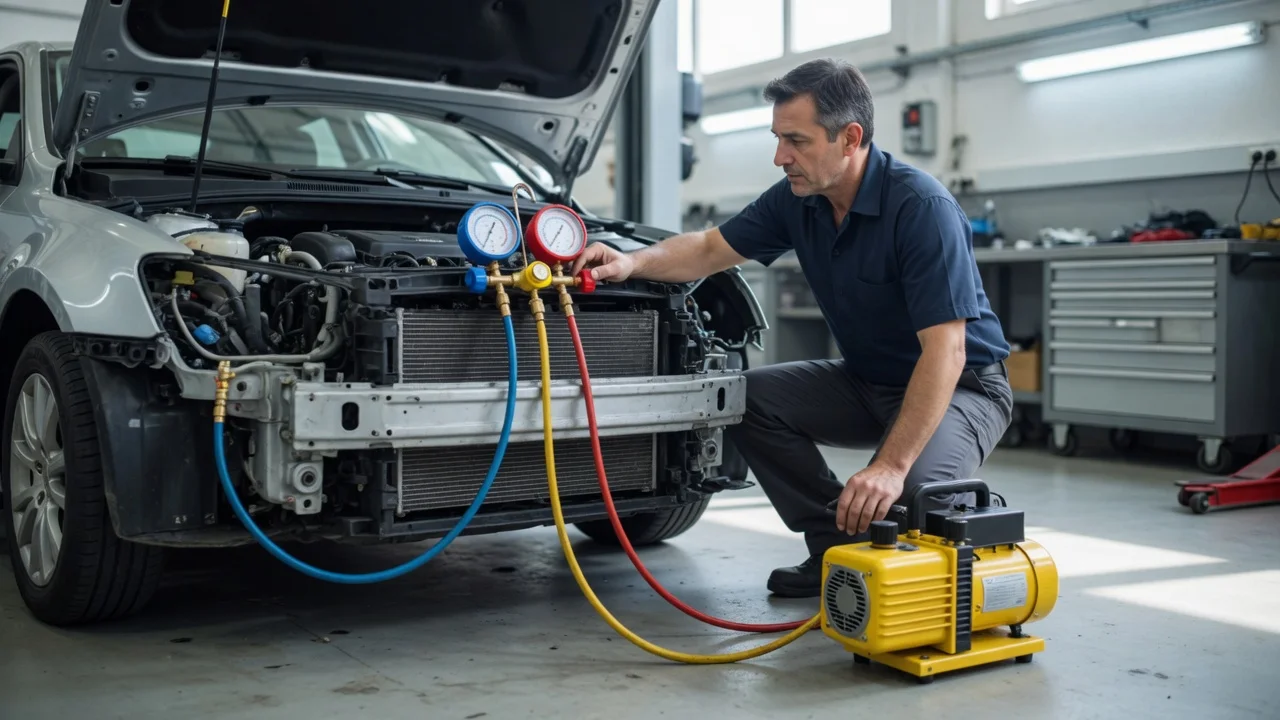
Evacuating a car AC system means connecting a vacuum pump to the closed air conditioning circuit and pulling a deep vacuum for a sustained period. The purpose is to remove air and moisture from the system before charging it with refrigerant. This is not the same as recovering refrigerant. Evacuation is typically performed after the system has been opened for component replacement, after a leak repair, or when contamination is suspected. If the system still contains refrigerant, that refrigerant must be recovered using appropriate equipment before evacuation begins.
A correct evacuation lowers the internal pressure enough to boil off water at ambient temperature. Leaving moisture in the system can cause ice formation at the expansion device, internal corrosion, and acid formation when mixed with refrigerant and oil. A system that cannot hold a vacuum after the pump is isolated likely has a leak.
Tools and Prerequisites
You will need a two-stage vacuum pump rated for automotive AC work, a manifold gauge set with high- and low-side hoses, and safety glasses and gloves. The manifold gauge set must be compatible with the service port type on the vehicle. Many modern cars use R-134a quick-connect fittings, while newer models may use R-1234yf fittings. The fittings are different by design and are not interchangeable.
Before starting, confirm that all components are installed, all O-rings and seals are in place, and the service valves are closed. The vacuum pump oil should be clean and at the correct level. Contaminated or low pump oil will reduce the pump's ability to reach a deep vacuum.
Step-by-Step Evacuation Procedure
First, confirm the recovery machine has removed any remaining refrigerant if the system was not already empty. Never connect a vacuum pump to a pressurized system. Put on safety glasses and gloves. Connect the blue low-side hose and red high-side hose from the manifold gauge set to the corresponding service ports on the vehicle. Connect the yellow center hose to the vacuum pump intake.
Open both manifold gauge hand valves fully. Turn on the vacuum pump. Let the pump run until the low-side gauge reads approximately 29 inches of mercury vacuum, or as close to that value as your altitude allows. At high altitude, the achievable vacuum reading will be lower because ambient pressure is lower.
Continue running the pump for at least 30 to 45 minutes after the target vacuum is reached. This dwell time gives moisture time to vaporize and be removed. For a system that has been open to the atmosphere for hours or exposed to high humidity, a longer evacuation of several hours may be necessary. Shortcuts here commonly lead to poor cooling performance later.
Close both manifold hand valves, then turn off the vacuum pump. Watch the low-side gauge for 10 to 15 minutes. If the needle rises noticeably, there is a leak or residual moisture still boiling off. If the vacuum holds steady, the system is ready for charging. If the vacuum does not hold, repair the leak and repeat the evacuation.
Safety and Professional-Service Boundaries
Do not use compressed air or a solvent flush as a substitute for evacuation. Compressed air introduces moisture and contaminants. Refrigerant must be recovered by a certified recovery machine before opening the system. Venting refrigerant to the atmosphere is illegal in many markets and damages the environment.
If the system has suffered a compressor failure or contains debris, evacuation alone is not enough. The system may need flushing, a new receiver drier or accumulator, and a replacement expansion device. In these cases, the service procedure goes beyond a simple evacuation and charging job.
A DIY vacuum pump can remove air and moisture, but it cannot tell you how much oil remains in the system or whether the correct refrigerant charge has been restored. You still need an accurate refrigerant scale or charging cylinder, and for R-1234yf systems the equipment is often different from older R-134a tooling. If you are unsure about the refrigerant type, oil type, or charge weight for your vehicle, consult the underhood label or a professional workshop.