EV Battery Chemistries Explained: Lithium-Ion, NMC, LFP and LiFePO4
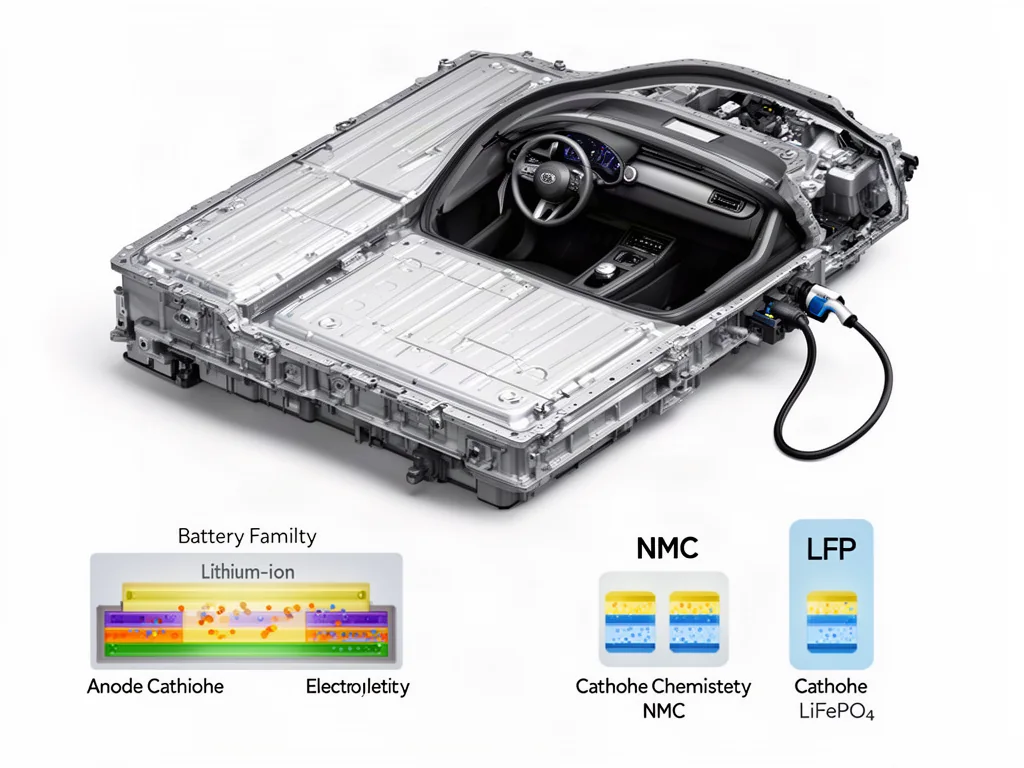
A lithium-ion battery for an EV is a family of rechargeable cells, not one recipe. Production cars use several cathode chemistries, including nickel manganese cobalt oxide and lithium iron phosphate, and those materials influence charging habits, aging, and cold performance. Knowing what an EV lithium battery label actually names helps a driver read range, charging screens, and manufacturer guidance without treating chemistry as a universal ranking.
What Lithium-Ion Means in an Electric Vehicle
Lithium-ion is a rechargeable family that includes NMC and LFP as different classification levels, not competing brand names for the same cell. A li-ion battery for EV cars still moves lithium ions between electrodes: they leave the cathode on charge, travel through the electrolyte, and occupy the anode, then reverse on discharge while electrons supply the external circuit. Energy is stored by that shuttle, not by burning the electrodes as a one-use fuel.
Everyday talk about an EV lithium battery usually means the high-voltage traction pack. A separate auxiliary battery still supports lights, computers, and low-voltage systems, so those roles should stay distinct. The lithium-ion name alone cannot set range, charging speed, or service life, because pack size, cooling, software, and driving conditions intervene. A lithium ion EV battery and a lithium-ion battery for EV car use can share the family label and still behave differently day to day.
The Materials Behind EV Battery Chemistry Names
EV battery chemistry names usually identify the cathode. In a lithium ion battery in EV cells, the cathode stores and releases lithium, the anode hosts ions during charge, the electrolyte carries those ions, and a separator keeps the electrodes from touching. Nickel manganese cobalt oxide, or NMC, names that cathode chemistry. It does not specify every material in a lithium-ion battery for EV service, and it is not a complete inventory of EV battery chemicals.
Most production cells use a graphite anode, and some add silicon or silicon-carbon blends to raise anode capacity. Those anode EV battery materials matter even when marketing cites only the cathode. NMC, LFP, and NCA belong among production-EV lithium-ion terminology; the list is not exhaustive and is not a ranking. Flow battery EV designs are not typical traction packs. Silicon carbide battery EV talk usually refers to power electronics, not cell chemistry.
LFP and LiFePO4 Both Mean Lithium Iron Phosphate
LFP means lithium iron phosphate, and LiFePO4 is the same cathode written as a formula. Drivers will see LFP, an EV LiFePO4 battery, or LiFePO4 on spec sheets; those names all identify the same phosphate cathode. A lithium iron phosphate EV battery remains a lithium-ion battery: ions still shuttle, and a battery management system still watches voltage, current, and temperature. The LFP label identifies cathode chemistry, not a non-lithium family.
Lithium iron phosphate often holds a relatively flat voltage through much of its operating range, so state of charge is hard to read from voltage alone. Charge estimation therefore depends on the battery management system rather than a steep voltage slope. Thermal stability is a material trait, not a claim that a LiFePO4 EV battery pack is harmless. An LFP battery EV still carries high voltage, and fire and electrical hazards remain. Treat the pack as high-voltage equipment.
How to Confirm Whether an EV Has an LFP Battery
Chemistry can change inside one model name by year, trim, market, and production configuration. Another EV with LFP battery hardware does not prove the next car of that name uses the same cells. Confirm chemistry from manufacturer documentation, in-car battery screens when they exist, or VIN-based manufacturer confirmation. Advertising copy about a lithium battery for EV use is not that confirmation. Until the exact vehicle is documented, a claim that the pack is LFP stays unverified.
Range badges, advertised capacity, and seller descriptions cannot establish chemistry by themselves. Two packs can share similar kilowatt-hours and still use different cathodes. Any production-EV example must be checked against the exact configuration rather than treated as a model-wide fact. Saying a nameplate is an EV with LiFePO4 battery cells overreaches without year, market, and option detail. The useful question is which cells this VIN received, not which types of battery used in EV brochures appear in marketing.
How Cells Become a Pack—and What Energy Density Means
Cells become a lithium ion battery pack for EV use only after they are grouped, sometimes through modules, and joined with cooling, protection, and a battery management system. That assembly is the high-voltage lithium-ion battery pack EV drivers actually live with. A li-ion battery pack for EV service therefore includes thermal and electrical hardware that bare cells do not provide. Range estimates that ignore those pack-level pieces miss how energy is stored and delivered.
EV battery energy density can be measured by mass or by volume, and cell numbers are not complete-pack numbers. Structure, coolant, and electronics lower pack energy density versus a bare cell. Usable capacity is what software releases; gross capacity is the installed figure; power is how quickly the pack can charge or discharge. Chemistry influences those specs, but efficiency, temperature, and operating conditions still set delivered range. A lithium ion EV battery pack cannot be ranked by cathode name alone.
Charging Habits Must Follow the Vehicle’s Battery Guidance
Daily charge limits and full-charge routines must follow the instructions for that vehicle and battery configuration. Software already knows the installed chemistry, thermal limits, and warranty rules for a lithium-ion battery for EV car charging. Some LFP vehicles specify periodic full charges so the battery management system can keep state-of-charge estimates honest. That is a calibration practice for those cars, not a universal schedule for every lithium-ion EV.
Calibrating charge estimation does not restore lost capacity. A full charge that helps software locate 100 percent does not reverse calendar aging or cycle aging. Fast charging still depends on temperature, state of charge, pack design, and software as well as chemistry. An EV lithium ion battery may taper early in heat or cold even when the plug is capable. Do not treat any cathode as a fixed-rate promise; use the vehicle's displayed limits and battery preconditioning prompts.
Battery Life and Cold-Weather Behavior in Daily Use
Calendar aging and cycle aging both act on an EV lithium ion battery pack. Time, temperature, and long stays at a high state of charge shape calendar aging even when the car sits. Cycle aging tracks how often and how hard the pack is used. Cold can temporarily restrict available energy, regeneration, and charging power without proving permanent loss. Those limits are operating constraints, not proof that the lithium-ion battery in EV service has failed.
Manufacturer-supported battery preconditioning warms the pack before a planned charge through navigation or charging-screen tools. Use that guidance in cold weather instead of forcing high power into a cold pack. The best EV battery type depends on climate, charging access, and ownership plans; EV battery chemistries have no universal winner. Persistent battery warnings, unexpected charging restrictions, or a substantial unexplained range change warrant professional assessment. Leave pack opening and high-voltage repair to trained service.