EGR Solenoids, Vacuum Modulators, Hoses, and Tubes Explained
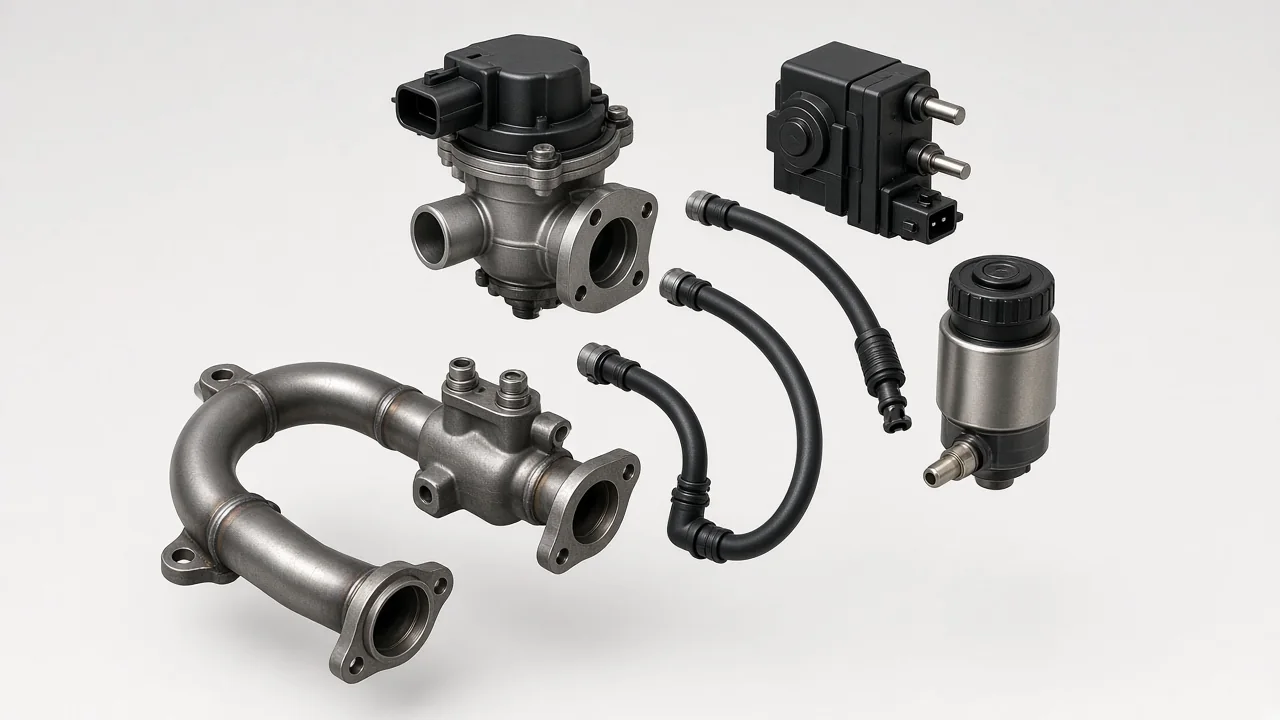
Exhaust gas recirculation depends on more than the valve itself. An EGR solenoid valve, vacuum modulator, hoses, and metal tubes work together to meter recirculated exhaust. Layout varies by engine: some systems use electrical vacuum control, others do not. Identifying the installed hardware is the first step before reading symptoms, ordering parts, or assuming a failed component.
How the Supporting Components Control EGR Flow
Exhaust gas recirculation meters a controlled amount of exhaust into the intake so combustion temperatures can be managed. An exhaust passage feeds the EGR valve, which opens and closes the path. In systems that use both an EGR valve and solenoid, the valve is the metering device while the EGR valve solenoid switches or regulates the vacuum that moves the actuator. Without that vacuum control signal, the valve cannot follow the commanded EGR flow even if the pintle itself is free.
Component layout is not universal. Some engines use an electrically commanded vacuum solenoid and a separate vacuum modulator; others drive the valve electronically and have no external vacuum controls at all. Metal tubes, hose ports, and electrical connectors appear only where that design needs them. Interpreting a misfire, a stored code, or a missing vacuum hose as an EGR solenoid problem is unreliable until the installed system is identified from the vehicle’s service information and the actual hardware on the engine.
What the EGR Solenoid Does and What Can Go Wrong
When a vacuum-operated EGR actuator is used, an electrically commanded EGR solenoid valve typically sits in the vacuum supply line. The powertrain control module energizes the coil, the internal valve opens or bleeds, and the resulting vacuum at the actuator determines how far the EGR valve opens. Catalog listings may call the same part an EGR valve solenoid, a solenoid EGR valve, or simply an EGR solenoid, so matching the vehicle, connector shape, and port layout matters more than the phrase on the box.
A failed coil, a corroded electrical connector, a stuck internal shuttle, or a cracked vacuum nipple can all keep the solenoid from delivering the intended vacuum control. None of those conditions is proven by a single symptom. Idle quality, an illuminated lamp, or a code pointing at EGR flow can originate in wiring, the actuator, a restricted exhaust passage, or the valve itself. Confirming commanded operation, circuit integrity, and vacuum response usually requires scan data and gauge work best handled by a technician familiar with that engine family.
The Vacuum Modulator’s Role in Applicable EGR Systems
In systems equipped with an EGR vacuum modulator valve, the modulator shapes the vacuum signal that reaches the EGR actuator rather than simply switching it on and off. Some designs also use exhaust backpressure as an input so EGR flow tracks engine load more closely, but that arrangement must be confirmed for the specific vehicle. The modulator typically sits in the vacuum path between source, solenoid, and valve, so its ports and hoses are part of the same vacuum control circuit that meters recirculated exhaust.
Restricted internal passages, a deteriorated diaphragm, or hoses swapped onto the wrong ports can delay, weaken, or invert the vacuum the actuator receives. A modulator that looks intact can still leak internally or fail to respond to backpressure. Visual inspection may reveal collapsed hoses or disconnected fittings, but it cannot establish whether the modulator functions correctly. Functional checks against the vehicle’s procedure are needed before replacing an EGR vacuum modulator valve on appearance or on a neighboring code.
EGR Hoses: Function, Visible Damage, and Routing
An EGR valve hose may carry manifold vacuum to the actuator, connect a modulator or solenoid, or, in some layouts, serve a different purpose such as a vent. The function depends on the system, so the hose cannot be assumed to be a vacuum line just because it sits near the valve. With the engine off and cool, look for cracks, loose connections, abrasion against brackets, and heat damage near exhaust parts. Soft, collapsed, or oil-soaked rubber is a useful observation, not a diagnosis of the valve.
A split or incorrectly routed hose can interrupt the vacuum control signal so the EGR valve stays closed, opens too far, or responds late. Vacuum hose routing is vehicle-specific; swapping two similar nipples can change how the solenoid and modulator interact even if every part is new. Consult the routing diagram for that engine before disconnecting anything, and keep hands away from hot exhaust and moving belts. EGR valve hose replacement should use the specified material, length, and heat resistance for the actual duty of that line.
EGR Metal Tubes, Connections, and Flow Restrictions
A metal EGR valve tube carries exhaust between the exhaust passage, the valve, and often the intake. Routing varies with manifold shape, accessory clearance, and whether the EGR valve and tube share a common assembly. External cracks, leaking joints at a tube flange, and missing or crushed sealing gaskets can let exhaust escape. Internal deposits may restrict EGR flow without showing much on the outside, so a clean-looking tube does not prove an open passage.
Soot staining near a joint can suggest leakage, but it does not confirm the exact source; a nearby manifold, turbo flange, or valve gasket can mark the same area. Exhaust odor, a visibly damaged EGR valve and tube, or suspected restricted flow is a reason for professional inspection, especially if fumes reach the cabin. Do not try to straighten, weld, or clear a hot exhaust tube as a roadside fix. A technician can inspect joints and blockage and confirm whether the tube, gasket, or another leak path is at fault.
Confirming the Fault and Planning Replacement
Rough running, hesitation, or an illuminated check-engine light can come from ignition, fuel delivery, vacuum leaks unrelated to EGR, or a restricted exhaust passage. Those symptoms cannot identify a failed EGR solenoid valve, modulator, hose, or tube by themselves. If a diagnostic code is stored, its definition must be verified for that vehicle; manufacturer-dependent codes are not interchangeable, and a code is evidence to interpret rather than proof that a particular part has failed. Flow, command, and mechanical integrity still need to be separated before parts are ordered.
Replacement hoses must match the specified material, inside diameter, heat tolerance, and vacuum hose routing for their actual function; a generic fuel hose is not a substitute for an EGR valve hose replacement near exhaust heat. Solenoids, modulators, and tubes need vehicle-specific fitment, the correct electrical connector or port layout, and new sealing gaskets at each tube flange. Inaccessible fittings, seized fasteners, unresolved electrical faults, or uncertain EGR flow call for professional service, then a leak check and a confirmation that commanded operation has been restored.