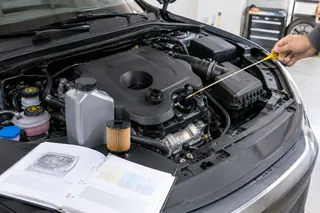
Diesel Engine Oil Change Interval: How Often to Change It and Where to Find Your Schedule
There is no single correct diesel engine oil change frequency that applies to every truck, SUV or car. The right interval is the one the engine manufacturer specifies for your exact engine, model year and operating conditions. Many modern diesels use an oil life monitor that calculates the interval from how the engine is actually used. This guide explains where to find your interval, how to identify which schedule applies to your vehicle, and which conditions can shorten it.
The Short Answer
Follow the service interval in the owner's manual or maintenance schedule for your specific vehicle and engine. If the vehicle has an oil life monitor, change the oil when the monitor calls for it. Also observe any maximum time or distance limit the manufacturer sets. If you tow, idle for long periods, drive short trips, or operate in dusty or extreme conditions, check whether your manual applies a severe service schedule. That schedule usually calls for more frequent changes.
Two qualifications change the answer the most. The first is the engine itself, because intervals vary by manufacturer, generation and powertrain, even within one model line. The second is how the vehicle is used, because the same engine can have different recommended intervals under normal and severe operation.
Why Diesel Oil Intervals Differ From Gasoline Engines
Diesel engines put different demands on their oil than most gasoline engines do. Combustion produces soot, and some of it ends up in the crankcase oil. As soot builds up, it can thicken the oil and increase wear, so diesel oils are formulated to keep soot suspended. That capacity is finite.
Modern diesels with a diesel particulate filter (DPF) add another factor. During an active regeneration, the engine may inject extra fuel to raise exhaust temperatures and burn off trapped soot. Some of that fuel can wash past the piston rings into the oil, which dilutes it. Frequent regenerations, often caused by short trips or low-load driving, can increase this effect. Oil life monitors on many diesels account for these conditions, which is one reason their recommendations can vary noticeably from one oil change to the next.
Where to Find Your Diesel Engine Oil Change Interval
Owner's manual: The maintenance or scheduled service section lists the oil change interval, often with separate normal and severe service schedules. Oil life monitor: Displayed in the instrument cluster or infotainment screen on many newer diesels, usually as a percentage of oil life remaining or a service reminder. Maintenance or warranty booklet: Some manufacturers publish the service schedule separately from the owner's manual. Dealer service department: Can look up the schedule by vehicle identification number (VIN), which ties the vehicle to its exact engine and configuration. Manufacturer owner portal or app: Many brands offer digital maintenance schedules once you register your vehicle by VIN.
If the vehicle was bought used and the manual is missing, the VIN is the most reliable way to retrieve the correct schedule. Do not rely on a schedule for a similar model, because a different engine option or model year may have a different interval or oil requirement.
Identifying Which Engine and Schedule Apply
Equipment identification matters because the same nameplate is often sold with gasoline and diesel engines, or with more than one diesel. Before you apply any interval or lubricant specification, confirm exactly which engine you have.
Vehicle emission control information label: Usually under the hood on the underside of the hood, a strut tower or the radiator support. It typically identifies the engine family and displacement. VIN: On the driver-side dashboard visible through the windshield, the driver door jamb and the registration. For many US-market vehicles, one character in the VIN encodes the engine, but which position is used and what it means depend on the manufacturer. Engine markings: Some engines carry a cast or stamped engine code or a plate on the block or valve cover. Oil filler cap and under-hood labels: Some manufacturers print the required oil viscosity or specification on the filler cap or a nearby label.
Watch for easily confused items. A diesel exhaust fluid (DEF) filler, typically marked with a blue cap, is not related to engine oil and must never receive oil. The fuel filler on a diesel is also separate from the engine oil filler, which is located on the engine itself, usually on the valve cover.
Normal vs. Severe Service
Many manufacturers define severe service conditions that call for shorter intervals. The exact definitions vary by brand, so check your manual. Conditions commonly treated as severe include the following:
Frequent towing or hauling heavy loads; Extended idling, such as work trucks left running at job sites; Repeated short trips where the engine does not reach full operating temperature; Dusty, sandy or unpaved roads; Very hot or very cold climates; Stop-and-go driving, delivery or fleet use
Idling deserves special attention on diesels. An engine can accumulate significant run time and contamination while the odometer barely moves. Some manufacturers track engine hours or count idle time toward the service interval for this reason. If your vehicle displays engine hours, check whether your manual sets an hour-based limit.
Situation | Where to look | What to follow; Vehicle has an oil life monitor | Instrument cluster or settings menu | The monitor's prompt, plus any maximum time limit in the manual; No oil life monitor | Owner's manual maintenance schedule | The fixed interval for your usage category; Regular towing or heavy idling | Severe service section of the manual | The shorter severe service interval; Used vehicle with no manual | Dealer or manufacturer portal using the VIN | The schedule matched to the exact engine; Low annual mileage | Owner's manual | The time-based limit, which can come before the distance limit
Using the Oil Life Monitor Correctly
An oil life monitor estimates remaining oil life from operating data such as engine revolutions, temperature, load and, on some diesels, regeneration activity. Most systems do not chemically test the oil. Their accuracy depends on being reset after each oil change, and only after the oil is actually changed. A monitor that is not reset, or is reset without an oil change, gives a misleading reading.
Most manufacturers also set a maximum calendar interval regardless of what the monitor shows, because oil degrades over time even with little driving. The reset procedure varies by vehicle and is described in the owner's manual.
Lubricant Specification and Manufacturer Approval
The interval in your manual assumes that you use oil meeting the specified requirements. Using a non-compliant oil can undermine both engine protection and the validity of the service interval.
Viscosity grade: A rating such as an SAE multigrade, chosen by the manufacturer for your engine and climate. Industry service category: In the US, heavy-duty diesel oils are commonly classified by API categories, such as CK-4 and FA-4. FA-4 is intended for certain newer engines and is not a universal replacement for CK-4, so use it only where the manufacturer allows it. Some light-duty diesels, particularly European designs, call for ACEA sequences instead. Manufacturer approval: Many manufacturers require oil that carries their own approval or specification code, listed in the manual and printed on approved oil containers. Some light-duty diesels with sensitive aftertreatment require low-ash oils to protect the DPF.
Check the container for the exact approval or specification your manual lists, not just a similar-sounding category. A gasoline-only oil should not be used in a diesel unless the oil is also labeled for the diesel specification your engine requires.
Fill Quantity and Oil Filter
Diesel engines often hold more oil than comparable gasoline engines, and capacity varies by engine. The correct fill quantity is listed in the capacities section of the owner's manual, usually with and without a filter change. Most schedules call for replacing the oil filter at every oil change. Use a filter that meets the manufacturer's requirements, because diesel filters are designed for higher soot loads and the engine's flow requirements.
Level Checks Between Changes
Following the interval does not replace regular level checks. Check the oil with the vehicle on level ground, following the manual's guidance on whether the engine should be warm or cold. Some newer vehicles use an electronic level reading instead of a traditional dipstick.
A falling level indicates oil consumption or a leak. A rising level on a diesel is a warning sign rather than good news. It can point to fuel dilution, often linked to frequent DPF regenerations, or to coolant entering the oil. Either condition warrants prompt inspection. A milky appearance or a fuel smell in the oil is also a reason to have the engine checked before the next scheduled change.
Oil Analysis as a Supplement
Fleet operators and some owners use laboratory oil analysis to track wear metals, soot, fuel dilution and coolant contamination. Analysis can reveal developing problems and show whether a given usage pattern is hard on the oil. If you consider extending intervals based on analysis, keep in mind that warranty coverage generally depends on following the manufacturer's published schedule. Review your warranty terms before deviating from it.
Next Steps
Confirm your exact engine using the under-hood label or VIN. Find the maintenance schedule in the owner's manual, or retrieve it from a dealer by VIN. Decide honestly whether your driving fits the normal or severe service schedule. If equipped, follow the oil life monitor and reset it after every change. Buy oil that meets the listed viscosity, service category and manufacturer approval. Check the oil level regularly and investigate any unexpected rise or drop.