CVT Transmission Fluid Change
The essential answer
A CVT transmission fluid change replaces the used lubricant in a continuously variable transmission with the exact CVT fluid specified for that gearbox. The service interval, fluid specification, fill quantity, and whether a filter, strainer, or pan gasket is also replaced are set by the vehicle manufacturer and differ by model year, generation, powertrain, trim, and market. The owner’s manual and the factory maintenance schedule for the specific vehicle are the controlling documents; a generic mileage figure does not apply across makes.
This guide covers passenger-car and light-truck belt- or chain-and-pulley CVTs that use dedicated CVT fluid. It does not cover dual-clutch gearboxes, conventional stepped automatics, or hybrid e-CVT units that share fluid with an electric motor unless the manufacturer lists a separate CVT-fluid service for that powertrain.
Why CVT fluid is specified separately
A CVT varies ratio with a steel belt or chain running between two variable-diameter pulleys rather than with fixed gears and a torque-converter clutch pack. The fluid has to cool the unit, protect bearings and valves, and provide a controlled friction level so the belt or chain can grip the pulleys without excessive slip or glazing. Fluids labeled only as ATF for conventional automatics do not meet those friction and viscosity targets on most CVT designs. Mixing the wrong fluid, or topping up with a universal product that is not listed for that transmission family, can cause shudder, overheating, or accelerated wear.
When the fluid is due
Change intervals are variant-dependent. Some makers publish a mileage-and-time interval under normal use and a shorter interval under severe use (frequent short trips, towing, mountain driving, extreme heat, or taxi and delivery duty). Others describe the fluid as “lifetime” in the sales literature while still listing an inspection or replacement in the maintenance booklet, a technical service bulletin, or a severe-service schedule. “Lifetime” in this context means the design life the maker assumed, not a guarantee that the fluid never ages. Heat, contamination, and shear still degrade CVT fluid.
A documented interval for one model year or market must not be applied to another generation of the same nameplate without checking that vehicle’s schedule. If the booklet is missing, the dealer or an independent shop with factory service information for that VIN can retrieve the published interval and the required fluid specification. Independent testing of drain intervals is not supplied here; treat shop or forum mileage rules of thumb as editorial opinion unless they cite the factory schedule.
Which fluid to use
Use only a fluid that meets the specification printed in the owner’s manual, on the transmission dipstick or fill-plug label if fitted, or in the factory service information for that transmission code. Common OEM labels include Nissan NS-2 or NS-3, Honda HCF-2, Toyota CVT fluid (FE or WS-family products where specified), Subaru CVT fluid, and Jatco or Aisin family fluids sold under the vehicle brand. Aftermarket fluids are acceptable only when the bottle states compatibility with that exact OEM specification. Capacity is also model-specific: a drain-and-fill typically exchanges only part of the total fill, because fluid remains in the valve body, cooler, and torque converter; a complete exchange, if the maker allows it, requires a measured refill procedure rather than a guessed volume.
How the service is done
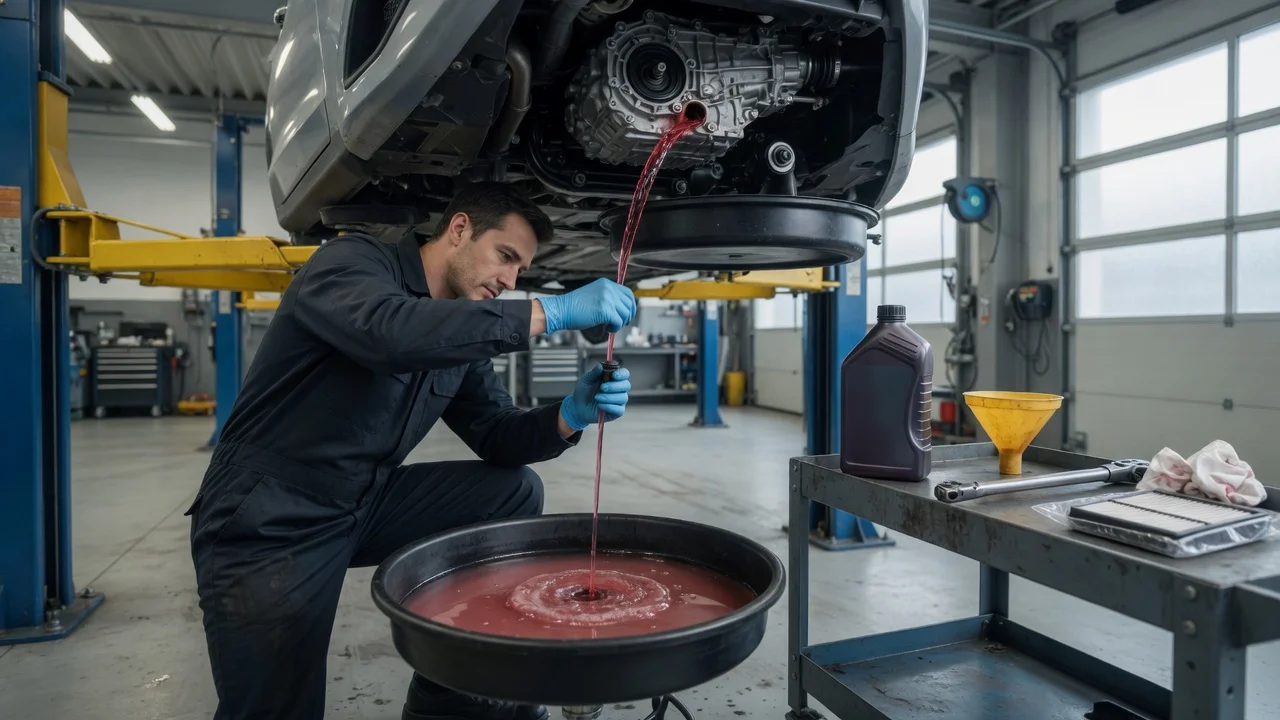
On many CVTs the pan is dropped or a drain plug is opened, the old fluid is measured, a filter or strainer is replaced if the design has a serviceable one, the pan gasket or drain washer is renewed, and new fluid is added to the specified level at the specified temperature. Level is often set with the engine running, in Park or Neutral, using a dipstick, overflow tube, or scan-tool temperature reading. Overfill and underfill both cause problems: aeration, foaming, poor pulley clamp force, or overheating. Some designs have no owner-service dipstick; those units should be filled by a shop that has the procedure and tools for that transmission.
A machine “flush” that forces solvent or unmatched fluid through the cooler is not the same as a factory drain-and-fill or a specified fluid exchange. Follow the maker’s method. If a cooler replacement or valve-body work is also being done, the refill procedure changes and the shop should document the fluid type and the quantity actually installed.
Symptoms that warrant inspection
Delayed engagement, a rubber-band sensation that has become worse, shudder on light acceleration, whine that tracks vehicle speed, overheating warnings, or dark, burnt-smelling fluid are reasons to inspect the CVT and its fluid before the next scheduled service. Those symptoms have more than one cause, including software, a failing pulley or belt, a cooler restriction, or low level from a leak. Fluid condition alone does not diagnose the unit. A leak at the pan, axle seals, or cooler lines should be repaired before a refill, or the new fluid will be lost.
Cost, DIY limits, and a practical next step
Price varies with fluid cost, whether a filter and gasket are included, local labor rates, and whether the job is a simple drain-and-fill or a temperature-controlled fill with a scan tool. Dedicated CVT fluid is typically more expensive per litre than conventional ATF. DIY is realistic only when the vehicle has a documented drain-and-fill procedure, a way to set level, and the correct fluid on the shelf. Sealed units, overflow-tube fills, and transmissions under warranty or extended coverage are better left to a shop that can record the service.
The supported next action is to look up the maintenance schedule and fluid specification for the exact year, model, engine, and transmission code, then book a drain-and-fill or specified exchange with that fluid. If the schedule is silent or contradictory (for example a “lifetime” claim next to a severe-service interval), ask the dealer or a transmission specialist to cite the current factory document for that VIN rather than substituting a generic CVT product or an ATF meant for a stepped automatic.
What this article cannot specify
No single mileage, litre quantity, or fluid part number is documented here for every CVT. Those figures are model-year and market specific and must come from the vehicle’s factory information. Comparative shop testing, long-term durability results, and brand-by-brand rankings are not included. If the transmission already slips, bangs, or has metal in the pan, a fluid change may not restore function; diagnosis of the unit itself is a separate step.