Car Towing Capacity: Ratings, Weight Limits, and Chart Basics
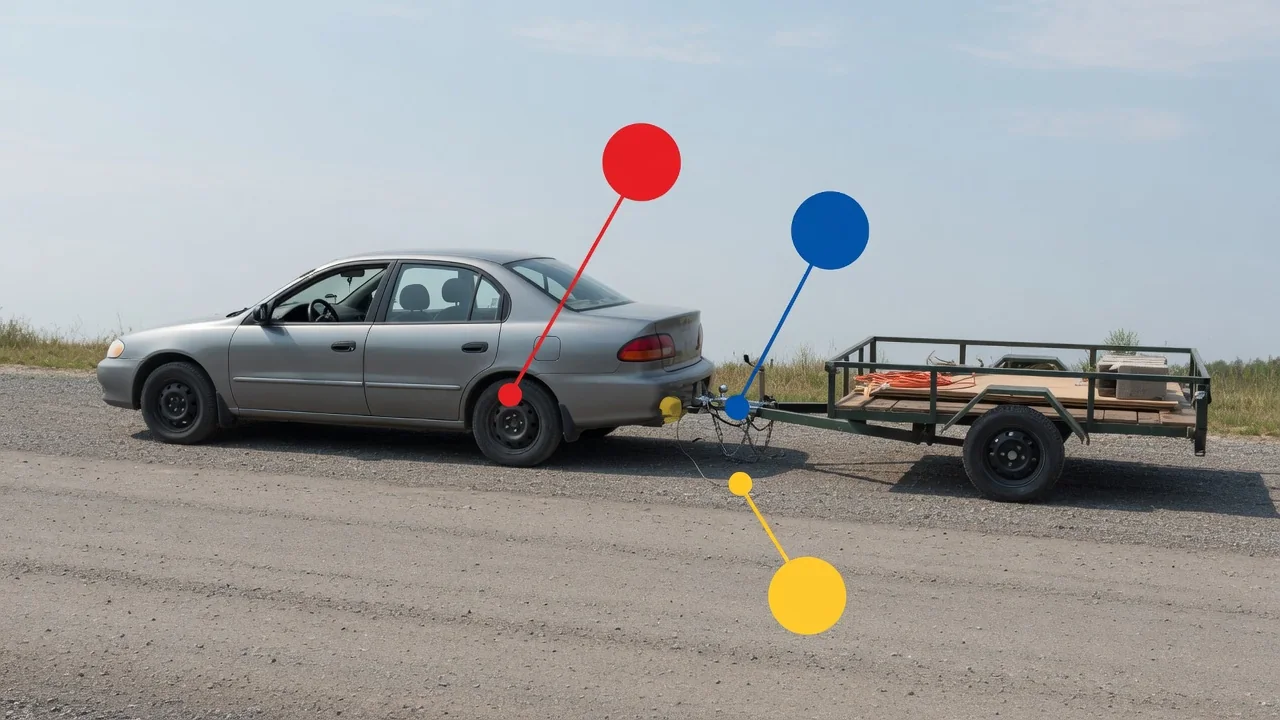
Car towing capacity is the manufacturer’s permitted trailer weight for a given passenger car under specified conditions. Buyers comparing towing capacity by car, looking for a car with towing capacity, or reading a car trailer towing capacity chart still need the same ratings: trailer weight, hitch limits, and combined-weight rules. Small cars and high-capacity cars follow the same logic, even though their numbers differ.
What a Car’s Towing Capacity Actually Allows
The towing capacity of a car is the manufacturer’s permitted loaded trailer weight when the vehicle is equipped as the approval requires. Loaded trailer weight includes the trailer’s structure, cargo, fluids, spare parts, and accessories, not an empty-weight sticker alone. A car with towing capacity still has that limit only under the stated hitch, cooling, and brake conditions. If required equipment is missing, the published figure does not apply. Treat the rating as a ceiling for an approved trailer, not a target to fill.
A published maximum does not prove that a particular passenger load, hitch rating, and trailer combination is permitted. Occupants, luggage, and tongue weight still consume payload, and the hitch itself may be rated below the car. Towing car capacity concerns pulling an approved trailer behind the vehicle. It does not describe how the car itself may be transported on a flatbed, dolly, or another trailer. Those methods follow separate manufacturer rules for towing the vehicle, not the trailer-weight rating on the car.
Find the Towing Approval for Your Exact Car
Towing capacity by car is not a generic class figure. Locate the approval in the owner’s manual and other manufacturer documents for that model year, market, and exact configuration. Powertrain, drivetrain, cooling package, and required towing equipment can change whether towing is allowed and at what trailer weight. A car with high towing capacity in one market or trim may carry a lower limit, or none, in another. Match the VIN-level equipment list to the document, rather than assuming a similar-looking car shares the same rating.
An aftermarket hitch that bolts on does not establish manufacturer approval or raise the car’s towing rating. Hitch hardware can exist on vehicles the maker never certified for a trailer. When documentation omits a rating or prohibits towing, treat that as no approval and request manufacturer clarification. Do not infer towing car capacity from horsepower, torque, or engine size. Those figures describe propulsion, not cooling, structure, axle ratings, or stability under a loaded trailer. Without a written approval for that configuration, there is no permitted trailer weight to use.
Check GVWR, GCWR, Payload, and Tongue Weight Together
Gross vehicle weight rating is the permitted loaded weight of the car itself. Gross combined weight rating is the permitted total of the loaded car and loaded trailer. Gross axle weight rating limits each axle independently. Payload is the remaining vehicle-side capacity after the car’s curb weight; passengers, luggage, added equipment, and trailer tongue weight all consume it. Tongue weight is the downward force the trailer hitch connection applies to the car. If any of those ratings is exceeded, the combination is not within the manufacturer’s limits even if trailer weight looks acceptable.
Remaining room under GCWR is one constraint, not a standalone towing authorization. Trailer, vehicle, axle, hitch rating, and tongue-weight limits must all be satisfied at once. Use scale measurements of the loaded car, each axle, and the loaded trailer rather than brochure estimates. When determining combined weight, do not add tongue weight a second time after it is already part of the car’s scale weight; the trailer’s scale weight already includes that same downward load until the hitch is connected. Appropriately measured loaded weights keep the arithmetic consistent.
Why Small Cars Can Have Restrictive Towing Limits
Small car towing capacity is often restrictive because cooling, drivetrain durability, braking, body structure, and high-speed stability all have to survive trailer load. A small car with towing capacity may still have little thermal margin on grades and limited brake fade resistance. Hitch attachment points and rear structure may be designed for light duty only. Vehicle stability suffers when a compact wheelbase and modest mass try to control a trailer that yaws or pitches. Those engineering limits, not cabin size, explain why many compact cars carry low ratings or none.
Small car towing big trailer combinations raise extra risk even when the trailer looks light on paper. Large frontal area increases wind exposure, side-gust leverage, and cooling demand. Remaining payload can disappear once occupants and tongue weight are aboard. Physical trailer size and an empty-weight label cannot establish suitability; loaded trailer weight and manufacturer restrictions both matter. Trailer brakes or suspension accessories can help a permitted combination behave, but they do not independently authorize towing or raise the vehicle’s published limits. If the car is not approved for that load, extra hardware does not create approval.
What a High Towing Rating Requires From a Passenger Car
Searches for the highest towing capacity car, or a car with the highest towing capacity, need a defined model year, market, vehicle category, and configuration before any comparison is defensible. Passenger-car ratings change with cooling packages, axle ratios, and required towing equipment, so a universal maximum is not a useful claim. A car with high towing capacity in one year can be unrated the next. Rankings without those filters mix unlike vehicles. Stay with passenger-car approvals rather than importing truck figures or treating engine output as a proxy for trailer weight.
A high passenger-car towing rating usually depends on thermal management that can reject extra heat from the engine, transmission, and sometimes the differential; structural attachment provisions that carry hitch loads into the body or subframe; and a powertrain calibrated for sustained trailer work. Truck towing figures cannot be transferred to a passenger car even when engine output looks similar. Trucks typically use different frames, cooling, axle ratings, brake systems, and stability calibration. Those differences are why a car’s approval stands on its own documentation, not on a comparable displacement or advertised horsepower from another body style.
Read a Towing Capacity Chart Before Choosing a Trailer
A car towing capacity chart is useful only when the row matches the exact model year, configuration, market, and required equipment. Adjacent rows can differ by drivetrain or cooling package even if the cars look alike. Read footnotes covering trailer brakes, tongue weight, loading assumptions, and any trailer-area restrictions before treating the number as usable. Car trailer towing capacity on a chart is a conditioned maximum, not a menu of trailer sizes. If the footnote requires electric trailer brakes or a weight-distributing hitch, that equipment is part of the approval, not an optional upgrade.
Before choosing a trailer, confirm the chart figure together with GVWR, GCWR, payload, axle limits, and hitch limits so no single number is treated as sufficient. Weigh the loaded car and trailer when estimates are uncertain. Missing documentation, unknown loaded weights, or a hitch of questionable condition calls for manufacturer clarification, scale measurements, or qualified inspection before towing. Do not fill a gap by copying another car’s row or by assuming trailer brakes create extra capacity. The combination is ready only when every applicable limit is identified and the measured loads sit inside those limits.