Car AC Compressor: How It Works, Failure Symptoms and Repair Options
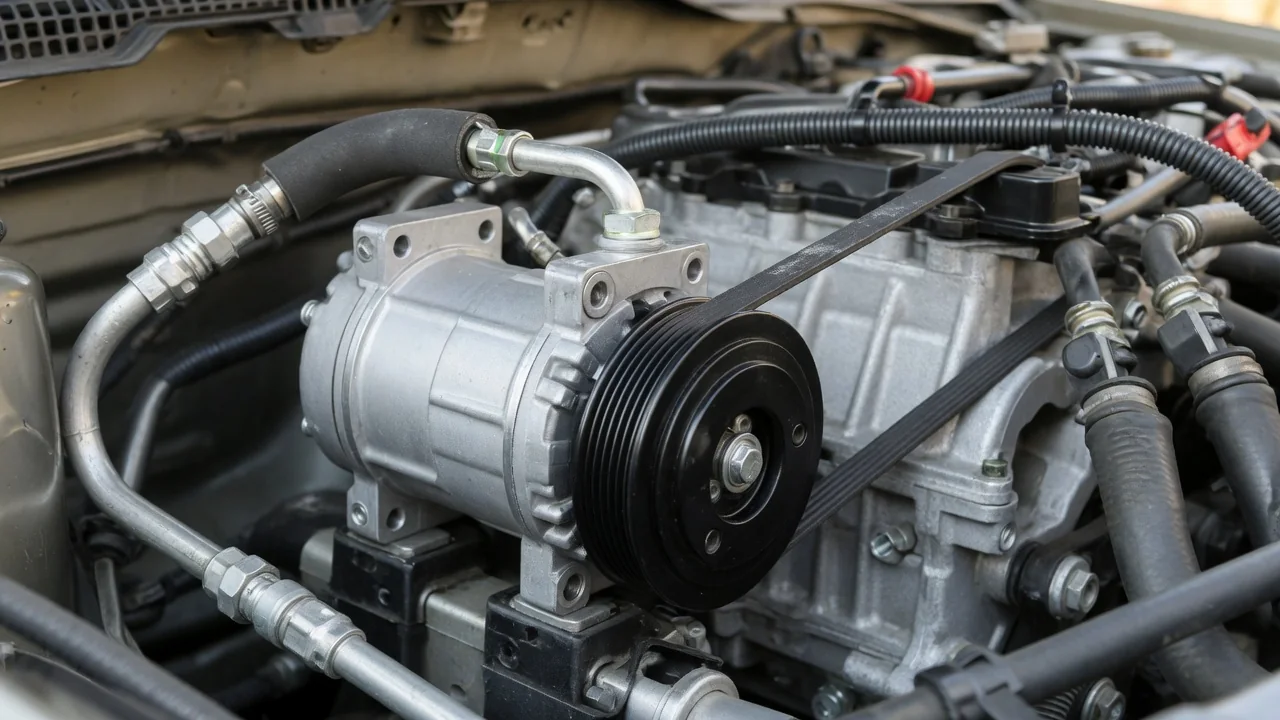
The AC compressor in a car is the pump that makes cabin cooling possible. When it fails, owners usually notice warm air, odd noises, or a clutch that will not engage. A car AC compressor repair may restore cooling, but some faults require replacement. Knowing how the compressor and clutch work, and which faults a shop can repair, keeps the next step realistic.
What the AC compressor does inside the refrigerant loop
The compressor for car AC is a belt-driven pump bolted to the engine, usually at the front of the block or on a bracket beside other accessories. A serpentine belt spins its pulley whenever the engine runs. That pump raises refrigerant pressure and moves the charge through the condenser, an expansion valve or orifice tube, and the evaporator that cools cabin air. Layouts vary, but the compressor on a car always occupies that high-pressure role.
People searching for an AC air compressor for car are often mixing two machines. A tire air compressor fills tires; the AC compressor in a car only moves refrigerant in a sealed system. Three families of car AC compressors are common: a fixed-displacement unit with a clutch, a variable displacement compressor with an electronic control valve, and an electric compressor on many hybrids and EVs. All need the correct refrigerant charge and circulating compressor oil, or the internals score quickly.
The compressor clutch and what tells it to engage
On a clutch-type AC compressor, the pulley freewheels on a bearing until the clutch coil is energized. Current through that coil pulls the drive plate against the spinning pulley and locks the compressor shaft to the belt. The control module or a relay typically checks the cabin AC request, a refrigerant pressure switch or sensor, evaporator temperature, and engine load. If pressure is out of range or the evaporator is near freeze, the clutch stays off.
The clutch air gap is the small space between the drive plate and the pulley face. As those surfaces wear, the gap can grow until magnetic pull is no longer enough, especially after heat soaks the coil. Intermittent engagement on a hot restart is a common result. Clutchless variable-displacement compressors spin with the belt and modulate output with a control valve, so clutch-not-engaging logic does not apply.
Warning signs: noise, warm air and a clutch that will not engage
Warm or mildly cool air is the complaint that starts a search to fix car AC compressor problems. Cooling may cut in and out, or fade at idle and in traffic when condenser airflow drops. Grinding or rumbling with the AC on often points at internal wear. A squeal when the clutch engages can be a slipping plate or a glazed serpentine belt. Rattle from the front often means a loose clutch plate; rumble with AC off is more likely a failing pulley bearing.
If the clutch plate stays still while AC is requested, the clutch is not driving the pump. Oily residue on the body or fittings often marks a refrigerant leak that carries oil out. Neither sign proves compressor failure; low refrigerant, a failed pressure switch, a blown fuse or relay, or a blend door on heat can mimic them. Switch the AC off at a sudden belt squeal or burning smell, before a seized compressor stalls the belt.
Safe observations before booking a diagnosis
Before booking a diagnosis to repair a car AC compressor, watch the front of the unit with the engine running and hands clear of belts. Note whether the clutch plate cycles, how quickly it cycles, and whether vent temperature changes when the plate locks. Rapid on-off cycling often points to a pressure-related condition such as a low charge. No engagement at all more often means an electrical, control, or pressure lockout, though a weak coil can look the same.
Confirm cabin controls are actually requesting AC, not just fan and temperature, and listen for the condenser fans when the system is commanded on, without opening the refrigerant circuit. Fans that never start can leave high-side pressure elevated and keep the compressor locked out. Refrigerant is under pressure and regulated; gauge readings, leak detection, and refrigerant recovery belong at a shop with recovery equipment. Stored climate-control codes are evidence to interpret, not proof a part failed; manufacturer-dependent codes need that vehicle's definition before anyone acts on them.
Faults that can be repaired without replacing the compressor
Car AC compressor clutch repair usually means servicing the clutch, not the pump. On many clutch-type units the pulley, clutch coil, and pulley bearing can be replaced as a kit or separately while the compressor body stays on the engine. Typical work includes measuring and shimming the air gap, replacing a burned coil, swapping a noisy pulley bearing, or installing a complete clutch kit. That repair only makes sense when the compressor still pumps and the system holds refrigerant.
Fixing a car AC compressor often starts upstream of the pump. A failed relay, blown fuse, corroded connector, or wiring break can leave the clutch coil dark. A failed refrigerant pressure switch or sensor can lock the compressor out even when the pump is healthy. A leak at a hose, condenser, evaporator, or expansion device can drop the charge until the system refuses to engage. On a variable displacement compressor, a control valve is viable only if the internals still pump; that call is a shop-level judgment.
When replacement is the only realistic fix and what a proper job involves
Some failures cannot be repaired in place. Internal seizure, scored pistons or a damaged scroll, a body leak at a shaft seal that is not serviceable, and metal debris in the loop all point to replacing the AC compressor for a car rather than rebuilding it on the engine. Metal from a failed pump travels into the condenser, lines, and expansion valve or orifice tube, so shops typically flush the lines, replace the receiver drier or accumulator, and often replace the condenser or expansion device.
A complete replacement follows a controlled sequence. The shop recovers remaining refrigerant, installs a new or remanufactured compressor, adds the correct compressor oil type and quantity, then performs a vacuum leak check before charging to the specification on the vehicle's underhood label. New and remanufactured units can both work when they match the vehicle's refrigerant type and oil. Skipping the drier or the system flush is a common reason a replacement fails again, and many warranties require that full scope.
Reducing repeat failures and questions to ask the shop
Running the AC periodically through the year keeps compressor oil moving across seals and bearings instead of pooling in the evaporator. Keep the condenser clear of leaves and road debris so high-side pressure does not stay elevated. Address weak cooling early; a slow refrigerant leak can starve the pump of oil long before the cabin feels fully warm. Those habits will not salvage a seized unit, but they reduce the chance a car AC compressor fix fails again after a short season.
Before authorizing work to fix an AC compressor car complaint, ask what test confirmed the compressor as the fault, whether a leak was found, whether the drier and flush are included, and what the parts warranty requires. Read the written estimate for scope rather than the bottom line. Refrigerant recovery, evacuation, oil, dye, and a post-repair performance check should each appear as line items. Vent temperature after repair depends on ambient conditions and system design, not only on the new compressor.