How a Car AC System Works: Components, Diagram, and What Each Part Does
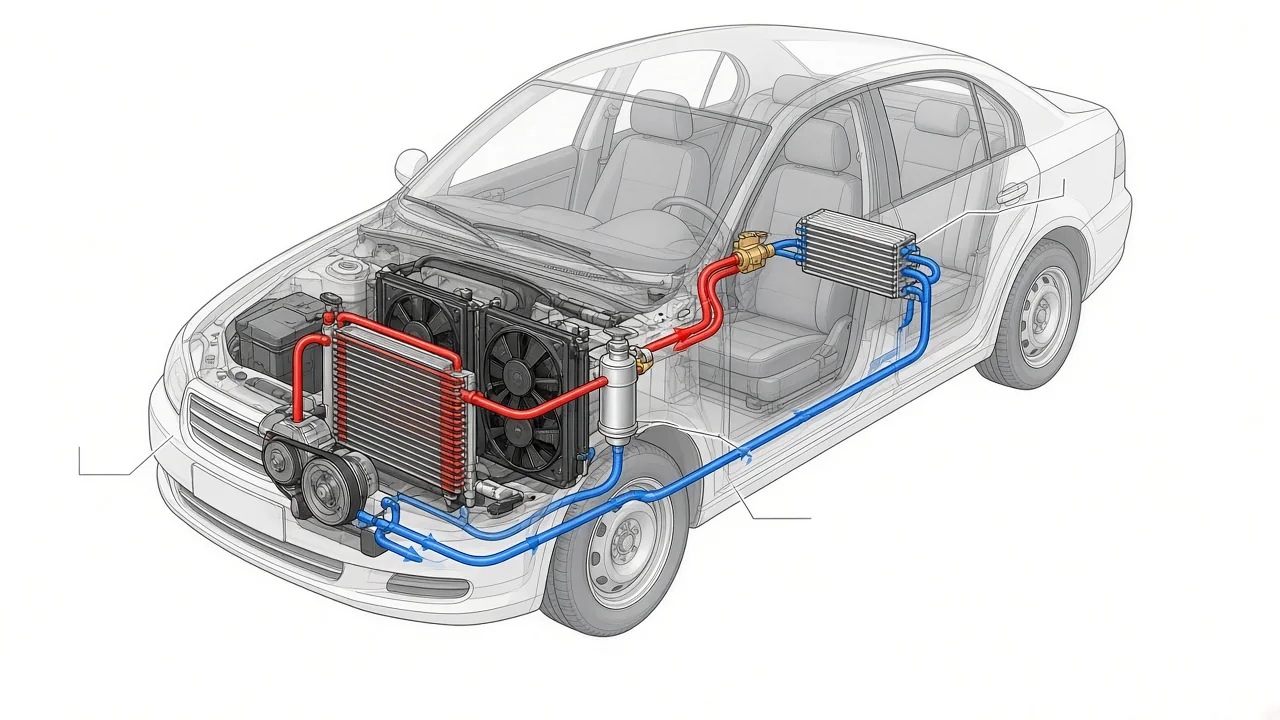
Every time you press the AC button, a sealed loop under the hood and behind the dash starts pulling heat out of the cabin. Knowing how that loop works helps you make sense of symptoms and talk clearly with a technician. This guide starts with the big picture and then maps the refrigerant path. Next it follows one cooling cycle, and finally it covers each part in the order the refrigerant reaches it.
What the AC in a Car Actually Does: Moving Heat, Not Making Cold
A car's air conditioner doesn't create cold. It is a closed refrigeration loop that picks up heat from the air passing through the dashboard and carries it to the front of the vehicle, where it is released outside. The loop has two halves. The high-pressure side, mostly under the hood, holds hot refrigerant that is giving off heat. The low-pressure side, centered on a part inside the dash, holds cold refrigerant that is absorbing heat from cabin air. The rest of the parts exist to keep those two halves separate and working.
In normal operation the refrigerant is never used up. It just circulates, so a system that keeps needing a recharge has a leak somewhere. The loop also dries the air, because moisture condenses on the cold side before the air reaches the vents. That's why running the AC clears a fogged windshield so quickly. Most passenger cars share this basic layout, but hybrids and EVs often use an electric compressor instead of one turned by the engine belt. The sections below follow the loop in the order the refrigerant meets each part.
Car AC System Diagram: The Refrigerant Loop at a Glance
Picture the system as a circle. Starting at the compressor, a discharge line runs to the condenser at the front of the car. From there, liquid refrigerant passes through a receiver drier (on cars that have one) and on to the expansion valve or orifice tube. Past that restriction sits the evaporator in the dash. A suction line then returns gas to the compressor, passing through an accumulator on orifice-tube designs. Service diagrams commonly shade the run from the compressor to the metering device as the high side and the return run as the low side.
The refrigerant changes state twice per lap: it turns from gas to liquid in the condenser and from liquid back to gas in the evaporator. There is a service port on each side of the loop, and the low-side and high-side fittings are deliberately different sizes so equipment can't be connected to the wrong one. Airflow follows its own separate path. Outside air crosses the condenser, while the blower pushes cabin or fresh air across the evaporator. Component placement varies widely by vehicle, so treat this as a map of how the system works, not a picture of any particular engine bay.
How the AC Cycle Cools the Cabin, Step by Step
One lap begins at the compressor, which squeezes low-pressure refrigerant gas into a hot, high-pressure gas. Compression matters because it raises the refrigerant's temperature above the outside air, and that's the only way heat can flow out of it. In the condenser, air moving across the fins carries that heat away, and the refrigerant condenses into a warm liquid. The liquid then reaches the expansion device, where a narrow passage causes a sharp drop in pressure and temperature before the refrigerant enters the evaporator.
At low pressure, the refrigerant boils at a temperature well below that of the cabin air. As the blower pushes warm air across the evaporator, heat moves into the refrigerant and turns it back into gas. Water vapor in that air condenses on the cold fins and drains out through a tube under the car. That's the puddle you see beneath a parked car on a humid day. Output is regulated in one of two ways. Clutch-type compressors cycle on and off, while variable-displacement compressors adjust their pumping continuously without disengaging.
High-Side Parts: Compressor, Condenser, and Receiver Drier
The compressor is the pump that keeps refrigerant moving. On conventional cars, the accessory belt turns it through an electromagnetic clutch that engages when you ask for cooling. Many hybrids and EVs instead use an electric compressor that runs independently of engine speed. Refrigerant oil travels with the refrigerant to lubricate the compressor, so a large leak can starve it of oil as well as refrigerant. Next comes the condenser, which sits in front of the radiator. It relies on the cooling fans to move air across it when the car is stopped in traffic.
Expansion-valve systems use a receiver drier on the high side. It stores liquid refrigerant, filters out debris, and holds a desiccant that traps moisture before it can cause corrosion or icing. Orifice-tube systems use an accumulator on the low side instead, so a car normally has one or the other, not both. What you can safely check yourself is limited. From a safe distance, away from belts and fans, you can see whether the compressor clutch engages. You can also look for debris on the condenser and confirm the fans run with the AC on. Pressures and internal condition need gauges and professional testing.
Low-Side Parts: Expansion Valve, Evaporator, Lines, and Seals
The metering device separates the high and low sides. A thermostatic expansion valve senses conditions at the evaporator outlet and opens or closes to adjust flow as the cooling load changes. An orifice tube is a fixed restriction with no moving parts to adjust flow. Just past it, the evaporator core works like a small radiator buried inside the heating and cooling housing behind the dash. Because the dashboard and ductwork usually surround it, the evaporator tends to be the hardest part of the system to reach.
Rigid aluminum lines and flexible hose connect the loop. The flexible barrier hose near the engine absorbs movement and vibration. Every joint depends on O-ring seals, and aging or disturbed seals are a common source of slow leaks. On the air side, the cabin air filter keeps dust and debris off the evaporator fins. When the filter clogs, airflow drops even if the refrigerant loop is healthy. Weak cooling can therefore come from airflow, the refrigerant charge, the metering device, or the controls, so a symptom by itself rarely points to one failed part.
Controls and Sensors: What Tells the System When to Run
Several sensors decide when the compressor can run. Pressure switches or transducers shut it off when the charge is too low to protect it or when pressure climbs too high, for example when air isn't moving across the condenser. An evaporator temperature sensor or thermostat keeps the core from freezing, since ice on the fins blocks airflow. On the air side, the blower motor sets how much air flows. The blend door mixes cooled and heated air, and the mode doors send it to the dash vents, the floor, or the windshield.
Automatic climate control adds cabin, outside-air, and sun sensors. With their input, the climate control module adjusts blower speed, door positions, and compressor demand to hold the temperature you set. The module can store diagnostic codes, but AC-related codes and their meanings vary by manufacturer and should be confirmed for your specific vehicle. A code points to something worth investigating. It doesn't prove a part has failed. Handling refrigerant requires recovery equipment and certification, and reading pressures or checking for leaks is a job for a qualified technician, not an at-home project.