Automatic Transmission Fluid Change: When and How to Replace the Fluid
The essential answer
Automatic transmission fluid (ATF) is the oil that lubricates an automatic gearbox, carries heat out of it, and supplies the hydraulic pressure that applies clutches so the unit can shift. Replace it on the interval in the owner’s manual or factory maintenance schedule for that model year, market, and transmission, and sooner if the fluid is burnt, dirty, or the gearbox is slipping or shifting harshly. The correct fluid specification, refill quantity, filter, bolt torque, and level-check method are vehicle-specific; those figures have to come from the manufacturer’s service information for the exact vehicle. Using the wrong fluid, the dry-fill capacity after a pan-only drain, or a pressure flush the factory does not allow can damage the transmission.
What the fluid does, and what “lifetime fill” means
In a conventional automatic, ATF is pumped through the valve body and torque converter. It both lubricates and acts as the hydraulic medium. Continuously variable transmissions (CVTs) and dual-clutch transmissions (DCTs) use different fluids with different friction and viscosity requirements; those fluids are a separate family from ATF and are not substitutes for it.
Some schedules list a mileage or time interval. Others describe the fill as “lifetime,” which is the manufacturer’s stated service policy for that unit, not a claim that the fluid never oxidizes or picks up wear debris. Severe use the manufacturer names in the schedule—towing, taxi or livery work, mountain driving, or high ambient temperature—often shortens the interval when a shorter interval is published. The published schedule for the vehicle in hand is the governing figure; a generic mileage that applies to every automatic is not established here.
Signs the fluid needs inspection or service
Bring the service forward, or have the transmission inspected, when any of the following are present.
Fluid that is dark brown or black, or that smells burnt. Metal flakes, chips, or heavy clutch material in the pan or on the magnet. Harsh, delayed, or slipping shifts, or a long pause before drive or reverse engages. A leak that has lowered the level. A transmission warning lamp or stored transmission fault codes.
Many late-model automatics have no dipstick. Level is set at a stated fluid temperature through a fill or overflow plug, often with a scan tool reading transmission temperature. If that procedure is not in the factory information you have, the level check is qualified-service work.
Fluid specification and how much to pour
Confirm the required specification from the owner’s manual, a marking on the dipstick or case, or factory service information for that vehicle. Dexron, Mercon, Chrysler ATF+4, and the various “genuine” labelled fluids are examples of specification families; they are compatible only when the manufacturer lists an equivalent that meets the same spec. CVT fluid and DCT / dual-clutch fluid stay with those gearboxes.
A pan drain leaves fluid in the torque converter, cooler, and valve body. The quantity to add after a pan service is the pan-refill amount in the service information, which is lower than the dry-fill capacity used only after a rebuild. Exact litres or quarts are model-specific and are not given here; overfill aerates the fluid and can push seals, and underfill causes slip and overheating.
Drain-and-fill compared with a machine flush
A pan drain-and-fill, usually with a new filter and gasket, is the method most factory procedures describe. It replaces the fluid that leaves the pan. Repeating a drain-and-fill after a short drive exchanges more of the total fill; do that only when the manufacturer’s procedure supports it.
A flush or fluid-exchange machine displaces a larger share of the old fluid through the cooler lines or pan. Some factory procedures allow an exchange; others warn against pressure-flushing a given unit, especially when the fluid is already heavily contaminated, because debris can be driven into valves. Use a flush only when the factory procedure for that transmission allows it.
What you need, and when the job belongs in a shop
Gather the factory procedure first, then the parts and tools it names.
Service information for the exact vehicle: fluid spec, pan-refill quantity if published, pan-bolt torque and pattern, filter part number, drain-plug torque, and the level-check method including any required temperature band. The specified ATF only, in a quantity that covers the pan refill plus the level check. New filter and seal if the design uses a serviceable filter; new pan gasket or the specified sealant; new crush washer or drain-plug seal if a plug is fitted. Drain container, funnel, lint-free cleaning method, torque wrench, gloves, and eye protection. A level, ventilated workspace and, if the pan is reached from below, a lift or jack stands rated for the vehicle’s weight. A plan to dispose of used ATF under local hazardous-waste rules. The applicable rule set depends on the jurisdiction and is not stated here.
Stop and use a qualified transmission technician when there is no published owner-service procedure; the unit is sealed and the fill is temperature-and-overflow based and you cannot measure that temperature; the pan or filter is not a service part; cooler lines or the case are leaking; or the gearbox is already in fail-safe, slipping, or storing fault codes. A lift, a scan tool, and factory fill adapters are often required on those units.
How to complete a pan drain-and-fill
The sequence below is a typical pan service. Bolt patterns, filter design, sealant rules, and fill method vary by transmission. At every torque, temperature, and quantity, use the factory figure for that vehicle. Do not copy settings from another model.
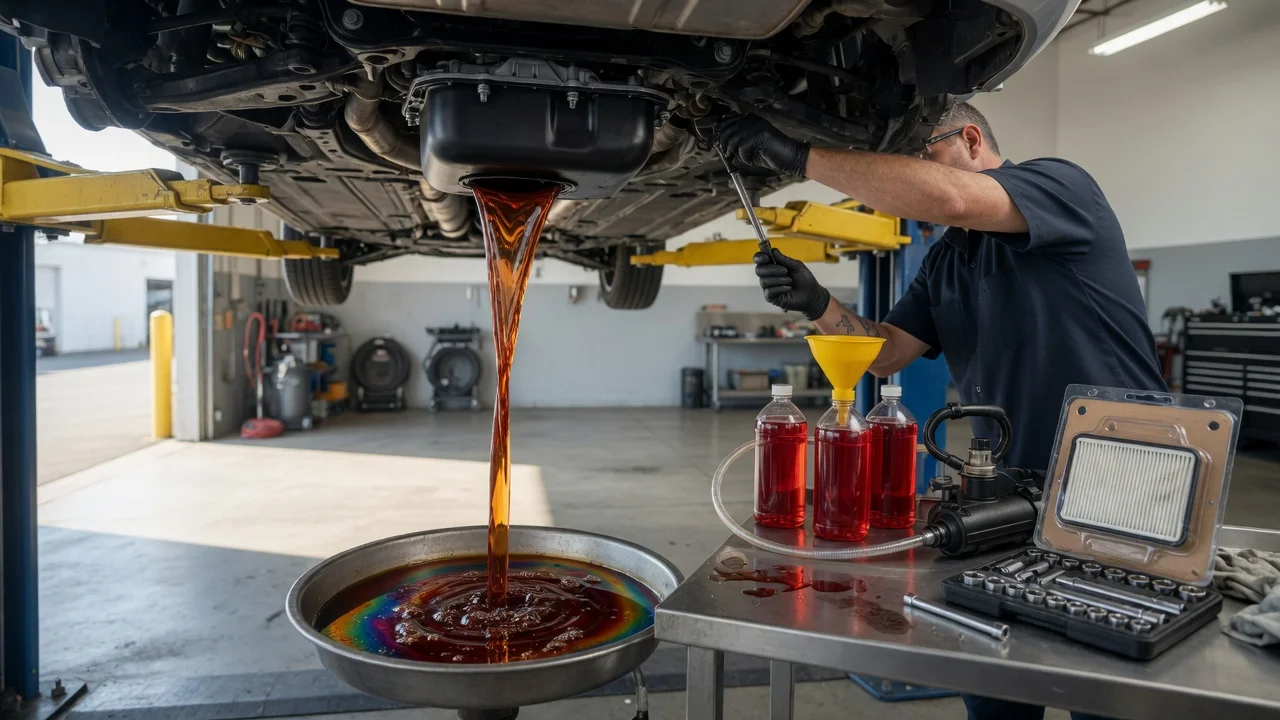
Identify the transmission and open the factory procedure. Confirm fluid spec, whether the pan has a drain plug, whether the filter is serviceable, and whether level is set on a dipstick or at an overflow at a stated temperature. If that information is missing, this is qualified-service work. Park on level ground, set the parking brake, and chock the wheels. Drain only as warm as the procedure requires. With the engine off, hot ATF still causes burns; wear gloves and eye protection and keep skin out of the drain path. If the pan is accessed from below, raise the vehicle and support it on a lift or stands rated for the vehicle weight. Do not work under a vehicle held only by a jack. Place a drain container under the pan. Remove the drain plug if fitted and let the pan empty. If there is no plug, loosen pan bolts evenly, leave several bolts at one end engaged, and ease the pan down so fluid pours from the opposite corner. Keep ATF off belts, the exhaust, and electrical connectors. Remove the pan. Inspect the magnet and the drained fluid. Fine grey paste on the magnet is ordinary wear. Chunks of metal, large flakes, or burnt clutch lining are a stop condition: do not treat the job as a routine fill-and-drive service; the transmission needs diagnosis. Replace the filter and its seal if the unit uses a serviceable filter. Clean the pan and magnet with a lint-free method. Fit a new gasket, or apply the specified sealant in the specified bead. Use both together only when the manufacturer says to. Install the pan and torque the bolts in the published pattern and to the published value. Overtightening warps the pan and causes leaks. Reinstall the drain plug with a new seal if specified, and torque it to spec. Lower the vehicle so it sits level. Add the specified fluid through the dipstick tube or fill plug, starting with the pan-refill quantity in the service information. Never start the engine with the pan off or with a grossly low level. With the vehicle held, start the engine and move the selector slowly through each range, pausing in each, then return to the range the procedure names for the level check. Inspect the pan and plug for leaks. If the pump noisily cavitated on start-up, shut down and correct the fill before further running. Set the level by the factory method only. Dipstick units are typically checked warm, engine running, in park or neutral as specified, on level ground. Sealed units are typically filled until the overflow behaves as described inside a stated temperature band; do not guess that temperature. Drain to correct overfill; add only the specified fluid to correct underfill. Take a short test drive at light to moderate load, then recheck the level and inspect for leaks. Confirm engagement into drive and reverse, upshifts and downshifts, and that no transmission warning is displayed.
Completion check
The service is complete when all of the following are true.
Pan bolts and the drain plug are dry and torqued to the published values. The fluid in the unit matches the required specification. Level is correct by the factory check, including temperature where the procedure requires it. The transmission engages, shifts, and holds without slip, flare, or harsh engagement, and no warning lamp is on. Used ATF is contained for disposal under local rules.
What a fluid change will not repair
Fresh fluid does not restore worn clutches, a weak pump, a damaged torque converter, or a valve body already sticking from debris. If the transmission slipped before the change and still slips after, the service did not repair the fault; further diagnosis is required. Heavy contamination or metal in the pan is a diagnostic job, and a simple fluid swap is the wrong next step in that condition.