Are TPMS Sensors Universal? Frequency, Fitment, and Programming
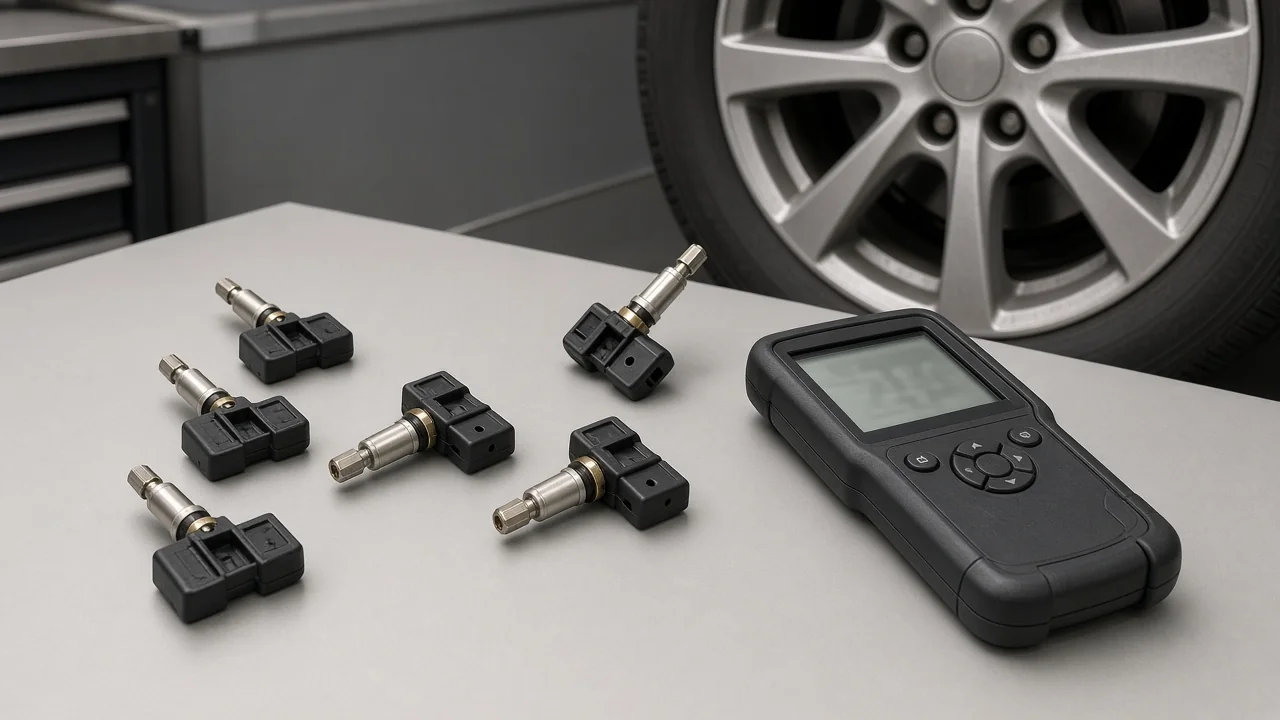
Are TPMS sensors universal? Direct TPMS sensors are not universally interchangeable. Universal TPMS sensors support a defined set of vehicle applications rather than every car and light truck. Sensor compatibility depends on radio frequency, communication protocol, sensor ID handling, valve stem fitment, and documented application coverage. Programmable sensors and an OE TPMS sensor can both work when they match those requirements, including any needed programming and vehicle relearn.
What Universal TPMS Sensor Coverage Actually Means
A universal sensor is not interchangeable with every vehicle; it supports only a defined set of applications. Coverage is a published application list, not a promise that any transmitter will talk to any module. Direct TPMS uses a pressure transmitter at each wheel, so the replacement must match radio frequency, communication protocol, sensor configuration, and physical fitment. Indirect TPMS estimates pressure from wheel-speed data and does not use individual wheel pressure transmitters.
Application coverage, not the marketing word universal, decides whether a TPMS universal sensor will work on a given vehicle. A programmable sensor may store more than one protocol or identity, but it still needs configuration for the target application before mounting. Without that setup, the control module may never recognize the sensor ID. Valve stem fitment and mounting style also have to match the wheel, even when the electronics are otherwise suitable for that protocol.
Confirming an OE or OEM TPMS Sensor Application
Listings for an OE TPMS sensor, OE TPMS sensors, an OEM TPMS sensor, or OEM TPMS sensors typically mean the part is sold as original-equipment style or as an original-equipment manufacturer replacement. The label itself does not prove sensor compatibility. Two vehicles that look similar can use different frequencies, protocols, or valve designs. Confirm the exact vehicle application and the correct part number, including any documented superseding or replacement part number, before buying or installing.
When catalogs disagree, the VIN, production date, and original sales market can separate otherwise identical-looking applications. A sensor built for one market may not communicate with a module from another, even if the wheel hardware looks the same. After the correct application-specific sensor is installed, the vehicle may still need to learn the new sensor ID. Matching the original part does not skip that recognition step when the control module expects registered identities.
Checking Aftermarket Sensor Coverage and Support
Aftermarket TPMS sensors are not one product type. Some aftermarket sensors are application-specific, some arrive preconfigured, and others are programmable. After market TPMS listings still need the same checks as a factory-style part. The exact product's setup requirements matter. Documented coverage must list the vehicle, and the installer needs a supported tool with applicable software. A programmable universal TPMS sensor that looks ready in the box can still fail to transmit usable data until it is configured.
When comparing options, use coverage documentation, installation requirements, warranty terms, and programming support rather than assuming one aftermarket line behaves like another. Replacement sensors for a factory TPMS must speak to the vehicle's own module. Standalone add-on monitoring systems are a separate application; they display pressure on their own receiver and do not substitute for factory sensor compatibility. If the tool or software cannot configure that product for the vehicle, documented coverage is incomplete for that shop.
Matching 315 MHz or 433 MHz and the Required Protocol
A 315 MHz TPMS sensor and a 433 MHz TPMS sensor are specified by radio frequency, not by a complete match. Listings may write 315mhz or 433mhz the same way, but the replacement still must support the vehicle's specified frequency. Matching frequency alone does not establish compatibility. The vehicle also requires the correct communication protocol, so a 315mhz TPMS unit that transmits on the right band can still be ignored if the message format is wrong.
Do not guess frequency from the sensor's appearance or from the vehicle's original sales region, because similar housings are used on both bands. Use vehicle-specific service information, verified application data, or professional sensor identification. A dual-band unit advertised for both 315 MHz and 433 MHz still needs confirmed vehicle coverage and any required configuration. Until the programmable sensor is set to the protocol the module expects, transmitting on either frequency will not make that sensor compatible with the application.
Understanding Sensor Programming and Vehicle Relearn
Programming a sensor and completing a vehicle relearn are different jobs. Programming writes the application and identity into a programmable sensor so it can speak the correct protocol. Relearn teaches the vehicle which sensor IDs belong at each wheel position. Sensor activation is another step: a suitable tool prompts the transmitter and reads a response. Activation does not necessarily program the sensor or finish the relearn. A live response only shows the unit can wake, not that the module has accepted it.
Some sensors and applications support ID cloning, copying a previously registered identity onto a new transmitter. Cloning can avoid a full relearn on vehicles that will accept the copied ID, but that is not true of every system. Verify whether a separate relearn is still required. Relearn methods vary by vehicle and may involve automatic learning during a drive cycle, a prescribed stationary procedure, or a diagnostic tool. There is no single sequence that applies to every direct TPMS.
Verifying Fitment and Resolving a Warning After Installation
Before installation, confirm wheel, valve stem, and mounting compatibility, including clamp-in or snap-in valve stem fitment. Tire removal and sensor installation belong with a qualified tire professional because the transmitter sits inside the wheel. After the tire is mounted, check cold tire pressure with a gauge against the vehicle placard instead of relying solely on the TPMS display. A warning lamp or a missing pressure reading cannot by itself prove the sensor is incompatible.
Treat a fault indication as evidence to interpret. Actual inflation, sensor response, configuration, and relearn status all need checking. A professional should verify transmission, recognized sensor IDs, stored system faults, and a successful relearn before treating the job as complete. Follow the owner's manual for how warnings behave, and seek prompt tire service for pressure loss or visible damage. A diagnostic code points to a condition the system reported; it does not by itself prove a part has failed.