Adjustable Trailer Hitch Ball Mounts: Fit, Ratings and Setup
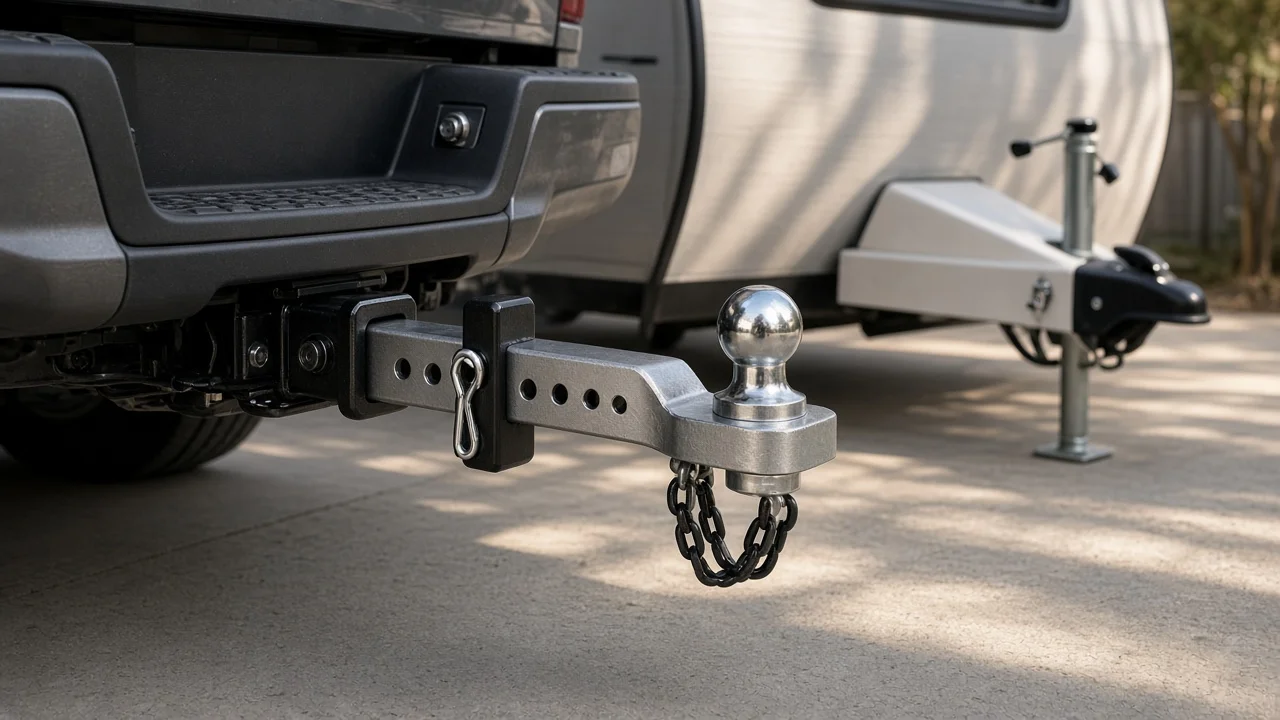
An adjustable trailer hitch ball mount lets you raise or lower the hitch ball so the trailer rides level behind your vehicle. It also lets one mount serve more than one trailer. It does not increase what your vehicle can tow. A safe setup depends on your exact vehicle configuration, the hitch and trailer ratings, and how much payload passengers, cargo and accessories have already used.
Is an adjustable ball mount the right choice?
An adjustable height ball mount is usually the practical answer if you tow more than one trailer, switch between tow vehicles, or tow with a lifted or lowered truck. You don't buy a fixed mount for every drop or rise. You move the ball platform along a vertical channel until the coupler sits level. If you tow one trailer with one vehicle and the height never changes, a single fixed mount is often simpler, lighter and quieter.
The main qualification is capacity. The working limit of the whole hitch is set by its lowest-rated part: the receiver, the ball mount, the hitch ball, the pin, the trailer coupler, or the vehicle's own towing figures. A mount rated above your vehicle's limit does not raise that limit. A heavy-duty vehicle also cannot exceed the rating stamped on a light mount.
How the height adjustment works
Most adjustable designs have a horizontal shank that slides into the receiver and a vertical shank or channel with a row of holes. You pin the ball platform, or a separate ball carrier, into the hole pair that gives the height you need. Pins and clips or a locking mechanism hold it in place. Some designs can be flipped so the same mount provides either drop or rise. Others use a sliding head held by a single locking pin.
Ball height matters because it controls how the load is shared. If the coupler sits too high, the trailer tilts nose-up and shifts weight toward its rear axle. That can reduce tongue weight and contribute to sway. If it sits too low, the tongue presses harder on the rear of the tow vehicle and lightens the front axle, which can affect steering and braking. A level trailer keeps the weight split close to what the trailer was designed for.
What changes the right setup
The tow vehicle's loaded stance changes the answer. Passengers, cargo, a bed cover, a toolbox or a camper shell all compress the rear suspension, and tongue weight compresses it further once the trailer is coupled. Set ball height with the vehicle loaded the way it will travel. A measurement taken with the vehicle empty can leave the trailer nose-down on the road.
Weight ratings set the limits for every adjustment. Tongue weight counts against payload. A heavy tongue load plus a full cab can exceed payload or the rear axle rating before the trailer reaches the vehicle's maximum tow rating. The gross vehicle weight rating covers the loaded vehicle, including tongue weight. The combined weight rating covers the vehicle and trailer together. For conventional ball-hitch trailers, a common guideline is a tongue weight of about 10 to 15 percent of the loaded trailer weight. Where the trailer or vehicle manufacturer gives different figures, follow theirs.
Hardware choices matter too. The shank must match the receiver. Common receiver sizes are 1-1/4, 2, 2-1/2 and 3 inch, with the larger sizes used on heavier-duty hitches. An aluminum trailer hitch ball mount is lighter to handle and resists rust. Steel mounts are common and often cost less. Compare the stamped ratings rather than assuming one material is stronger. A long drop or rise puts the ball farther from the receiver, so check whether the manufacturer rates every hole position, in both drop and rise orientation, at the same capacity. If your load calls for a weight distribution hitch, an ordinary adjustable ball mount is not a substitute.
Measuring and setting the ball height
Park the loaded vehicle and the trailer on level ground. Level the trailer with its jack, then measure from the ground to the bottom of the coupler. On the vehicle, measure from the ground to the top inside edge of the receiver opening. If the receiver is higher, the difference is the drop you need. If the coupler is higher, the difference is the rise you need. Choose a mount whose adjustment range covers that figure with some room for changes in load.
Pick a hitch ball whose shank diameter fits the mount's hole and whose ball size matches the coupler. The size markings on the coupler and the ball should agree. Tighten the ball nut to the torque the ball or mount manufacturer specifies. Set the ball platform in the hole pair closest to your measurement and install the pins and clips. Couple the trailer, lower it onto the ball, and check that it sits level or very slightly nose-down rather than nose-up, unless the trailer manufacturer specifies otherwise.
Checks before every trip
Adjustable mounts have more joints than fixed ones, so inspect them each time you hook up. Confirm every pin is fully seated with its clip or lock in place and the ball nut is tight. Look for cracks, elongated holes and bent sections. Many owners add an anti-rattle device or locking pin to reduce play in the receiver, which also reduces wear.
After the first few miles of a trip, stop and recheck the coupler, pins and safety chains. Watch the trailer's angle in the mirror and look again at each stop. If it now sits nose-up or nose-down because the load changed, readjust the ball height rather than continuing with an unlevel trailer. When you are not towing, take a removable mount out of the receiver to protect it and to avoid striking shins or other bumpers.
Limitations and when to get help
This guide covers general practice, not the limits of a specific vehicle. Exact towing capacity, payload, gross vehicle weight rating, combined weight rating and axle ratings depend on the engine, axle ratio, cab, bed, drivetrain and factory towing equipment. Read the owner's manual and the door-jamb labels for your configuration. To confirm actual weights, weigh the loaded vehicle and trailer at a public scale.
Get professional help if the receiver was installed aftermarket and its rating is unknown, if the trailer still sways after you correct the height, or if you are close to any rating. The same applies if the load may need weight distribution or sway control. A towing specialist can verify the hitch installation, measure tongue weight and set up the complete system for the trailer you actually tow.