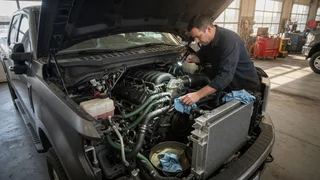
6.7 Powerstroke losing coolant with no leaks

A 6.7 Powerstroke losing coolant with no visible leaks often points to a loss path that only opens under heat, load, or pressure, rather than an external drip on the driveway. Because the cooling circuit can hide escape routes inside the engine or cab, the reservoir may drop slowly while the ground stays dry. Interpreting the exact rate, exhaust behavior, and pressure-cap condition helps distinguish harmless expansion losses from a genuine internal consumption problem that demands closer inspection.
Direct answer
The most common reasons a 6.7 Powerstroke loses coolant without an obvious puddle are a weak pressure cap, a small leak that evaporates before it can collect, or an internal path through the exhaust gas recirculation cooler, head gasket, or oil cooler. Even a properly functioning cooling circuit moves fluid between the radiator, degas bottle, and engine as temperature changes, so a slightly low cold level should first be checked after the truck has sat on level ground. Confirm the correct coolant specification and concentration before interpreting the level, because an overfilled system can simply push out excess fluid when hot.
When the reservoir repeatedly drops with no external leak, the next step is to distinguish external evaporation from internal consumption. Coolant escaping near a hot turbocharger, exhaust manifold, or radiator seam can vaporize quickly and leave only a faint residue or sweet smell. Internal coolant loss may enter a cylinder and exit as white vapor, or mix into the transmission or engine oil through a cooler failure. Since a fault code is only evidence to interpret, not proof one part has failed, use pressure testing, cooling system inspection, and fluid condition checks to identify the actual escape path.