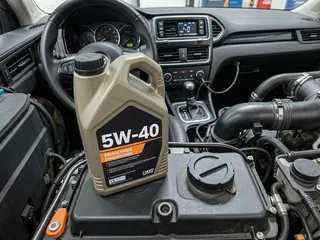
5W-40 Diesel Engine Oil: When It Is the Right Choice
The short answer
A 5W-40 diesel engine oil is the right choice only if your vehicle's owner's manual lists 5W-40 as an approved viscosity and the oil carries the performance specification or manufacturer approval your engine requires. The viscosity grade alone does not make an oil suitable. Two 5W-40 oils can be built to very different standards, and one may suit your diesel while the other does not.
Two conditions change the answer most often. First, if your diesel has a diesel particulate filter (DPF), you usually need a low- or mid-SAPS oil. SAPS stands for sulphated ash, phosphorus and sulphur, which are additive by-products that can clog the filter over time. Second, light-duty passenger-car diesels and heavy-duty truck diesels use different specification systems, so an oil made for one is not automatically correct for the other.
What the 5W-40 grade tells you
5W-40 is a multigrade viscosity rating defined by the SAE J300 standard. The "5W" part describes cold behaviour: the W stands for winter, and a lower number means the oil flows and lets the engine crank more easily at low temperatures. The "40" part describes thickness at normal operating temperature, measured at 100°C. Under SAE J300, a 40 grade must fall within a set viscosity range at that temperature and meet a minimum high-temperature, high-shear (HTHS) viscosity, which indicates how well the oil film holds up under heavy load.
In practice, 5W-40 is a relatively thick hot grade with good cold-start flow. That combination is why it is common in turbocharged diesels and in vehicles that see both cold winters and heavy loads. It does not tell you anything about detergents, wear protection or compatibility with emissions hardware. Those properties come from the specification.
Why the specification matters more than the grade
Engine makers specify oil in two ways: an industry performance category and, often, their own approval code. The oil bottle should show both if the oil qualifies. Match what your manual asks for, not just the numbers on the front label.
Light-duty diesel cars and vans: commonly specified under ACEA categories such as C3 (mid-SAPS, suited to many DPF-equipped engines) or A3/B4 (full-SAPS, generally for engines without a DPF), plus manufacturer approvals from the carmaker. Heavy-duty diesel trucks and equipment: commonly specified under API categories such as CK-4 (or the older CJ-4) and ACEA E-categories such as E6, E8, E9 or E11, plus approvals from engine or truck manufacturers. Manufacturer approval codes: many carmakers and engine builders publish their own oil standards. If your manual lists one, the oil should state that exact approval, not merely claim it "meets the requirements" of a broad category.
Note that the API FA-4 heavy-duty category is a lower-HTHS category and is not associated with 40-grade oils, so a 5W-40 heavy-duty oil will typically be labelled CK-4 rather than FA-4. Always confirm the backward-compatibility rules for your engine, because some older engines and some manufacturers place limits on newer categories.
Diesels with a particulate filter
Ash from oil additives cannot be burned off during DPF regeneration and builds up inside the filter. Using a full-SAPS oil in an engine that calls for low- or mid-SAPS oil can shorten filter life and, depending on the manufacturer, may affect warranty coverage. If your diesel has a DPF, check that the 5W-40 you choose is explicitly rated for it under the specification your manual names. Many 5W-40 oils sold as "diesel" oils are full-SAPS heavy-duty or older-specification products, so the label is not a safe shortcut.
When 5W-40 may be the wrong choice
Some modern diesels are designed for thinner oils such as 0W-30, 5W-30 or 0W-20, often to meet fuel-economy or emissions targets and to suit tight internal tolerances or specific variable valve timing and turbo oil-feed designs. Putting a 40 grade in an engine that does not list it can be outside the manufacturer's recommendations even if the oil is high quality. Conversely, if your manual lists 5W-40 for your climate or duty cycle, switching to a thinner grade without approval is equally a departure from specification. Requirements can differ between model years, markets and engine variants of what looks like the same vehicle, so check the exact engine code rather than relying on the model name.
How to confirm the right oil for your vehicle
Find the oil section of your owner's manual or service booklet for your specific model year, market and engine. Note every approved viscosity grade and any temperature chart that applies to your climate. Note the required performance category and any manufacturer approval code. Check whether your vehicle has a DPF and whether the manual specifies low- or mid-SAPS oil. On the oil container, look for the exact category and approval wording, not just the 5W-40 grade. If the manual is unavailable, ask a dealer or the engine manufacturer using your vehicle identification number or engine code.
What this guide cannot confirm
No specific vehicle, engine, model year or market was supplied, so this guide cannot state whether 5W-40 is approved for any particular diesel, nor recommend a particular product. It also does not cover prices, availability or comparative test results. Use the checks above against your own vehicle's documentation to make the final decision.