2003–2012 Honda Accord Serpentine Belt Routing and Replacement
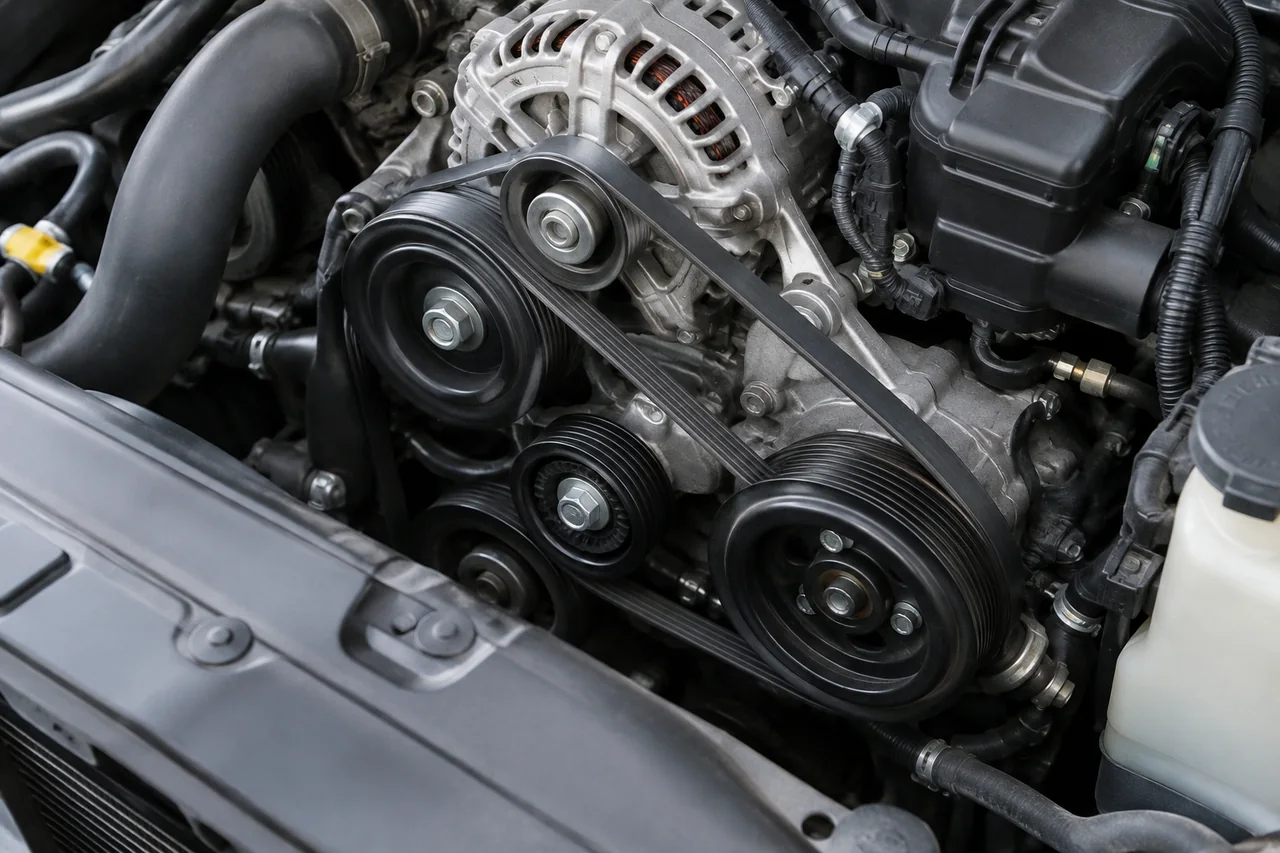
The Honda Accord serpentine belt, also called the accessory drive belt, drives accessories on 2003 through 2012 seventh- and eighth-generation Accords. K24 four-cylinder and V6 engines do not share one belt or one routing diagram. Confirm engine identification before selecting a serpentine belt for Honda Accord work, reading a diagram, or estimating replacement labor. A model year alone does not establish fitment.
Identify Your Accord’s Engine and Belt Application
A serpentine belt for a Honda Accord from 2003 through 2012 must be confirmed on the vehicle, not inferred from the year on the title. Seventh-generation cars (2003-2007) and eighth-generation cars (2008-2012) both offered a K24 four-cylinder and a V6 with different accessory layouts. Engine identification, equipment, and the exact year together determine which accessory drive belt and which belt routing diagram apply. A 2004 Honda Accord serpentine belt is not a universal Accord part.
The accessory drive belt turns the alternator, air-conditioning compressor, power-steering pump, and, on some layouts, the water pump. It is not the timing belt or chain, and timing-system service stays outside this replacement. Confirm length, rib count, and part number through a vehicle-tied application lookup. Do not assume a shared specification across 2003-2012 Accords. A 2005 Honda Accord serpentine belt listed for a K24 will not automatically match a V6 of the same year.
2003–2006 Accord Belt Fitment and Routing
Routing for a 2003 Honda Accord serpentine belt, a 2004 Honda Accord, a 2005 Honda Accord serpentine belt, or a Honda Accord 2006 serpentine belt belongs to that year and engine. Locate the matching belt routing diagram in service information, or use an intact under-hood label if it remains readable. Read the diagram's viewing direction first, usually from the accessory end. Identify each labeled pulley, then trace the complete path from the crankshaft around the tensioner and every accessory.
Belt ribs seat in grooved pulleys, while the smooth backing rides on flat idlers or the tensioner face where the diagram shows that contact. The verified diagram governs the path; an incorrectly installed belt cannot be the only routing reference. With the engine stopped, sketch the current path, then compare it with the 2003, 2004, 2005, or 2006 Honda Accord serpentine belt diagram for that engine. A path that skips a pulley or puts ribs on a smooth roller needs correction first.
2007 Accord Routing for the 2.4-Liter and V6
Ordering a 2007 Honda Accord serpentine belt starts with confirming whether the engine is the 2.4-liter K24 or the V6. The 2007 Honda Accord 2.4 serpentine belt diagram is K24 four-cylinder routing and must come from verified information for that application, not a generic Accord drawing. A V6 in the same year uses a separate diagram and a different accessory layout. After identification, use the matching diagram to name the crankshaft pulley, belt tensioner, and every accessory pulley actually present so the path is not borrowed from the other engine.
If a serpentine belt for 2007 Honda Accord seems too short to reach the last pulley, or hangs too loose once placed, stop and recheck fitment and routing before forcing it. Common causes are a four-cylinder belt offered for a V6, a skipped idler, reversed rib contact, or a tensioner not moved through its service procedure. A belt that matches the K24 serpentine belt diagram still needs pulley alignment confirmed on the car.
2008 Accord Belt Selection and Diagram Checks
Confirm the engine in a 2008 Honda Accord before choosing a replacement serpentine belt or interpreting a diagram. The 2008 Honda Accord V6 serpentine belt diagram is separate from four-cylinder routing on the same year. Check that every pulley in the selected diagram exists on the identified vehicle, including the tensioner and any hidden idler. A Honda Accord 2008 serpentine belt that follows a diagram with an extra pulley will not seat correctly.
On the verified 2008 Honda Accord serpentine belt diagram, trace grooved contact on ribbed pulleys and smooth backing on flat rollers so no wrap is skipped. Eighth-generation packaging can hide an idler, which makes an unlabeled image a poor substitute for service information. If the label is missing or a pulley cannot be identified, obtain vehicle-specific routing before the belt comes off. A serpentine belt for 2008 Honda Accord should not be installed until that path is confirmed.
2009–2012 Accord Routing References
Belt selection for a 2009 Honda Accord still depends on exact year and engine, as do the 2009 Honda Accord serpentine belt diagram and 2010 Honda Accord serpentine belt diagram. Select the belt from the identified K24 or V6 application. Extend the same rule to 2011 and a 2012 Honda Accord serpentine belt diagram: later years are not proof of identical routing or belt length. Orient the printed diagram against an engine-off accessory-end view, matching labeled pulleys to hardware rather than an unlabeled photo.
If the serpentine belt on a 2009 Honda Accord or a later car is missing, shredded, or hanging off a pulley, do not guess the wrap from neighboring years. Obtain the confirmed routing reference for that engine, then have the cause of failure evaluated before replacement. A thrown belt can follow a seized pulley, weak tensioner, oil contamination, or misalignment. A destroyed belt cannot document the original route, so the diagram must come from verified service information.
Replacement Preparation and Installation Checks
Honda Accord serpentine belt replacement follows a short sequence: confirm the application, establish routing, inspect related parts, install the correct belt, then verify seating. Limit owner observations to a cool, fully stopped engine with the ignition off and keys secured. Keep hands and tools away from a moving accessory drive belt. Tensioner spring force and tight K24 or V6 packaging make tool placement and tension release dependent on the correct service procedure and suitable equipment, not an improvised pry bar.
When the old belt is off, have the technician check pulley condition, tensioner operation, alignment, and contamination from oil, coolant, or power-steering fluid. To replace the serpentine belt on a Honda Accord, address those findings first. After install, confirm with the engine off that every rib is seated and the backing contacts only the smooth pulleys shown on the diagram. Professional operational verification follows. Stop further driving if the belt tracks incorrectly or abnormal noise persists.
Belt Wear, Warning Signs, and Replacement Costs
Belt wear includes fraying, missing rib material, glazed ribs, edge damage, and oil or coolant contamination. An absence of obvious cracks does not establish belt condition. Squealing, chirping, or a charging warning can come from the belt, a slipping pulley, a weak tensioner, or an electrical fault, and those noises do not prove the belt is the only failed part. If the belt is displaced or broken, the engine overheats, or steering assistance changes suddenly, stop safely and arrange assistance.
Honda Accord serpentine belt replacement cost is an estimate, not a single national price. Break the quote into the belt, replacement labor, diagnostic time, and any separately justified tensioner or pulley repairs. Engine configuration and access differ between the K24 and V6, and local labor rates change the total. Confirmed extra faults raise the bill. Use applicable maintenance information and inspected condition to time replacement, rather than a calendar guess that ignores contamination, rib wear, or a noisy tensioner.