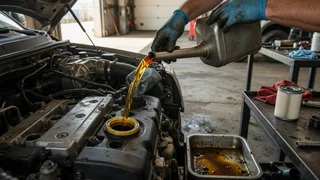
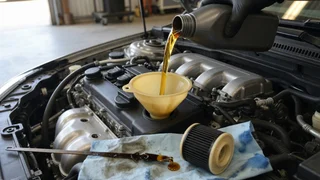
15W-40 Break-In Oil: When It Fits and When It Doesn't

The short answer
A 15W-40 break-in oil is a dedicated lubricant for the first run-in period of a freshly built or rebuilt engine, usually a diesel or an older-design gasoline engine. It helps new piston rings seat against the cylinder walls and protects new parts that rub against each other. Whether you should use one depends on the engine. A rebuilt engine whose builder or parts supplier calls for this grade is the clearest case. A new vehicle from a dealer usually needs nothing special, and the owner's manual specification applies from the first mile.
What the 15W-40 label means
15W-40 is a multigrade viscosity rating under the SAE classification. The number before the W (for winter) describes cold-temperature behavior. The number after it describes viscosity at normal operating temperature. A 15W-40 oil is thicker when cold than lower-W grades such as 5W or 10W, so it is better suited to moderate climates than to very cold starts. The grade has long been a common choice for heavy-duty diesel engines.
The viscosity grade alone does not make an oil a break-in oil. A product is a break-in oil because of its additive package and its intended use, which the manufacturer states on the label and in its product information.
How break-in oil differs from regular oil
Break-in oils are generally formulated for two goals during an engine's first hours of running:
Ring seating: the piston rings need some controlled friction against the cylinder walls to wear into a good seal. For this reason, break-in oils are commonly mineral-based rather than full synthetic. This is common industry practice rather than a universal rule. Wear protection for new parts: many break-in oils carry higher levels of anti-wear additives, especially zinc dialkyldithiophosphate (ZDDP). ZDDP forms a protective film between heavily loaded sliding parts, such as a flat-tappet camshaft and its lifters, while their surfaces mate.
Additive levels vary by product and are not supplied here. Check the specific product's data sheet rather than assuming any figure.
Which engines it suits
Rebuilt or freshly assembled engines, especially those with flat-tappet camshafts, where the cam or engine builder specifies a high-zinc break-in oil. Rebuilt diesel engines, where 15W-40 is often the normal service grade and the rebuilder specifies a break-in oil of that viscosity. Engines whose service grade is a lighter oil are a poor fit. In these cases, a 15W-40 break-in oil is only appropriate if the engine builder explicitly calls for it.
Why a new factory vehicle usually doesn't need it
Modern production engines are broken in partly at the factory and ship with a factory-fill oil chosen by the manufacturer. Owner's manuals typically give break-in driving guidance, such as varying engine speed and avoiding sustained heavy loads for an initial period. They usually do not call for a special oil. Using an oil grade or formulation other than the one specified could conflict with emissions equipment or warranty terms, and requirements differ by manufacturer, model year, engine and market.
One point about modern heavy-duty diesel oils matters for rebuilders. Current API diesel categories limit some additive chemistry to protect exhaust after-treatment systems. A standard modern 15W-40 diesel oil is therefore not automatically a high-zinc break-in oil, even though it shares the viscosity grade.
How long to use it
Break-in oil is meant for the initial run-in period only. It is typically drained, together with the filter, after that period, and the engine then goes onto its regular service oil. The right interval depends on the product and the engine builder's instructions, and no specific mileage or hour figure is supplied here. Follow the label and the builder's guidance.
Choosing the right oil
New vehicle from the factory: use the oil grade and specification in the owner's manual, and follow its break-in driving advice. Rebuilt engine: use the oil the engine builder or camshaft manufacturer specifies. If that is a 15W-40 break-in oil, confirm the product is labeled for break-in use. Flat-tappet camshaft: prioritize an oil with documented high ZDDP content, and check that its viscosity matches the builder's requirement.
Gaps in this guide
No product-specific test data, additive measurements or manufacturer specifications were supplied for this guide. It does not rank or compare individual 15W-40 break-in oils. The guidance above is general, so confirm details against your engine's documentation and the oil maker's published product data.