THE SPARROW STORY
Turbulators: Why the Sparrow Body Uses Golf-Ball Dimples
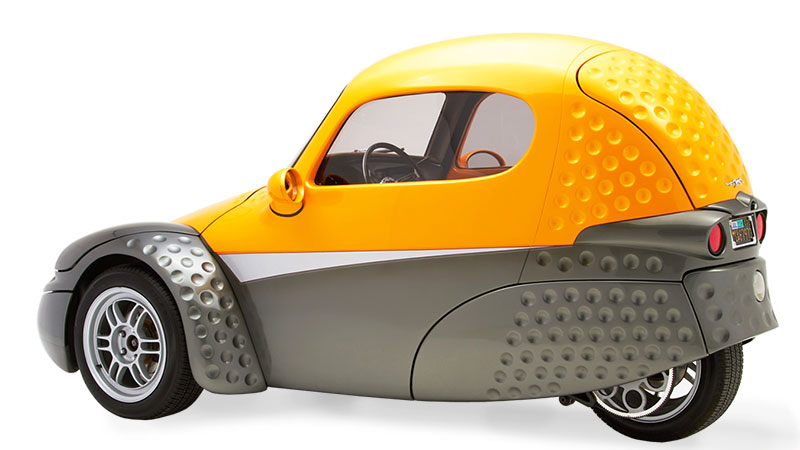
The dimples on the rear of the Sparrow body are called turbulators. The Corbin team described their function as working much like the dimples on a golf ball, deliberately stirring up the layer of air closest to the surface so the vehicle can leave the air mass with less drag.
From the Sparrow archive. Product plans, events and availability described here belong to the original historical period.
The boundary layer in general terms
As any object moves through air, a thin layer of air clings to its surface. This is the boundary layer. When that layer stays smooth and laminar, it tends to separate from a curved surface fairly early, leaving a wide, low-pressure wake behind the object. A wake of that kind pulls backward on the body and shows up as drag.
A boundary layer that has been made slightly turbulent carries more energy and stays attached to the surface longer. The wake behind the object becomes narrower and the eddies within it smaller, which lowers overall drag. This is the same principle that lets a dimpled golf ball fly farther than a smooth one. It is a general aerodynamic effect, not something unique to any one vehicle.
How Corbin applied it to the Sparrow
On the Sparrow the turbulators are placed only where the body is exiting the air mass, toward the tail, which is where the team wanted to suppress drag and wake eddies. They are deliberately absent from the nose. There the design relies on a small, tapered front end to produce a clean, smooth entry into the air. The team credited this combination with helping the Sparrow move more efficiently and, by extension, with contributing to range.