THE SPARROW STORY
Low Profile: The Sparrow's Tapered Nose and Low Battery Placement
The front of the Sparrow is deliberately small and pointed. The Corbin team designed the nose to split the oncoming air into a clean, laminar boundary layer, and they kept the frontal area small so there is simply less air to push aside.
From the Sparrow archive. Product plans, events and availability described here belong to the original historical period.
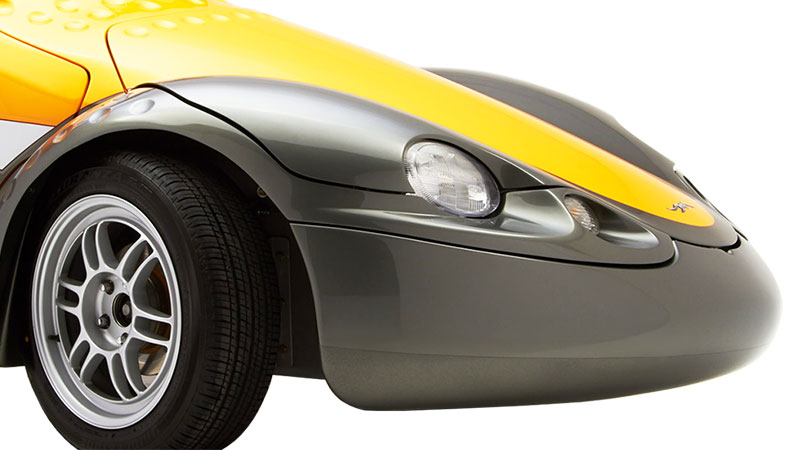
Frontal area and a clean entry
Aerodynamic drag depends heavily on two things: how much area a vehicle presents to the wind and how smoothly the air flows over it. A single-occupant cabin allows a narrow body, so the Sparrow's frontal area is far smaller than that of a conventional car. That alone reduces the energy needed to hold highway speed.
At the nose the goal is the opposite of what the rear turbulators do. Here the team wanted the air to attach smoothly and stay laminar over the front surfaces, so the nose is small, tapered and free of dimples or other disturbances.
What the low profile requires underneath
A low nose is only possible if nothing tall sits behind it. The Sparrow's battery pack is therefore mounted low and centered between the two front wheels. This keeps the hood line down and, at the same time, places the heaviest single component near the ground and inside the triangle formed by the three wheels, which benefits stability as well as aerodynamics.