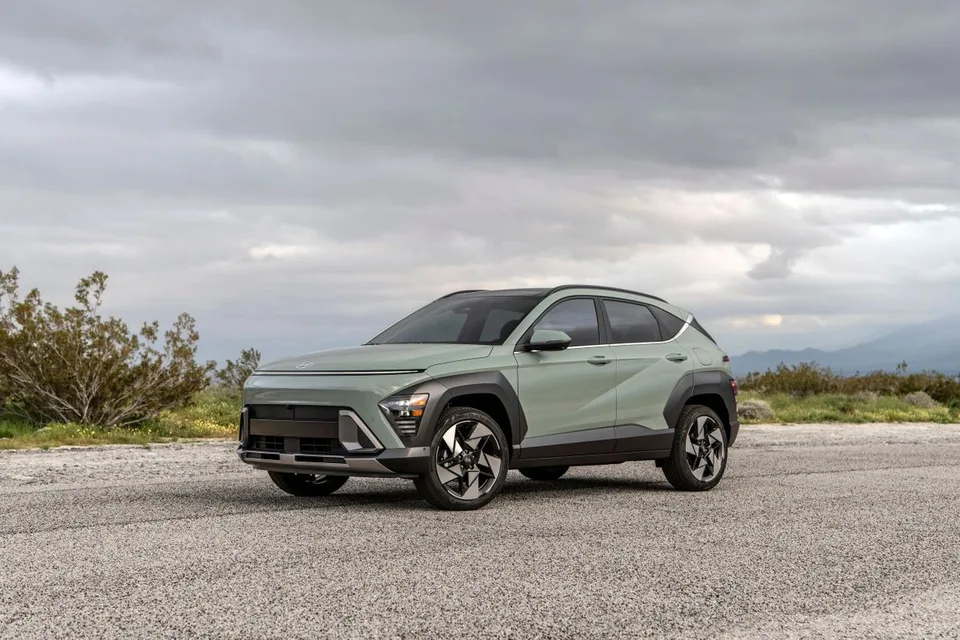
← Hyundai Kona generations

TRIM DETAILS

Hyundai Kona 1.6 DCT Premium Equipment — Second Generation

The Hyundai Kona 1.6 DCT Premium is a compact crossover version, and the notes below cover everyday themes: seating comfort, getting used to the controls before setting off, and routine phone and audio use.

2 generation · SUV 5-doors

2023

1.6 DCT

Hybrid · Robotic · FWD

At a glance

View full specifications ↓

Premium

Report an inaccuracy ↗

Specifications

Jump to a section

Performance & powertrain

Top speed
?

The highest speed a vehicle can sustain under manufacturer test conditions. Some cars are electronically limited below their mechanical potential. Glossary entry

161 km/h
Engine type
Hybrid
Transmission
Robotic
Type of boost
?

A turbocharger or supercharger compresses the air entering the engine so a smaller engine can produce more power. Naturally aspirated engines draw air without a compressor. Glossary entry

Turbo
Type of drive
?

Which wheels receive power: front-wheel drive, rear-wheel drive or all-wheel drive. All-wheel drive can send power to every wheel for extra traction. Glossary entry

FWD
Bore and stroke
?

The diameter of a cylinder (bore) and the distance the piston travels inside it (stroke). Together they determine the displacement of the engine. Glossary entry

75.6 × 89 mm
Engine capacity
?

The total volume swept by all pistons inside the cylinders, usually stated in cubic centimetres or litres. Larger displacement often means more power but higher consumption. Glossary entry

1580 cm³
Engine location
Front, transverse
Number of gears
?

How many fixed forward ratios a gearbox offers. More gears can improve economy and refinement; continuously variable transmissions have no fixed steps. Glossary entry

6
Maximum power
?

A unit of engine or motor output. One metric horsepower is about 0.735 kilowatts. Peak power is normally reached at high engine speed. Glossary entry

139 hp
Maximum power, kw
?

A unit of engine or motor output. One metric horsepower is about 0.735 kilowatts. Peak power is normally reached at high engine speed. Glossary entry

102 kW
Compression ratio
?

The ratio between the largest and smallest volume of a cylinder as the piston moves. Higher ratios improve efficiency but may require higher-octane fuel. Glossary entry

Not provided
Maximum power rpm
5700 rpm
Maximum torque N⋅m
270 N⋅m
Maximum torque rpm
4000 rpm
Acceleration to 100
?

The time a vehicle needs to reach 100 km/h from a standstill, a common shorthand for overall performance. Glossary entry

11.2 s
Engine power system
Not provided
Number of cylinders
4
Valves per cylinder
?

The number of intake and exhaust valves in each cylinder. Four valves per cylinder is common and helps the engine breathe at higher speeds. Glossary entry

4
Cylinder arrangement
Inline
Maximum power ICE
105 hp
Maximum power ICE
77 kW

Energy & emissions

ECO class
Euro 6
Battery power
42 kWh
Fuel grade
95
Mild Hybrid
?

A car with a small electric motor and battery that assist the combustion engine and recover braking energy but cannot drive on electricity alone. Glossary entry

Not provided
Battery type
Lithium-ion batterie
CO2 emissions
?

The amount of carbon dioxide released per kilometre under a standardised test. Lower figures usually go hand in hand with lower fuel consumption. Glossary entry

Not provided
Full charge home
Not provided
Power consumption
Not provided
Fuel tank capacity
47 l
Full public charging time
Not provided
Driving range, maximum
?

The distance an electric or plug-in vehicle can travel on a full charge under a stated test cycle. Temperature, speed and load change the real result. Glossary entry

Not provided
Driving range, minimum
?

The distance an electric or plug-in vehicle can travel on a full charge under a stated test cycle. Temperature, speed and load change the real result. Glossary entry

Not provided
Fuel consumption city
Not provided
Average consumption
4.6 l
Fuel consumption highway
Not provided

Dimensions & body

Doors number
5
Number of seats
5
Width
1820 mm
Height
1570 mm
Length
4355 mm
Body type
SUV 5-doors
Wheelbase
?

The distance between the centres of the front and rear wheels. A longer wheelbase usually gives more cabin space and a calmer ride; a shorter one helps agility and parking. Glossary entry

2660 mm
U-turn diameter
Not provided
Depth of the ford to be crossed
Not provided
Body style
SUV
Rear track width
?

The distance between the centres of the two wheels on the same axle. A wider track generally improves stability in corners. Glossary entry

Not provided
Trunk volume max
1156 l
Trunk volume min
466 l
Front track width
?

The distance between the centres of the two wheels on the same axle. A wider track generally improves stability in corners. Glossary entry

Not provided
Max weight
Not provided
Curb weight
?

The weight of the vehicle with all standard equipment and fluids but without passengers or cargo. Glossary entry

Not provided
Ground clearance, maximum
?

The gap between the lowest point of the underbody and the road. More clearance helps on rough roads and steep driveway ramps. Glossary entry

Not provided
Ground clearance, minimum
?

The gap between the lowest point of the underbody and the road. More clearance helps on rough roads and steep driveway ramps. Glossary entry

170 mm

Identity & configuration

Vehicle class
J
Right-hand drive
No
Engine code
G4FG

Additional specifications

Stop
Not provided
Start
2023-01-01
Wheel size
Not provided
Rear brakes
Disc
Front brakes
Ventilated disc
Rear suspension
Independent, spring
Front suspension
Independent, spring

Trim equipment

Dimensions & body

Number of seats
5

Additional specifications

Driver Assistance Systems
Anti-lock braking system (ABS), Electronic stability program (ESP), Emergency brake assist (BAS, EBD, EBA), Automatic slip regulation (ASR), Collision avoidance system, Lane departure warning system, Drive mode selection system, Traffic sign assist, Pedestrian detection system, Traffic Jam Assist, Rear occupant alert system, Front Cross Traffic Alert
Stop
Not provided
View
Daytime running lights, Light sensor, Rain sensor, High beam assist
Start
2023-01-01
Airbags
Driver's airbag, Passenger airbag, Side front airbags, Window airbags (curtains), Between the front seats
Camera
Rear-view camera
Isofix
Isofix for the back row
Material
Alloy
Comfort
Digital instrument cluster, Keyless entry system, Engine Start Button, Power mirrors, Multifunction steering wheel, Electronic parking brake, Self-darkening central mirror
Interior
Folding rear seat, Leather steering wheel, Power window
Safety
Driver drowsiness detection, Tire pressure sensors
Headlights
LED headlights
Sound
Audio system
Diameter
R16 ″
Multimedia
Bluetooth, Carplay, Android Auto, USB-C
Cruise control
Adaptive Cruise Control
Air conditioner
Single-zone climate control
Steering wheel adjustment
Steering wheel height adjustment, Steering wheel reach adjustment
Anti theft system
Keyless central locking, Immobilizer
Seat trim
Fabric seats
Seat adjustment
Front seats adjustment

Not provided means the source has no value. Zero remains zero. Units are shown as supplied; range test cycles are only stated when known.

Fuel cost calculator

Estimates use only the figures you enter, in your own currency. No live fuel prices or emissions data are used.

Units

Enable JavaScript to calculate estimates.

Comfort and Convenience

Seating position is a personal matter: some drivers prefer sitting high for a clear view of the road ahead, while others favour a lower, more enclosed posture. Habit and build both shape the preference.

Safety and Driver Assistance

Spending a few minutes with the wipers, lights and mirrors while parked means fewer unfamiliar movements later. Preparation of this kind is simply about knowing where things are before the journey begins.

Multimedia and Connectivity

A phone that runs low mid-route is a common annoyance, so a charging point within reach matters. Where one is available, it keeps the device usable for navigation without occupying a passenger's hands.