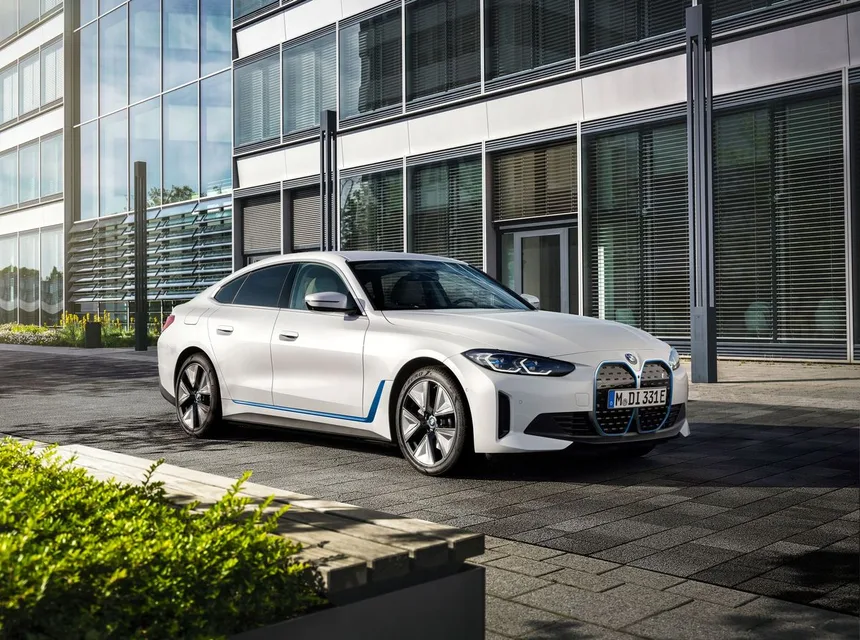
The first-generation BMW i4 M50 AT is an all-wheel-drive electric sedan, distinguished from single-motor i4 versions by carrying a second motor on the front axle.
1 generation · Sedan
Generation photo. Individual trim appearance may differ.
The highest speed a vehicle can sustain under manufacturer test conditions. Some cars are electronically limited below their mechanical potential. Glossary entry
225 km/h
Engine type
Electro
Transmission
Automatic
Type of boost?
A turbocharger or supercharger compresses the air entering the engine so a smaller engine can produce more power. Naturally aspirated engines draw air without a compressor. Glossary entry
Not provided
Type of drive?
Which wheels receive power: front-wheel drive, rear-wheel drive or all-wheel drive. All-wheel drive can send power to every wheel for extra traction. Glossary entry
AWD
Bore and stroke?
The diameter of a cylinder (bore) and the distance the piston travels inside it (stroke). Together they determine the displacement of the engine. Glossary entry
Not provided
Engine capacity?
The total volume swept by all pistons inside the cylinders, usually stated in cubic centimetres or litres. Larger displacement often means more power but higher consumption. Glossary entry
Not provided
Engine location
Not provided
Number of gears?
How many fixed forward ratios a gearbox offers. More gears can improve economy and refinement; continuously variable transmissions have no fixed steps. Glossary entry
1
Maximum power?
A unit of engine or motor output. One metric horsepower is about 0.735 kilowatts. Peak power is normally reached at high engine speed. Glossary entry
544 hp
Maximum power, kw?
A unit of engine or motor output. One metric horsepower is about 0.735 kilowatts. Peak power is normally reached at high engine speed. Glossary entry
400 kW
Compression ratio?
The ratio between the largest and smallest volume of a cylinder as the piston moves. Higher ratios improve efficiency but may require higher-octane fuel. Glossary entry
Not provided
Maximum power rpm
Not provided
Maximum torque N⋅m
795 N⋅m
Maximum torque rpm
Not provided
Acceleration to 100?
The time a vehicle needs to reach 100 km/h from a standstill, a common shorthand for overall performance. Glossary entry
3.9 s
Engine power system
Not provided
Number of cylinders
Not provided
Valves per cylinder?
The number of intake and exhaust valves in each cylinder. Four valves per cylinder is common and helps the engine breathe at higher speeds. Glossary entry
Not provided
Cylinder arrangement
Not provided
Maximum power ICE
Not provided
Maximum power ICE
Not provided
Energy & emissions
ECO class
Not provided
Battery power
83.9 kWh
Fuel grade
Electro
Mild Hybrid?
A car with a small electric motor and battery that assist the combustion engine and recover braking energy but cannot drive on electricity alone. Glossary entry
Not provided
Battery type
Lithium-ion batterie
CO2 emissions?
The amount of carbon dioxide released per kilometre under a standardised test. Lower figures usually go hand in hand with lower fuel consumption. Glossary entry
0 g/km
Full charge home
1300 min
Power consumption
Not provided
Fuel tank capacity
Not provided
Full public charging time
130 min
Driving range, maximum?
The distance an electric or plug-in vehicle can travel on a full charge under a stated test cycle. Temperature, speed and load change the real result. Glossary entry
521 km
Driving range, minimum?
The distance an electric or plug-in vehicle can travel on a full charge under a stated test cycle. Temperature, speed and load change the real result. Glossary entry
416
Fuel consumption city
Not provided
Average consumption
Not provided
Fuel consumption highway
Not provided
Dimensions & body
Doors number
4
Number of seats
5
Width
1850 mm
Height
1400 mm
Length
4650 mm
Body type
Sedan
Wheelbase?
The distance between the centres of the front and rear wheels. A longer wheelbase usually gives more cabin space and a calmer ride; a shorter one helps agility and parking. Glossary entry
2856 mm
U-turn diameter
12.5 m
Depth of the ford to be crossed
Not provided
Body style
Sedan
Rear track width?
The distance between the centres of the two wheels on the same axle. A wider track generally improves stability in corners. Glossary entry
1606 mm
Trunk volume max
1290 l
Trunk volume min
470 l
Front track width?
The distance between the centres of the two wheels on the same axle. A wider track generally improves stability in corners. Glossary entry
1589 mm
Max weight
2735 kg
Curb weight?
The weight of the vehicle with all standard equipment and fluids but without passengers or cargo. Glossary entry
2215 kg
Ground clearance, maximum?
The gap between the lowest point of the underbody and the road. More clearance helps on rough roads and steep driveway ramps. Glossary entry
Not provided
Ground clearance, minimum?
The gap between the lowest point of the underbody and the road. More clearance helps on rough roads and steep driveway ramps. Glossary entry
125 mm
Identity & configuration
Vehicle class
D
Body designation
G26
Right-hand drive
No
Additional specifications
Stop
2024-05-31
Start
2021-03-01
Wheel size
Not provided
Rear brakes
Disc
Front brakes
Ventilated disc
Rear suspension
Independent, spring
Front suspension
Independent, spring
No specifications match your search. Try another label or value, or clear the search.
Not provided means the source has no value. Zero remains zero. Units are shown as supplied; range test cycles are only stated when known.
Fuel cost calculator
Estimates use only the figures you enter, in your own currency. No live fuel prices or emissions data are used.
Fuel per trip
L
Trip cost
Monthly cost
Annual cost
Enable JavaScript to calculate estimates.
Engine and Transmission
With Electro listed as the fuel and an Automatic transmission, the powertrain uses a single fixed reduction gear rather than stepped ratios: the motor covers the whole speed range itself, so there is no shift interruption and no idle or warm-up phase before setting off.
Drivetrain and Everyday Driving
The listed AWD layout on an electric car is normally electrical rather than mechanical: separate motors drive the front and rear axles, and the control software shifts torque between them in milliseconds, with no propshaft or transfer case linking the two ends.
Body and Practicality
Access on a sedan body depends on whether the tail opens as a boot lid or a full hatch. A liftback-style opening frees the whole rear aperture, so tall or awkward items pass through rather than having to clear a fixed rear window.
Recently viewed
Your latest 12 modifications and trims, stored in this browser.