Yamaha Raider 150 Fi engine oil capacity
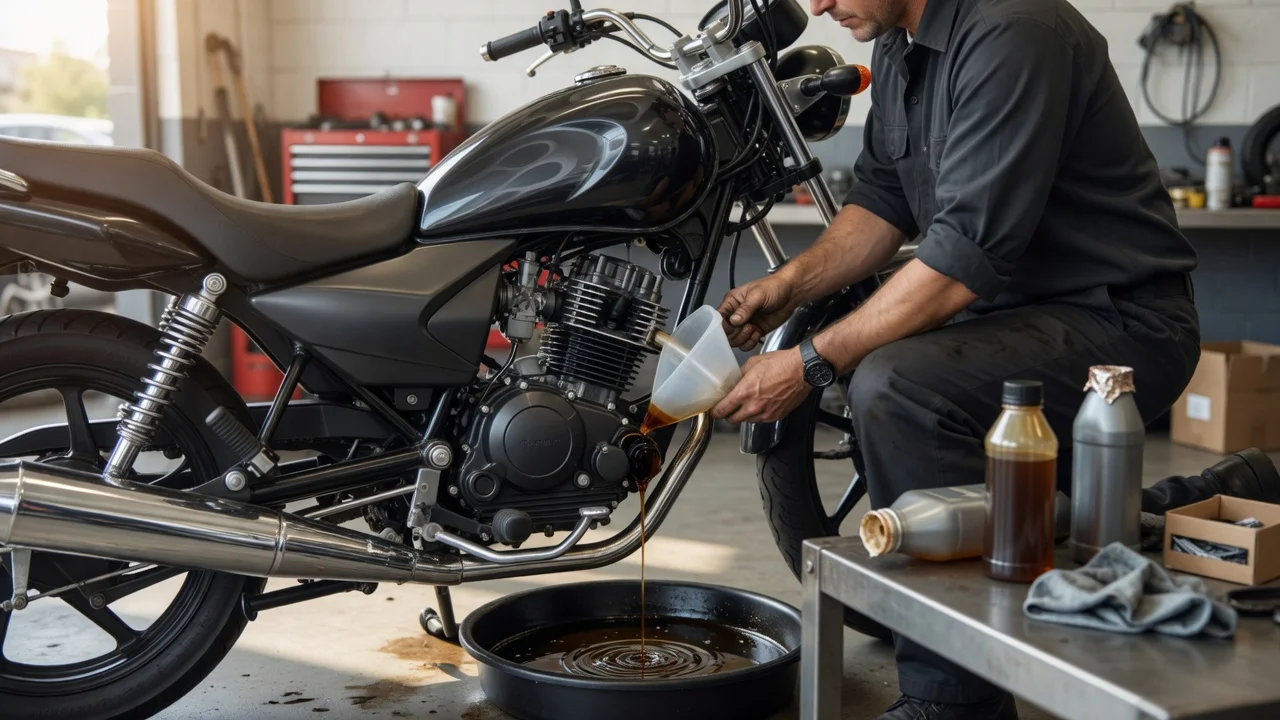
Capacity at a glance
For the fuel-injected Yamaha Raider 150 Fi, Yamaha literature for this 150 cc liquid-cooled four-valve underbone family specifies about 0.95 liters for a routine drain-and-fill and about 1.15 liters when the engine is filled dry after disassembly. Those two figures are the ones that change the job: a periodic oil service uses the smaller volume, while a rebuild or a fully empty crankcase uses the larger one. Final level is set with the crankcase sight glass, so the poured amount is a starting fill.
The Raider 150 Fi is the Philippine-market member of the same engine family as the Yamaha MX King 150, Jupiter MX 150, Sniper 150 Fi, and Y15ZR. Published oil volumes for that family are consistent at 0.95 L periodic and 1.15 L dry. Earlier carbureted Raider 150 models used smaller published fills, commonly around 0.80 L for an oil change and 1.00 L after overhaul, so the Fi badge and the model year both matter before you buy or pour.
Service type and how much oil to plan for
Service Typical published volume What it covers; Periodic oil change 0.95 L Warm drain, refill with the engine assembled; the usual ownership service; Dry fill after engine work 1.15 L Crankcase, galleries, and filter housing empty after disassembly; Oil change with filter service Start at 0.95 L, then top to the sight-glass marks Cartridge or element replacement holds extra oil; the extra is set by level, not by a separate Yamaha fill figure on many sheets
Yamaha’s periodic figure is a measured drain-and-refill quantity, not a guarantee that every bike will take every milliliter of a 1-liter bottle. Residual oil left in the cases, how long the bike drained, and whether the filter was renewed all move the actual pour. A 1-liter bottle is the practical purchase for a standard service, with a small remainder for the post-idle top-up. A dry fill after engine work needs more than one liter on the bench.
Oil grade the engine is specified to use
Capacity and grade travel together. Yamaha specifies a four-stroke motorcycle oil in SAE 10W-40, meeting API SG or later and JASO MA or MA2. JASO MA/MA2 is the wet-clutch rating; the Raider 150 Fi shares engine oil with the clutch, so automotive oils labeled energy-conserving or Dexos-style friction modifiers are the wrong product even when the viscosity matches. In a hot, stop-and-go climate the 10W-40 grade is the documented default; follow the temperature chart in the owner’s manual for that unit if a different viscosity is listed for the market year.
How to fill and confirm the level
The Raider 150 Fi family uses a sight glass on the right crankcase. Level is read with the motorcycle upright on level ground, not on the sidestand. A supported sequence for a periodic change is: run the engine to operating temperature, shut it down, drain while warm, fit a new drain-plug washer, torque the plug to the manual value, refill with 0.95 L, idle the engine so oil reaches the head and filter, shut down, wait about a minute, then add small amounts until the meniscus sits between the lower and upper marks in the window. Overfilling loads the crank and can push oil into the airbox; underfilling starves the cam and transmission.
Warm the engine, then drain at the crankcase plug with the bike vertical enough for a complete drain. Renew the crush washer and tighten the plug to the specified torque. Pour 0.95 L of the specified 10W-40 JASO MA oil for a routine change, or 1.15 L only when the engine was emptied for workshop work. Idle, shut down, and set the final level in the sight glass between the minimum and maximum marks.
What still has to be confirmed on the bike in front of you
Treat 0.95 L / 1.15 L as the documented family figures for the fuel-injected 150 cc Yamaha underbone, then match them to the owner’s or service manual printed for that chassis year and market. Facelifts, dealer-fitted engines, and the older carbureted Raider 150 all exist in the same showrooms and classified ads. If the manual in the toolkit lists a different volume, that printed figure for that VIN range is the one to use. After the first fill on an unfamiliar bike, the sight glass is the check that closes the job.