Wireless EV Charging and Charging Roads: How Inductive Power Works
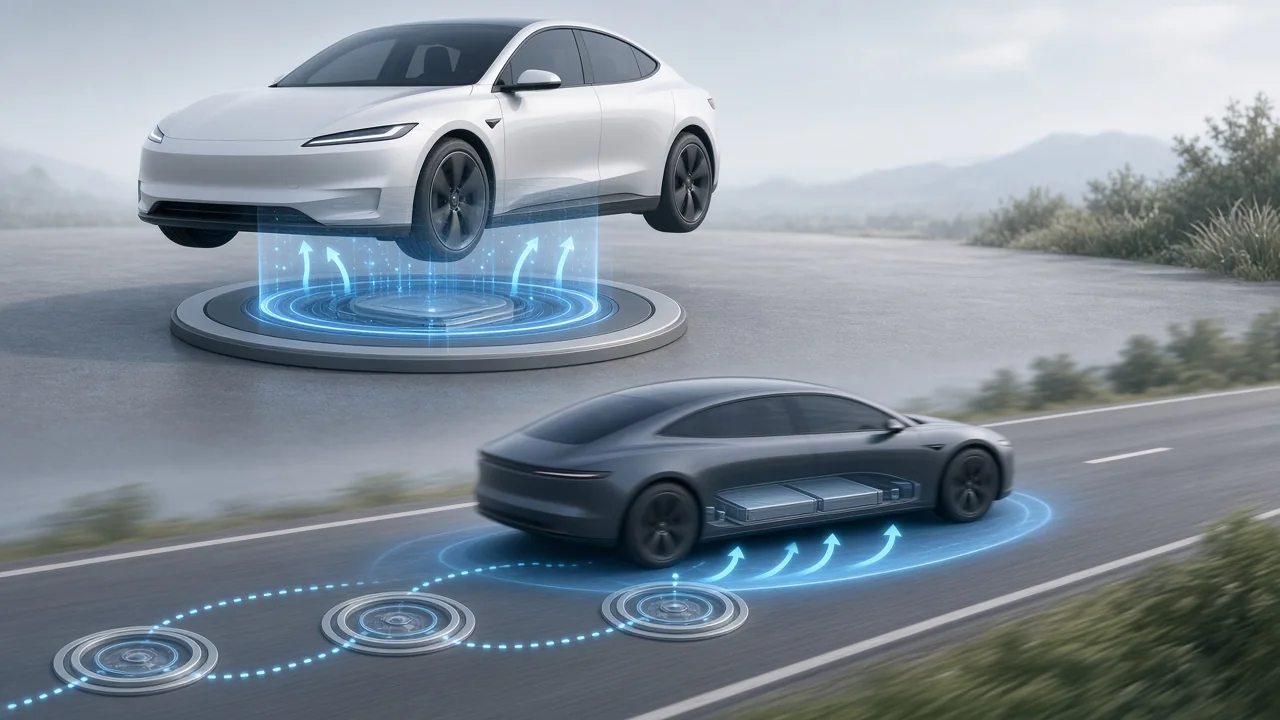
Wireless electric car charging uses inductive power transfer so a parked or moving vehicle can take energy without a cable. A ground charging pad or an electric car charging road couples magnetically to a vehicle receiver coil. Dynamic wireless charging in an electric car charging lane is the same idea stretched along the pavement. This electric car charging technology still depends on grid-fed coils, power electronics, and controls that only work with compatible hardware.
How Inductive Charging Transfers Energy to an EV
Electric car inductive charging starts with alternating current in a ground coil. That current produces a changing magnetic field, and magnetic coupling induces voltage in a compatible vehicle receiver coil when the two windings sit within the designed air gap. Onboard power electronics convert the received energy into the form the traction battery can accept. The battery management system then authorizes current, limits temperature, and ends the session when the pack's charging window is complete, so wireless energy is still managed like any other charge source.
Coil alignment and vertical separation decide how much of that magnetic field actually links the receiver. Offset parking, a taller ride height, or debris in the gap all weaken coupling and raise losses as heat in the coils and inverters. System design sets the operating frequency, coil size, and shielding so stray fields stay within the equipment's intended zone. None of this replaces a wired supply: the ground charging pad still needs an electrically fed installation, with a grid connection and controls that energize the transmitter only when a valid vehicle is present.
What Happens During a Wireless Parking Session
A wireless parking session begins with placing the vehicle so the receiver sits over the pad's supported alignment area. Many systems then exchange identification and charging-capability messages before they apply power, and they check that the air gap, temperatures, and authorization state are within the equipment's operating window. Parking guidance, whether camera, magnet, or in-cabin arrows, is there to shrink that alignment error, because a few centimeters of offset can drop transferred power or prevent the session from starting at all.
Once transfer starts, cabin or pad indicators typically show that the session is active, paused, or faulted, so a driver can confirm energy is moving without standing over the coils. An interrupted session can follow a parking shift, lost communication, or a protective stop; the display reports that state rather than proving a part has failed. Energy delivered depends on the supported power of that pad and vehicle pair, battery temperature and state of charge, and how long the car stays aligned. No universal charging time applies to every wireless charging electric car.
How Dynamic Charging Lanes Supply Moving Vehicles
Dynamic wireless charging turns the pavement into a sequence of transmitters. As a compatible vehicle travels an electric car charging lane, successive energized road segments couple to the receiver coil for only the time the car is over them. Vehicle detection and short-range communication typically tell the roadside controller when to power a segment and when to drop it, so unused coils are not left live. Proposed systems do not all use the same detection method or segment length; some trials switch short coil arrays, while others energize longer stretches under different traffic and safety rules.
Energy received on a trip depends on delivered power, time over energized distance, and vehicle energy use at that speed. Higher speed shortens dwell on each segment, so even a well-matched electric car charging lanes installation may only offset propulsion demand rather than refill the pack. If road load, climate control, and accessories exceed the power coupled through the receiver, state of charge can hold or still fall while the car takes energy. Dynamic transfer is range support, not a guarantee of a rising charge gauge.
What a Charging Road Needs Beneath and Alongside the Pavement
An electric car charging road is more than pavement with a coil under it. Embedded transmitters need electrical connections back to roadside power electronics, switchgear, and a grid supply sized for the number of segments that may be live at once. Those assemblies sit in a structure that must carry axle loads, shed water, tolerate freeze-thaw and heat, and remain accessible when a coil, cable, or inverter fails. Road repairs then become electrical work as well as civil work, because cutting or milling through an energized array can damage both the surface and the inductive power transfer hardware.
Operators also have to decide who may use the lane, how energy is metered, and how that energy is billed. Those arrangements depend on the deployment: a closed depot, a permitted test corridor, and a public highway would not share the same authorization or settlement rules. Availability should be read the same way. Proposed electric car charging roads exist on paper, controlled demonstrations run under test conditions with invited vehicles, and only a smaller set of sites operate as a service. Broad public access should not be assumed from a rendering, a press announcement, or a successful trial.
Vehicle Compatibility and Safe Use of Charging Equipment
Owning an electric vehicle does not make it ready for wireless electric car charging. The car needs a supported receiver coil, matching charging controls, and software that can complete the handshake the ground equipment expects. Owners should confirm those details in vehicle and equipment documentation: which inductive systems are supported, what installation the pad requires, and which aftermarket or dealer modifications are authorized. Charging interoperability is still developing, so a pad that works with one platform may refuse another even when both sit in the same parking bay.
Protective functions are part of the equipment, not a substitute for inspection from a safe distance. Foreign object detection is meant to reduce heating of metal left in the magnetic field, while temperature monitoring and shutdown controls can stop transfer if the pad, receiver, or power electronics leave their allowed range. Those capabilities vary by system. Drivers should read status messages and look for obvious damage, standing water over a pad, or debris in the gap from a position clear of the vehicle and the ground equipment. Repeated faults, damaged hardware, or any installation work belong with qualified service.
What Emerging Wireless Charging Claims Mean for Drivers
Access to electric car wireless charging depends on more than a working coil pair. Interoperability standards, factory vehicle integration, infrastructure investment, and operating approval all decide which cars can use which sites. Rated charging power describes a capability at a stated interface, not the energy that actually arrives in the battery after conversion losses, thermal limits, and battery-management throttling. Efficiency claims also have a measurement boundary, whether grid-to-battery or pad-to-receiver, and those figures are not interchangeable.
A successful demonstration shows that inductive power transfer can work under test conditions. It does not establish that a public pad or charging lane will be open, maintained, or compatible with a given car next year. Drivers who are evaluating the technology should ask which vehicles are documented as compatible, where equipment is actually accessible, who provides service support, what the payment terms are, and what operating limits the maker published for alignment, weather, and power. Those answers matter more than a headline about wireless charging for an electric car.