Why the Check Engine Light Turned Off on Its Own
What a light that goes out by itself actually means
A check engine light that turns off on its own usually means the powertrain control module (PCM or ECM, the engine computer) no longer sees the emissions-related fault that triggered the lamp. On typical OBD-II light-duty vehicles, the computer can extinguish the malfunction indicator lamp (MIL, the formal name for the check engine light) after the related diagnostic monitor runs and passes on consecutive driving cycles. The lamp going dark is not proof that the vehicle is fully repaired, that the stored trouble code has been erased, or that the fault will not return.
This guidance applies to OBD-II systems used on most cars and light trucks sold in the United States from the 1996 model year onward for gasoline engines, with diesel light-duty OBD phasing in around 1997. Pre-OBD vehicles, some heavy-duty, motorcycle, and market-specific calibrations can use different lamp logic. Hybrid, plug-in hybrid, and diesel strategies follow the same basic idea (detect, confirm, retest, then turn the lamp off) but the monitors and trip definitions differ by powertrain. Without a scan of stored, pending, and permanent diagnostic trouble codes (DTCs), the exact system that set the light cannot be identified.
How the check engine light is turned on and off
The PCM continuously runs onboard diagnostic monitors that watch sensors, actuators, and combustion for conditions that can raise emissions. When a monitor fails, the computer stores a DTC. Many faults are two-trip codes: the first failure is logged as pending, and the MIL is commanded on only if the same fault is detected again on a subsequent driving cycle. Some faults, including certain catalyst-damaging misfires, can illuminate the lamp on the first detection. A flashing MIL is the misfire warning that the catalyst may be overheating; a steady MIL is the more common confirmed-fault indication.
Once the lamp is on, the computer keeps retesting the same monitor when enabling conditions are met (engine temperature, speed, load, fuel level, and similar criteria that vary by monitor). Under common U.S. OBD-II rules for many confirmed emissions faults, the MIL may be extinguished after three consecutive driving cycles in which the responsible monitor runs and passes. A driving cycle here is not simply starting the engine; the specific monitor has to complete. The stored DTC, freeze-frame snapshot (operating conditions at the moment of failure), and readiness status can remain after the lamp goes out. Confirmed codes that do not return are commonly aged out of memory after a run of warm-up cycles (often cited as 40 in OBD-II regulations), while pending codes can clear sooner. Permanent DTCs, used on many later OBD-II vehicles, stay until the monitor itself passes and cannot be erased with a typical code-clear command.
That self-clearing logic is why the light can go off with no scan tool and no parts replacement. The computer is reporting that the failure is not present on recent completed tests. It is not certifying that a loose connector, evaporative leak, or marginal sensor has been repaired.
Plausible reasons the lamp went out
Intermittent conditions are the usual explanation. The fault was real enough to set a code, then the enabling conditions or the mechanical/electrical state changed long enough for the monitor to pass. Treat any code you still find as a lead to investigate, not as proof that a part has failed.
Loose, damaged, or missing fuel-filler cap. Evaporative-emission (EVAP) monitors look for vapor leaks. Tightening or replacing the cap, then completing the required drive conditions, is a frequent reason an EVAP-related MIL goes out. A dark lamp does not confirm the seal, filler neck, or purge system is sound.
Intermittent EVAP leak. Temperature, fuel level, and how recently the vehicle was refueled all affect whether a small vapor leak is detected. A leak that appears only when the tank is full, or only after a fill-up, can set the lamp and later pass.
Occasional misfire. Moisture in ignition components, a weak coil, a contaminated plug, poor fuel, or a brief lean or rich excursion can fail a misfire monitor, then pass on later trips. If the lamp was flashing at any point, catalyst damage is a concern even after the lamp returns to steady or off.
Connector, wiring, or sensor issues that come and go. Water intrusion, corrosion, a stretched harness, a failing oxygen (O2) or air-fuel ratio sensor, mass air flow (MAF) contamination, or a coolant-temperature sensor that reads incorrectly until the engine is fully warm can all produce a one-time or weather-related failure.
Fuel quality or a missed refill-related event. Contaminated or off-spec fuel, running very low on fuel, or an incomplete EVAP test after refueling can set codes that later pass.
Lost keep-alive memory. Disconnecting the battery, a failing battery, or a jump-start that dropped voltage can clear volatile memory and turn the lamp off without any repair. Readiness monitors then show incomplete until they run again. This is not the PCM deciding the fault is gone; it is lost memory.
Manufacturer calibrations, code type (one-trip versus two-trip), and which monitor failed all change how quickly the lamp can go out. Those details are not visible without a scan tool and, for some vehicles, factory-level software. Specific trip counts, monitor enable criteria, and aging rules for a given model year, engine, and market should be taken from that vehicle’s service information when a firm diagnosis is required.
What to check next
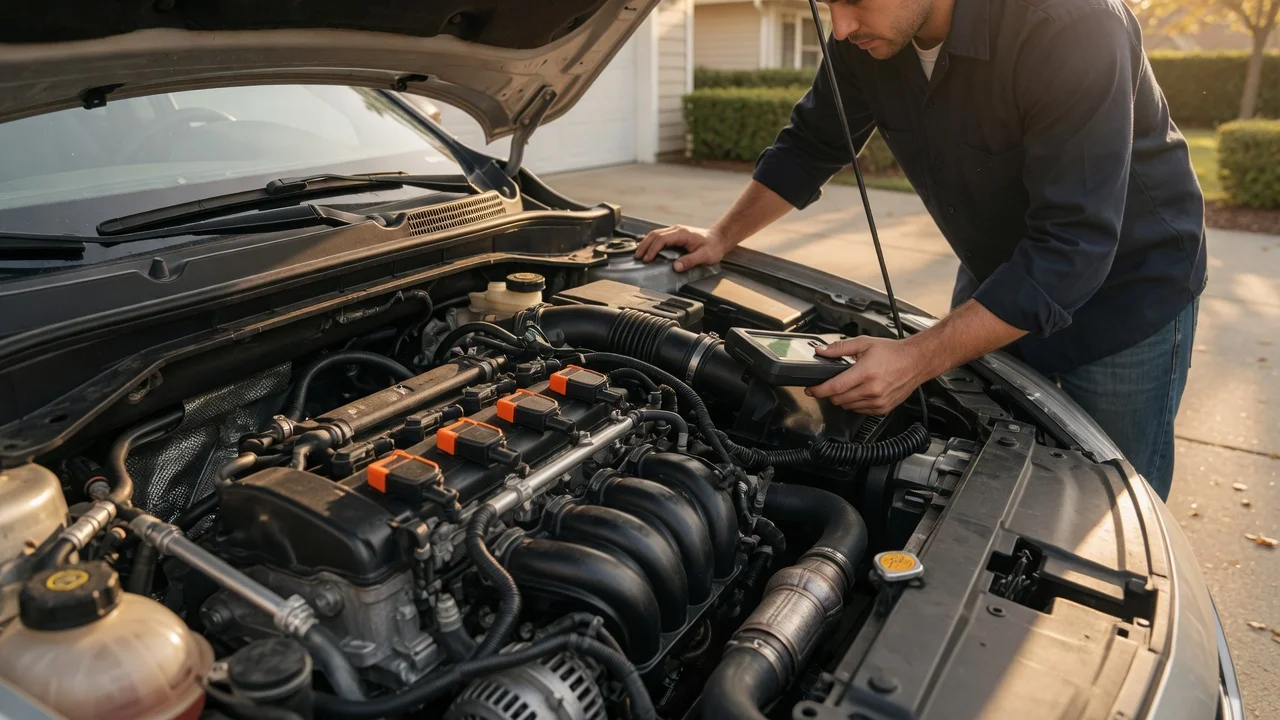
The useful evidence is still in the computer, and it can age out. Scan the vehicle before clearing anything and before many more drive cycles pass. A basic OBD-II reader is enough to see codes, freeze frame, and monitor readiness on most light-duty vehicles; it will not replace a diagnosis of the circuit or mechanical system those codes point to.
Read stored, pending, and permanent DTCs, and note freeze-frame data. Stored or pending codes show which monitor failed even if the MIL is now off. Freeze frame records engine speed, load, temperature, and fuel-trim conditions at the failure and helps separate a cold-start problem from a cruise or wide-open-throttle event. Permanent codes mean the monitor has not yet passed since the fault was confirmed. An empty code list with incomplete monitors is consistent with a recent battery disconnect or a manual clear, not with a completed self-heal.
Do not clear codes yet if you need a diagnosis or an emissions inspection. Clearing resets readiness. Many inspection programs reject a vehicle with the MIL commanded on, with certain stored codes, or with too many incomplete monitors, even if the dash lamp is currently dark.
Inspect the fuel cap and filler neck. Confirm the cap clicks or tightens fully, the seal is not cracked, and the neck is not damaged. Rechecking the cap is reasonable after an EVAP code; replacing related valves, canisters, or lines without a leak test is not justified by the code alone.
Look for drivability clues that match the code family. Rough idle, stumble, fuel smell, a hissing vacuum leak, repeated hard starts, or a change in fuel economy support an engine-performance or EVAP path. A dark MIL with none of those symptoms still leaves an intermittent electrical or EVAP fault on the table.
Note whether the lamp flashed, came on immediately after fueling, appeared only when wet or cold, or has cycled on and off more than once. Flashing points to misfire severe enough to threaten the catalyst. A post-fueling lamp points at EVAP. Weather-linked events point at connectors, ignition parts, or intake leaks. Repeated cycling means the monitor is still failing some trips and passing others.
When to stop driving or get a professional diagnosis
Stop using the vehicle and seek diagnosis if the lamp is flashing, if there is a strong fuel smell, if the engine overheats, if power is lost, if the engine knocks or misfires hard, or if the vehicle is difficult to control. Those are safety and hardware-damage conditions, not inspection nuisances. Repeated on-and-off MIL behavior, a permanent DTC that will not complete, or an upcoming emissions test are also reasons to have the stored data interpreted and the indicated system tested rather than waiting to see whether the lamp stays off.
A shop diagnosis should use the remaining code and freeze-frame data, then test the circuit or subsystem those codes describe. Parts should be replaced only after that testing. If no codes remain and all monitors are complete, the historical fault is no longer present in memory; keep a record of any codes you already captured, because a later return of the same lamp is otherwise starting from zero.