Why Should a Route Plan Include a Backup Road?
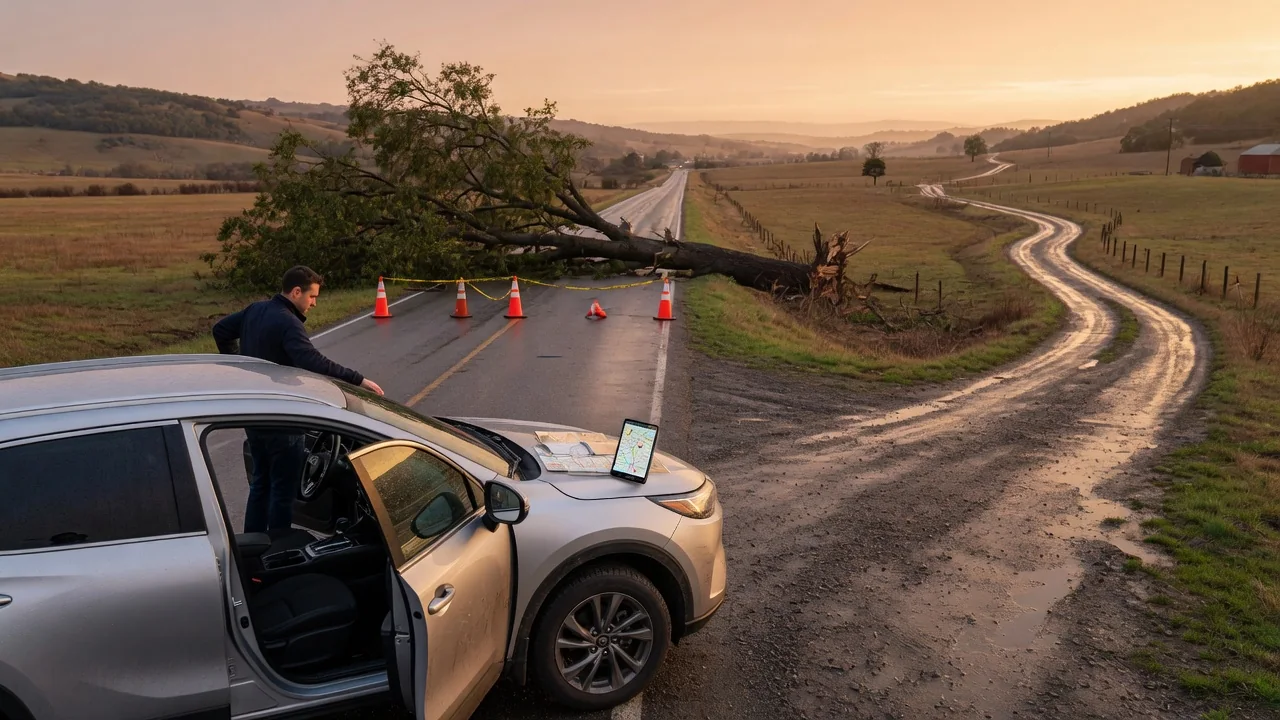
A route plan built around a single road assumes that road will stay open, passable and reasonably quick for the whole trip. In practice, crashes, construction, weather and events can change conditions within minutes. A backup road is a pre-checked alternative for the stretches where losing the main route would hurt most. That is the core reason a route plan should include a backup road: it turns an unexpected problem into a decision you already made with a clear head.
Closures and delays
Road closures rarely come with much warning on the road itself. A serious crash can shut a highway in both directions while emergency crews work and investigators document the scene. Rockslides, flooding, wildfires, snow and ice can close mountain passes or low-lying roads, sometimes for hours and sometimes for days. Planned work zones, bridge repairs and seasonal closures are more predictable, but they are easy to miss if the route was planned weeks earlier and never rechecked. On rural or mountain routes, the next practical way around may be far from the point of closure, so learning about it at the barrier can mean a long backtrack.
Delays are the more common problem. Heavy holiday traffic, lane restrictions, border or ferry queues, and slow trucks on two-lane grades can stretch a leg of the trip without actually closing the road. A backup road gives you a point of comparison: if the main route is crawling and the alternate is clear, you can switch with confidence instead of guessing. The key is identifying the decision points in advance, typically junctions before long stretches with no exits, before mountain passes, or before urban cores known for congestion.
Not every alternate is a real backup. A road that runs parallel but shares the same bridge, pass or valley can be closed by the same event. A useful backup avoids the likely failure point, whether that is a single river crossing, an exposed summit or a stretch prone to flooding. When choosing one, consider why the main route might fail and whether the alternative would be affected by the same cause.
Navigation
Navigation apps can reroute automatically, but that capability depends on a data connection, current traffic information and accurate map data. In remote areas, cell coverage can drop out exactly where options are fewest, and an app may not know about a closure until reports reach it. Automatic reroutes can also send drivers onto roads that are unsuitable for the conditions, such as unpaved forest roads, seasonal routes that are not maintained in winter, or narrow roads not intended for large vehicles or trailers. A backup road you have checked yourself does not depend on the app making a good choice in the moment.
Preparing the backup is mostly a matter of making it available offline and easy to follow. Downloading offline maps for the whole corridor, noting the junction numbers or town names where the alternate splits from the main route, and carrying a printed road map or atlas as a fallback all reduce dependence on a live signal. It also helps to look at the character of the alternate before the trip: whether it is paved throughout, whether it has steep grades or sharp curves, and whether it passes through towns where speed limits drop.
Road and highway agencies commonly publish closure and condition information through their own websites, phone lines and roadside message signs. Checking these sources before setting out and again at stops complements app-based navigation, and when you already know both routes, that information translates directly into a decision.
Fuel implications
A detour is rarely the same length as the road it replaces. An alternate route can add distance, add climbing, or replace steady highway cruising with stop-and-go driving through towns, all of which tend to increase fuel or energy use compared with the original plan. The exact effect depends on the vehicle, its load, the terrain and driving style, so it cannot be estimated with a single rule. What matters for planning is recognizing that switching to a backup road can use a larger share of the tank than the same number of miles on the main route would.
Fuel availability is the second concern. Backup roads, especially in rural areas, may pass few stations, and those that exist may keep limited hours. Before relying on an alternate, check where fuel is available along it and compare that with the range you can reasonably expect from your vehicle under the conditions you are likely to face. Electric vehicle owners face a similar question with charging, where the number, type and availability of chargers along a detour can matter as much as the distance itself.
A simple safeguard is to refuel or recharge before committing to a stretch where the backup road is long or sparsely served, rather than waiting until the gauge is low. Delays on the main route also consume fuel while idling or creeping in traffic, so a long stall followed by a detour can shrink your margin more than either event alone.
Practical implications and limits
Planning a backup road does not mean mapping an alternative for every mile. The effort is best spent on segments where a closure would cause the most disruption: long stretches without intersecting roads, high passes, single crossings of major rivers or bays, and areas with seasonal weather risks. In dense urban networks, where many roads connect, live navigation usually handles rerouting well and a detailed backup adds less value.
There are limits to what a backup can solve. Some regions have only one paved road through them, and when it closes, the realistic choices are waiting or taking a much longer route around the entire area. A backup also loses value when it is out of date, because roads close for construction, seasonal gates open and shut, and bridges are rebuilt; rechecking both routes close to departure keeps the plan accurate. A backup that suits a passenger car may also be wrong for a vehicle towing a trailer, a motorhome or a low-clearance car, so the route should match the vehicle actually being driven and the limits listed in its owner's manual.
Treated as part of normal trip preparation, a road trip alternate route costs little: a few minutes with a map, an offline download and a note of where to turn. The payoff is the ability to respond to a closure or long delay quickly, with a known fuel plan and without depending entirely on a signal or an automated reroute.