Why Should a Restoration Start With a Parts Inventory?
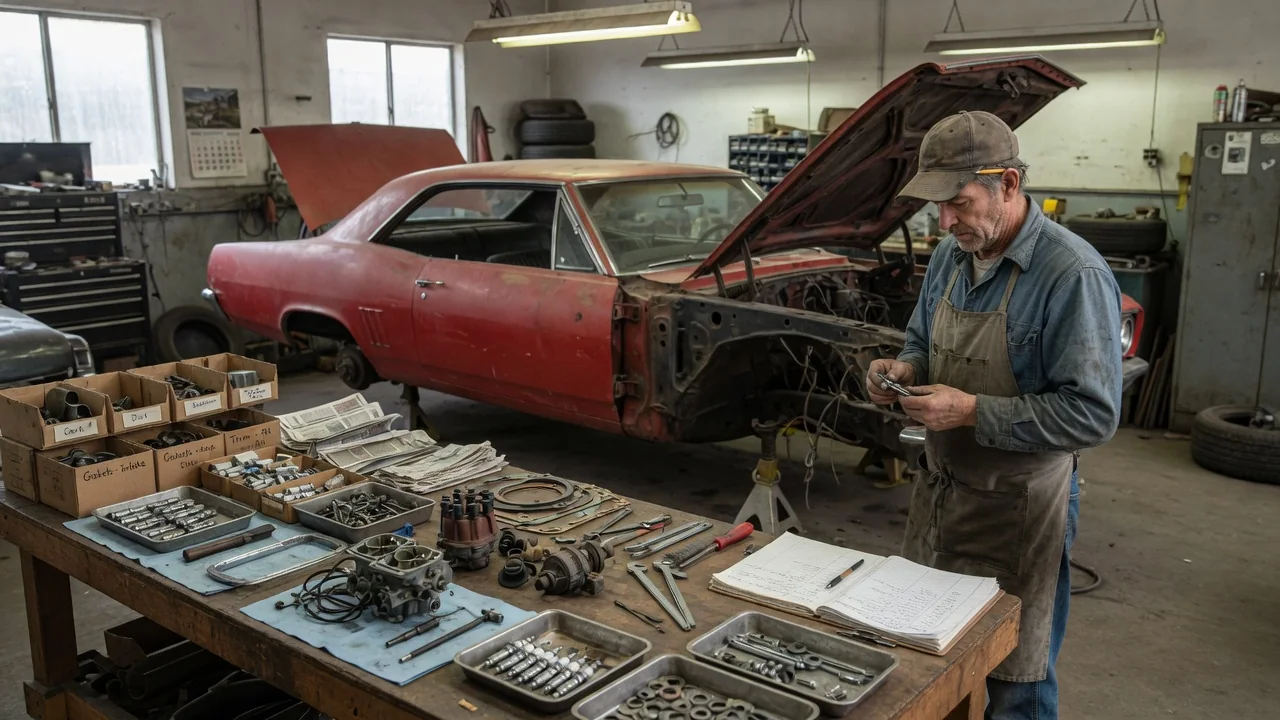
Starting a restoration by unbolting parts feels like progress. But without a record of what the car actually has, every later decision rests on guesswork. A restoration parts inventory turns the vehicle into a documented list of what is present, what is damaged, what is wrong and what is missing. So why should a restoration start with a parts inventory? Because that list drives three things that decide whether a project finishes: identifying missing pieces, understanding availability and setting a sensible work order.
Missing pieces
Project cars are rarely complete. A previous owner may have started disassembly and stopped, sold components separately, stored parts in unlabeled boxes or replaced originals with whatever fit at the time. Large items such as seats, bumpers or a carburetor are easy to notice when they are absent. The real trouble usually comes from small parts: clips, fasteners, trim retainers, brackets, seals, grommets, shims and wiring connectors. These are often overlooked until reassembly, when one missing piece can stop work on an otherwise finished assembly.
A useful inventory works system by system rather than randomly. Typical groups are body and structure, exterior trim, interior, engine, transmission, suspension, steering, brakes, fuel, cooling and electrical. For each part, record its condition in simple categories: usable as is, needs refurbishment, needs replacement or missing. Photographs taken before and during removal make the list far more useful later, as do labeled bags and notes on location and orientation. To know what should be there, compare the car against reference material for that exact vehicle, such as a factory service manual or a parts catalog with exploded diagrams. Component lists vary with model, market, trim level and production period.
Comparing against references also reveals a second kind of problem: parts that are present but incorrect. A component from a different year, a different variant or an aftermarket supplier may look close enough to pass a quick glance. It can still differ in mounting points, dimensions or finish. Record these as gaps on the list so they are not discovered during final assembly. This keeps the restoration goal honest, especially if originality matters to the owner.
Availability
Once the inventory shows what is needed, each item can be sorted by how it might be obtained. Common routes include new parts still supplied by the manufacturer, reproduction parts, and used parts from salvage or other owners. Other options are rebuilding or refinishing the existing piece, or fabricating a replacement. Which routes exist for a given car depends on its age, production volume, market and enthusiast following. Check availability for the specific vehicle rather than assuming it from what is common for others.
Checking availability early matters because scarce parts can define the whole project. A critical trim piece, panel or mechanical component that is hard to find may change the goal from a concours-style restoration to a reliable driver. It may also justify keeping and repairing a worn original instead of discarding it. Parts that require long searches or outside rebuild services can be sourced in parallel with other work, so the project does not stall months later. Early checking also helps avoid the worst outcome: stripping a car down only to learn it cannot reasonably be completed.
Recording part numbers from the vehicle's documentation, where available, makes searching more precise. Treat interchange information with caution. Parts that look similar across related models do not always fit or function the same, so confirm them against a vehicle-specific catalog. Keeping removed parts until replacements are verified also preserves a reference sample for comparing size, shape, connectors and fastener patterns.
Work order
Restoration work follows dependencies. Structural and rust repair generally comes before body finishing, and paint usually comes before trim installation. Wiring, lines and insulation are often easier to route before interior and engine components fill the space. The exact sequence depends on the vehicle's construction and the scope of the job, but the principle is consistent. Some tasks cannot begin until others are finished, and some cannot be finished until the right parts are on hand.
An inventory lets the work order account for parts rather than ignore them. Items with long or uncertain lead times can be ordered first, and tasks can be scheduled around parts that are already in hand. This reduces the risk of installing an assembly that must be removed later to fit a late-arriving component. It also supports test-fitting before final finishes are applied. Reproduction or used parts can then be checked for fit and alignment while adjustments are still practical, not after paint or plating.
The same documentation that tracks missing parts also links disassembly to reassembly. Notes on which fasteners came from which location, how brackets were oriented and how wiring was routed become the guide for putting the car back together. Without that record, even a complete set of parts can lead to delays. The restorer must reconstruct details that were plainly visible on the day the car came apart.
Practical implications and limits
In practice, an inventory turns budgeting and scheduling from rough guesses into estimates tied to a concrete list. It helps the owner decide the scope of the project before money is committed. It also gives a shared reference if parts of the work go to outside shops or other helpers. The format matters less than consistency: a spreadsheet, database or notebook can work. Each entry should record the part, its condition, its status and where it is stored. The level of detail can be scaled to the project, though skipping small hardware tends to cause the most trouble later.
An inventory also has limits. It is a snapshot of what can be seen at the time it is made. Hidden damage, such as corrosion under seams or wear inside an engine or transmission, often cannot be judged until components are opened. The list must be updated as disassembly reveals more. Availability changes over time as suppliers add or drop products and used parts circulate. Reference documents may not reflect every production variation or later modification. Finally, an inventory does not replace proper inspection of safety-critical systems such as brakes, steering and structure.