Why Is My Car Vibrating? Causes, Warning Signs, and Diagnostic Clues
Car vibration while driving can range from a faint buzz through the seat to a steering wheel that shakes in your hands. Tires, wheels, brakes, driveline parts, the engine, and suspension can all cause similar sensations. The best first step is careful observation. Knowing when and where the shaking appears helps you decide how urgently to act and gives a technician a clear place to start.
Recognize Vibration That Needs Urgent Attention
Every vehicle passes along some feedback from the road and engine. A light hum over coarse pavement or a brief shudder at startup is not automatically a problem. Still, no universal threshold separates acceptable vibration from a fault, and vehicles differ widely in how well they isolate occupants. What matters more is change. Shaking that is new, persists across different roads, or grows stronger over days or weeks deserves a professional assessment rather than a wait-and-see approach.
Some symptoms mean you should pull over as soon as it is safe: sudden severe shaking, steering that becomes hard to control, weak or erratic braking, a visibly damaged tire, smoke, or a flashing engine warning light with rough running. In those cases, stop driving and arrange roadside assistance or a tow. A mild sensation is no guarantee of safety either, because intensity alone cannot reveal which component is involved or how close it is to failing.
Record When the Vibration Happens
A simple symptom log turns a vague complaint into useful evidence. After each trip, once you are parked, write down the approximate speed where the vibration appeared. Note whether it happened while accelerating, cruising steadily, or braking, and what kind of road surface you were on. Also note whether the car shakes while stopped with the engine running. Rely on ordinary driving only. Avoid deliberate high-speed runs or hard stops, and never write notes while the car is moving.
These details matter because vibration often tracks vehicle speed, engine speed, or pedal input. Shaking that follows road speed regardless of gear may point toward rotating parts at the wheels or driveline. Shaking that follows engine speed, including at idle, shifts attention toward the engine and its mounts. These patterns narrow the search but do not prove a cause. Also record when the symptom began, how long episodes last, and whether it followed new tires, brake work, or a hard pothole impact.
Understand the Main Sources of Car Vibration
Tires and wheels are a natural first suspect because they spin constantly at road speed. An imbalanced tire and wheel assembly, a tire with irregular shape or uneven wear, or a wheel bent by an impact can each create a repeating disturbance as the car rolls. Not every vibration calls for balancing, since a damaged tire keeps shaking even when perfectly weighted. Brake pulsation, felt mainly while slowing down, can come from irregularities in brake components and needs inspection before a cause is assigned.
Driveline layouts vary. Depending on the vehicle, power may travel through axle shafts, a driveshaft, and various joints, and wear in those parts can cause shaking that changes with acceleration or load. Uneven engine operation, such as a misfire, causes roughness that tends to follow engine speed. Worn or damaged mounts let normal engine movement reach the cabin. Worn suspension or steering parts may not start a vibration, but they can amplify one, so a broader inspection is often worthwhile.
Describe Where You Feel It and What You Hear
Where you feel the vibration adds another clue. Notice whether it comes through the steering wheel, the pedals, the seat, the floor, the dashboard, or several places at once. Steering wheel shake is often associated with the front of the vehicle and seat vibration with the rear or driveline, but those are tendencies rather than rules. Vibration travels through the body structure, so where you feel it cannot reliably identify a specific wheel, axle, or component.
Sounds help fill in the picture. A steady hum that rises with speed, a rattle over bumps, a clunk when accelerating, or scraping while braking can each point toward different areas to inspect, especially if the sound begins at the same moment as the vibration. While parked, check the cabin and cargo area for loose items such as tools, bottles, or unsecured trim that could rattle. Silencing those items is worthwhile, but it does not resolve an underlying driving vibration.
Make Sense of Rhythmic or Intermittent Vibration
Rhythmic vibration is a repeating pulse or shake with a regular beat. Intermittent vibration appears for a while and then disappears. A rhythm that speeds up as the car moves faster may relate to something rotating, such as a tire, wheel, or shaft. However, evenly spaced road joints on a highway can create a similar pattern. The beat alone cannot identify the faulty part, but noting whether it tracks road speed or engine speed gives a technician a useful direction.
For symptoms that come and go, look for what the episodes have in common. Note whether they happen on a particular road surface, with a cold or fully warmed engine, under a heavy load, at certain speeds, or when you press a pedal. Do not deliberately recreate risky conditions. A vibration that fades does not mean the fault has fixed itself. A short history of dates and conditions is especially valuable when a shop cannot reproduce the symptom during a brief visit.
Give the Mechanic Useful Clues for Testing
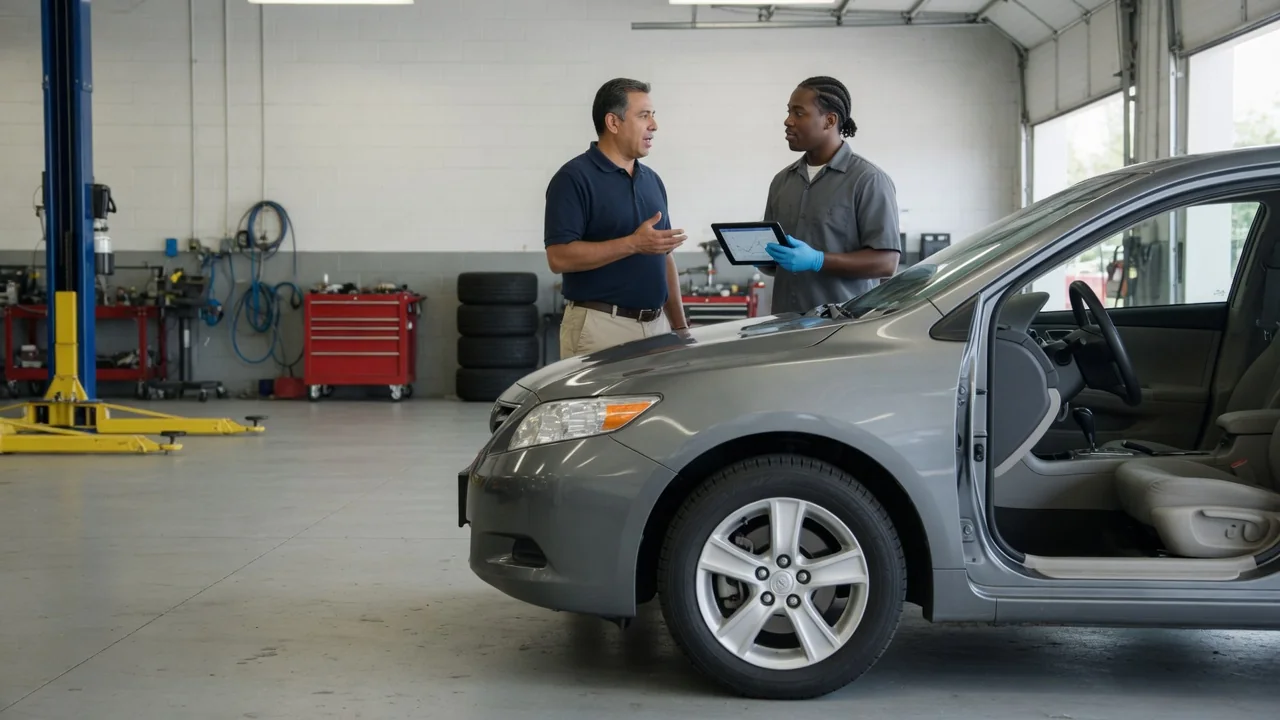
Bring a short summary to the shop. Include your symptom log, where you feel the vibration, any sounds that come with it, warning lights that have appeared, recent tire, brake, or suspension work, and any impacts with potholes or curbs. With that information, a technician may inspect the tires and wheels for damage and wear, check balance and measure runout, assess the brakes, and examine the steering, suspension, and driveline for looseness or wear.
When rough running is part of the complaint, engine data and a fault-code scan may help. A stored code is evidence to interpret, not proof that a part has failed, and code meanings can vary by manufacturer. Many mechanical sources of vibration never set a code at all. No single vibration test covers every cause, so the technician chooses checks based on your description and may take the car on a road test when it is safe to do so.
Choose Repairs After the Cause Is Confirmed
Once a cause is confirmed, repairs usually fall into broad categories: correcting a tire or wheel problem, servicing the brakes, repairing worn mechanical parts, or fixing uneven engine operation. Limit your own checks to safe observations while parked. Look for bulges, cuts, or unusual wear on the tires, and when it is safe, compare tire pressure with the vehicle placard. Lifting the car, removing wheels, and working on brakes or driveline parts are jobs for a qualified professional.
Replacing parts on a hunch, asking for an alignment by default, or adding vibration-damping products may hide symptoms or cost money without fixing the real fault. Ask the shop to document what caused the vibration, what repair was done, and how they confirmed that the reported symptom was fixed, ideally under the same conditions you recorded. If the vibration continues or comes back later, return for another assessment, because a second problem or an incomplete repair may still be present.