Why Is My Car Overheating? Cooling-System Causes Explained
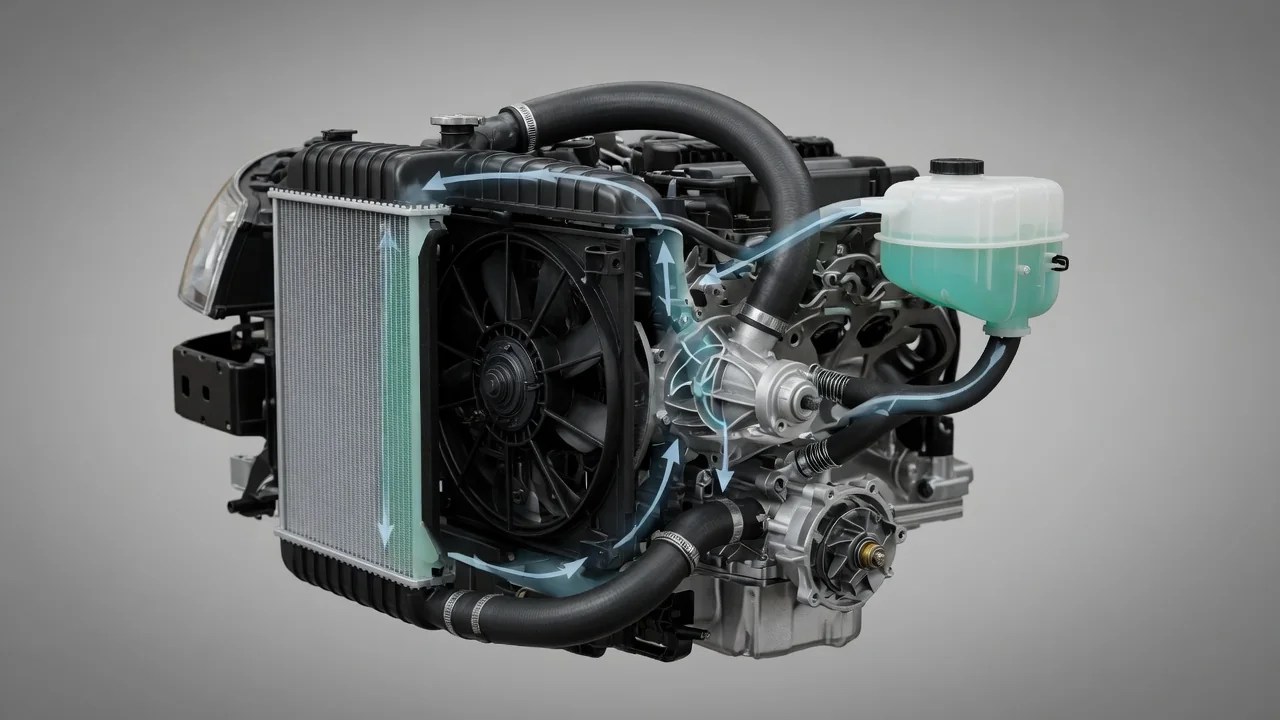
When a car is overheating, the temperature gauge or warning is telling you the engine is producing more heat than the cooling system can remove. The cause may be as simple as low coolant or as serious as an internal engine leak. If you understand how the cooling system works and what evidence points to each fault, you and a technician can find the real problem instead of guessing at parts.
What Engine Overheating Means and Which Signs Matter
Overheating means the engine's temperature has risen above the range it was designed to run in because the cooling system isn't removing enough heat. Combustion produces heat constantly, and the cooling system has to carry enough of it away. Coolant flows through passages in the engine block and cylinder head, absorbs heat, and travels to the radiator. There, the heat moves through thin tubes and fins into the air passing over them, with help from the car's movement and the cooling fan. If circulation, heat transfer, or airflow falls short, the temperature rises.
A temperature gauge that climbs above its usual position, or a temperature warning light or message, is a reason to investigate. It is not a diagnosis. Normal gauge behavior differs between vehicles, and many gauges are designed to hold steady across a range of temperatures, so no single number defines trouble for every car. The warning also can't tell you which part failed. A technician may check the actual engine temperature with a scan tool or other instrument, because a faulty sensor or circuit can give misleading readings.
Low Coolant, Leaks, and Loss of Cooling-System Pressure
Coolant is what carries the heat, so running short disrupts the whole process. With too little fluid, parts of the engine may not be fully covered by coolant, and the water pump can pull in air instead of liquid. Trapped air pockets can also block flow and create local hot spots. These can linger after a leak or after the system has been opened for service. The system is designed to run under pressure, which raises coolant's boiling point, so losing pressure leaves less margin before the coolant boils.
Leaks can develop at hoses, clamps and connections, the radiator, the coolant reservoir, or the water pump seal, and no one source is typical of every vehicle. When the engine is fully cold and your owner's manual allows it, you can compare the reservoir level with its markings and look for puddles or dried residue around those parts. Coolant that keeps disappearing needs to be investigated. A cooling-system pressure test can help a technician find external leaks and check whether the system holds pressure.
How Thermostat and Water Pump Faults Disrupt Circulation
The thermostat controls when coolant flows to the radiator. It stays closed while the engine warms up, then opens to send hot coolant to the radiator. If it sticks closed or opens only partway, coolant stays trapped in the engine, and heat can't reach the radiator fast enough. The water pump is what moves the coolant. A worn impeller, a failing bearing or seal, or a problem with whatever drives the pump on a particular design, such as a belt or an electric control, can reduce circulation.
Seepage near the pump, a stain at its weep hole, or a grinding or whining noise can be useful clues. However, a quiet, dry pump isn't proof that it is moving enough coolant, because internal wear can reduce flow without any outward sign. Thermostat designs and pump drives vary, and some engines use electronically controlled versions, so checks should follow the service information for that vehicle. A technician can confirm how the thermostat and coolant circulation are working with temperature measurements and scan data before recommending either part.
Radiator and Cooling Fan Problems That Limit Heat Removal
The radiator can only get rid of heat if coolant flows freely through its tubes and air passes freely across its fins. Inside, scale, corrosion, or sediment from old or mixed coolant can narrow the passages. Outside, leaves, insects, road debris, or bent fins can block airflow, including debris trapped between the radiator and the air-conditioning condenser. When the car's movement doesn't push enough air through, the cooling fan provides it. Faults in the fan motor, wiring, relay, or control module can reduce that airflow, as can a worn fan clutch on vehicles with a mechanically driven fan.
With the vehicle off and the engine fully cold, you can look through the grille for obvious debris or damaged fins. Keep your hands and tools away from electric fans, because many can start on their own even with the ignition off. A fan that isn't spinning when you happen to look hasn't necessarily failed, since fans run only when the control system turns them on based on temperature and air-conditioning demand. A technician may switch the fan on with a scan tool and test its power, ground, and control circuits to see whether it responds correctly.
When a Head Gasket Leak May Be Involved
The head gasket seals the joint between the cylinder head and the engine block, keeping the combustion chambers, coolant passages, and oil passages separate. If that seal breaks down, high-pressure combustion gases can be forced into the cooling system. The gases push coolant out of place, form air pockets, and put extra pressure on hoses. Coolant can also leak into a cylinder and burn. Either way, the engine's temperature control suffers. The problem can start from either direction: severe overheating can damage the gasket, and a failing gasket can cause overheating. Symptoms alone rarely show which came first.
Possible clues include coolant loss with no visible external leak, exhaust vapor that continues after the engine has fully warmed up, and oil or coolant that looks contaminated. Each of these has other possible explanations, such as normal condensation, a leak from an outside component, or a different internal fault, so none is conclusive by itself. If there's good reason to suspect the gasket, a technician can test the coolant for combustion gases and run a pressure test to see whether pressure drops without an external leak. Compression or cylinder leak-down testing can show which cylinder is affected.
How to Narrow the Cause Without Guessing at Parts
A methodical diagnosis starts by confirming that the engine really is running hot, rather than relying on one gauge reading. The next step is to check the coolant level and look for external leaks, since a shortage is easy to verify. After that, attention moves to circulation, meaning how well the thermostat and pump are working, and then to how well the radiator and fan remove heat. It helps to write down any warning messages, how often you've added coolant, where you've seen residue, any sweet or burning smells, and any recent cooling-system work.
Symptoms often overlap, and more than one fault can be present at once. Low coolant might be the result of a head gasket leak, or a partly blocked radiator combined with a weak fan might be enough to raise the temperature. That's why one observation rarely settles the question. Overheating that keeps coming back, coolant loss with no visible explanation, or signs of an internal leak all call for professional testing. Giving the technician your notes speeds up the diagnosis and helps make sure the parts replaced are the ones actually causing the problem.