Why Is My Car Leaking Coolant? Causes and How to Find the Source
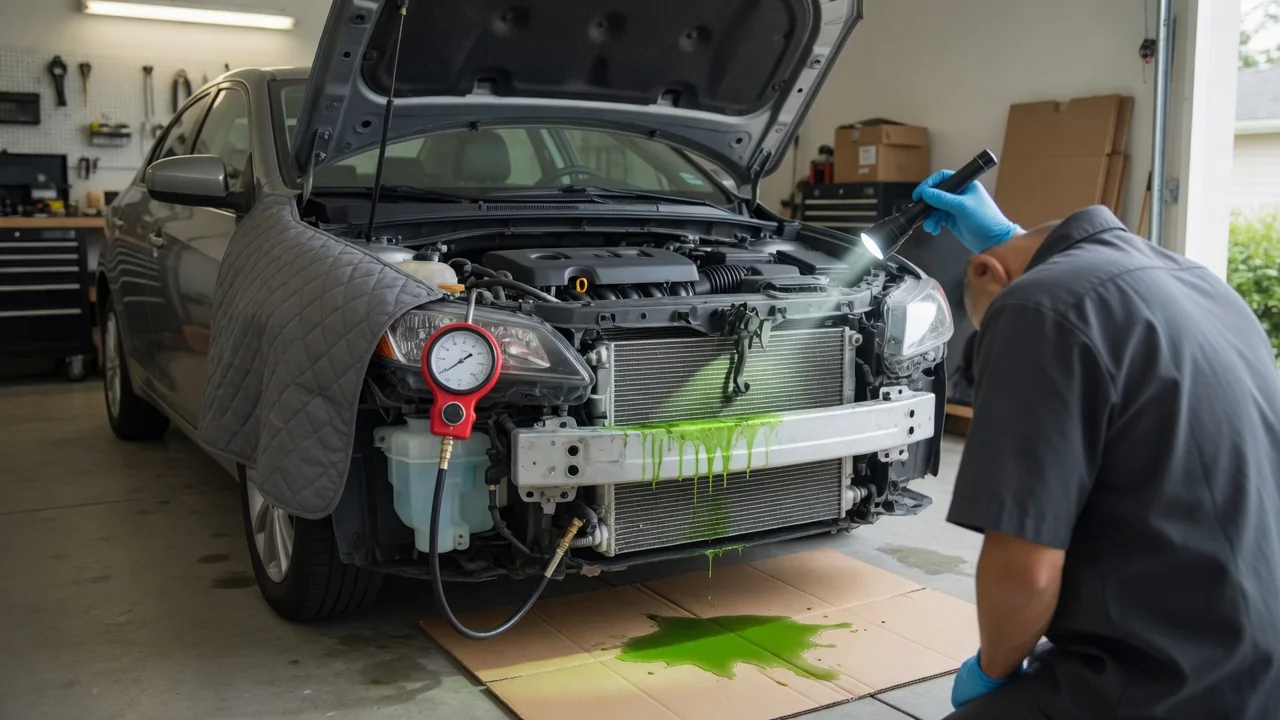
A coolant fluid leak rarely fixes itself, and ignoring one is a common path to an overheated engine. Most leaks leave clues: a puddle, a sweet smell, a dropping reservoir, or crusty residue on a hose joint. You can narrow down the source before real damage occurs by confirming the fluid, learning where leaks start, and using visual checks and pressure testing.
How to confirm the fluid under your car is coolant
Coolant feels slightly slick and has a faint sweet smell. Water has no odor and dries cleanly. Engine oil is darker and greasier, and washer fluid often smells like glass cleaner. Air-conditioning condensation is plain water that drips near the firewall on warm days. Coolant may be green, orange, pink, blue, or yellow depending on its formulation. Color can help confirm that a drip is coolant, but it should never be used to identify the exact type in the system.
A coolant puddle usually forms toward the front of the car, beneath the radiator or engine. Cardboard slid under the front overnight shows where drips land and how quickly fluid escapes. Watch for a low-coolant or temperature warning, a sweet smell after driving, or a fogged windshield. Check the reservoir only when the engine is fully cool, never open a hot cap, and read the level against the min and max marks. A small drop after recent service can be trapped air purging, so look for a loss that repeats over several days.
Where coolant leaks start: the main components that fail
Leaks can start anywhere coolant flows. The usual suspects are the radiator end tanks and core, the upper and lower hoses, hose clamps, the pressure cap, the water pump seal, the thermostat housing, the heater core, and the plastic reservoir. Each tends to leave its own signature. Crusty deposits beneath a hose joint point to that connection, and a wet streak below the water pump weep hole or pulley points to the pump. A damp passenger-side carpet and a sweet cabin smell point toward the heater core.
Age plays a large role. Rubber hoses harden and crack, plastic tanks grow brittle from repeated heat cycles, gaskets shrink, and clamps lose tension. Many of these leaks appear only when the system is hot and pressurized, so a car can drip after a drive and look dry when parked cold. Coolant also runs along hoses and brackets, so the source is often higher than the puddle. If coolant disappears with no external trace, an internal leak such as a head gasket or heater core needs professional testing.
Cracked or dripping radiator: what you can observe safely
A cracked radiator often seeps where the plastic end tanks meet the aluminum core, and white or colored crust builds along the tank seams. Drips may also form at the lowest point of the core. Road debris, front-end impacts, corrosion, and repeated overheating all contribute to cracks and pinholes. A small radiator drip rarely seals itself. Heat cycling and pressure tend to widen the gap, so the loss rate usually grows over time.
With the engine cold and off, shine a flashlight on the radiator from above and below. Check the tank seams, the hose necks, and the drain petcock, and note where the wetness begins. Never touch or probe a radiator on a hot engine. Avoid long drives once a crack is confirmed, because the leak can worsen suddenly. A puddle beneath the radiator does not prove the radiator is at fault, since hoses, the water pump, and the reservoir can drain onto the same spot.
Step-by-step visual inspection to trace a coolant leak
Park on level ground, let the engine cool completely, and open the hood. Start at the reservoir and cap, then follow each hose and joint downward. At every connection, look for dampness, dried colored residue, swollen or soft spots in hoses, loose clamps, and stains running down from higher up. Check the water pump area, the thermostat housing, and the heater hose connections at the firewall. Then inspect the cabin floor, and notice whether the defroster leaves a greasy film on the glass.
Wiping suspect areas with a clean paper towel makes new moisture easier to spot. After a short drive and a full cool-down, check those same areas again with a flashlight to see where wetness returns. A visual check has limits, though. Intermittent leaks and leaks that appear only under pressure often stay hidden, and some seep so slowly that they evaporate before leaving residue. If nothing turns up but the reservoir level keeps dropping, a pressure test is the logical next step.
Cooling system pressure testing to find hidden leaks
A cooling system pressure tester fits an adapter where the radiator or reservoir cap normally sits and uses a hand pump to pressurize the cold system. Leaks then show up as drips, hissing, or a falling gauge. Only run the test on a cold engine, and never go above the pressure rating printed on the cap or listed in the owner's manual. A steady gauge points away from external leaks, and a quick drop usually exposes the source. A slow drop with no visible wetness suggests a hidden or internal leak.
Most kits include a cap adapter. This matters because a cap that cannot hold its rated pressure lets coolant escape as steam or overflow, with no crack anywhere else. Many repair shops can run this test, and some parts stores lend testers. For slow leaks that don't show during a short test, UV dye is a related method. The dye goes into the coolant, and after several days of driving, an ultraviolet light makes it glow wherever coolant has escaped.
Coolant leak plus overheating: what it means and what to do
Low coolant leaves air pockets in the engine and reduces heat transfer, so the temperature gauge may swing or spike without warning, especially at idle or in slow traffic. If the warning appears while coolant is leaking, turn the heater to high to shed some engine heat. Pull over as soon as it is safe and shut the engine off. Wait until the engine has cooled fully before opening the hood. Never remove the radiator cap on a hot system, because pressurized coolant can cause serious burns.
Pouring cold water into a hot engine can also cause damage. Top up only once everything is cold, and only to get the car to help. White exhaust smoke, milky oil, coolant loss with no puddle, or repeated overheating after a refill all suggest more than a simple external leak and call for professional diagnosis. Driving while the engine overheats risks warped cylinder heads and blown gaskets. Towing is often the safer choice when the leak is large or the gauge climbs quickly.
When to stop diagnosing and get professional testing
Home inspection has reached its limit when visual and pressure checks find no source. The same goes for coolant loss with signs of internal leakage, or a suspected heater core behind the dashboard. A shop can test the coolant for combustion gases or run a cylinder leak-down check to see whether pressure escapes into the cooling system. It can also pressure-test the system at operating temperature under controlled conditions. Results should be weighed alongside the symptoms, not treated as automatic proof that a part has failed.
Coolant is toxic to people and animals, and its sweet taste can attract pets. Clean up spills promptly and keep animals away from puddles. Dispose of drained fluid properly rather than pouring it onto the ground or down a drain. The right fix depends on the confirmed source and the specific vehicle, so pinpointing the leak comes first. Knowing exactly where coolant escapes allows a focused repair instead of replacing parts on guesswork.