Why Is DC Fast Charging Limited by the Car? Voltage, Current and Heat
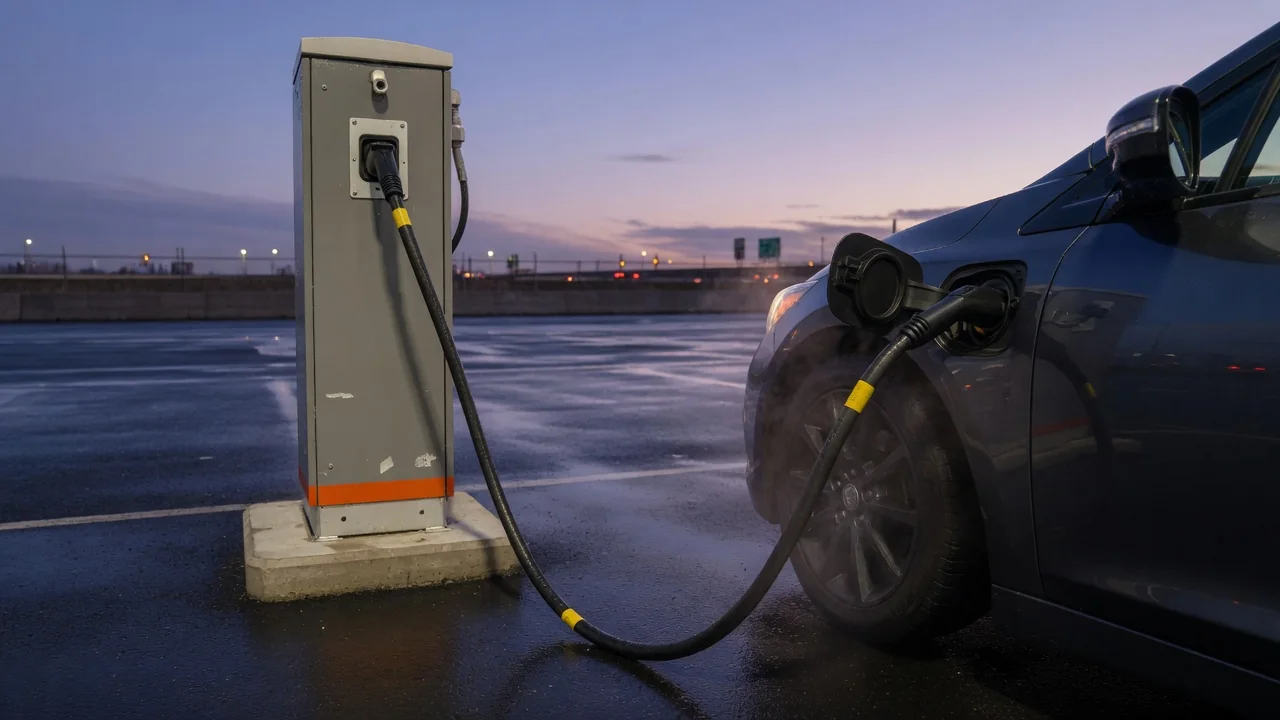
A DC fast charger may advertise a high power rating, yet the electric vehicle plugged into it often draws much less. That is because the car, not the station, decides how much power it will accept at any moment. Its battery management system continuously requests a specific voltage and current based on the battery's state of charge, its electrical design and its temperature. These three factors explain why DC fast charging is limited by the car and where a vehicle's DC charging limit comes from.
Battery voltage
Charging power equals voltage multiplied by current. During DC fast charging, the charger's output passes through the vehicle's charging inlet and contactors directly to the high-voltage battery, bypassing the onboard AC charger. The charging voltage must therefore match the battery's own voltage, which is set mainly by how many cells are connected in series. A pack with a lower nominal voltage needs more current to reach the same power as a pack built for a higher voltage. Every charger, cable and connector has a maximum current rating. As a result, a lower-voltage vehicle can reach that current ceiling well before it reaches the station's advertised power figure.
Battery voltage also changes during a session. As the state of charge rises, cell voltage rises too and approaches the upper limit the cell chemistry can safely tolerate. Pushing a cell past that limit risks lithium plating, accelerated degradation and, in extreme cases, thermal problems. To protect the cells, the battery management system moves from a constant-current phase to a constant-voltage phase near the top of the charge, and current tapers off. This is the main reason charging slows markedly at a high state of charge, whatever charger is used.
Voltage compatibility matters as well. Some vehicles use higher-voltage battery architectures, while some chargers were designed around lower output voltages. When a charger cannot supply the voltage a pack requires, the outcome depends on the vehicle's design. Some vehicles convert the voltage on board, and others may charge more slowly or not at all on that equipment. How a particular car handles this is vehicle-specific and is described in its owner documentation.
Current
Current is the second half of the power equation, and the car limits it at several points. Lithium-ion cells have a maximum charge rate, often expressed as a C-rate, that depends on chemistry, electrode design and state of charge. The battery management system calculates an allowable current from these properties and requests no more than that from the station. The charger follows the vehicle's request. It does not push current into the battery on its own.
Beyond the cells, every component in the charging path carries current and produces heat in proportion to the square of that current multiplied by its resistance. The inlet pins, high-voltage cables, busbars, fuses and contactors each have a current rating chosen by the vehicle designer. Even if the cells could briefly accept more, the most restrictive of these components sets a hard ceiling. This is one reason higher-voltage designs are attractive, because they deliver the same power with less current. Lower current reduces resistive heating and allows lighter conductors.
Current requests also change throughout a session. Vehicles follow a charging curve, which is a programmed profile that maps allowed current against state of charge, temperature and other conditions. The curve generally permits the highest current at a low or moderate state of charge and steps down as the battery fills. The exact shape of the curve differs between manufacturers and, on some vehicles, can be revised through software updates.
Temperature
Temperature often determines whether a vehicle reaches its best charging rate at all. Lithium-ion cells accept charge most readily within a moderate temperature window. When the battery is cold, the chemical reactions and ion movement inside the cells slow down. Forcing high current under those conditions can cause lithium to plate onto the anode surface instead of moving into the anode material. That damage is largely irreversible, so the battery management system sharply restricts current until the pack warms up.
Excess heat is the opposite problem. Fast charging generates heat inside the cells and across the conductors, and the vehicle's thermal management system must remove it. Depending on the design, it may use liquid coolant, a refrigerant circuit or another method. If the pack approaches its upper temperature limit, the vehicle reduces current to keep the cells within a safe range. Cooling capacity, ambient conditions and recent driving or charging all affect how quickly that point is reached.
Many vehicles can precondition the battery, heating or cooling it before arrival at a fast charger so that it starts the session closer to its preferred temperature. Where this feature exists, it may be triggered by navigating to a charging location in the built-in navigation system or by a manual setting. Availability and operation vary by vehicle, so the owner's manual is the reliable reference.
Practical implications and limits
For drivers, the key point is that a charger's power rating describes the most it can deliver, not what a given car will receive. Choosing a higher-rated station helps only when the vehicle can accept more than a slower option provides. The more useful figure is the vehicle's maximum DC charging rate in its specifications. Keep in mind that this peak usually applies only under favorable conditions and for part of a session.
Because charging slows as the battery fills, each additional mile of range generally takes longer to add near the top of the charge. On longer trips, it is often more time-efficient to arrive at a charger with a lower state of charge and continue driving once the rate has dropped substantially, rather than waiting for a full battery. A cold pack that has not been preconditioned, or a pack already hot from hard driving, can each reduce the rate for reasons that have nothing to do with the station.
Owners can change only some of these factors. Cell chemistry, pack voltage, component ratings and cooling hardware are fixed at the design stage. Software updates can sometimes adjust charging behavior, but they cannot exceed the physical limits of the hardware. Station-side factors, such as power shared between stalls, cable condition or an equipment fault, can also lower the rate, so a slow session is not always caused by the car. If a vehicle consistently charges well below expectations under good conditions, a dealer or qualified technician can inspect the battery and charging system for faults.