Why Does the Same EV Charge Differently at Two DC Stations?
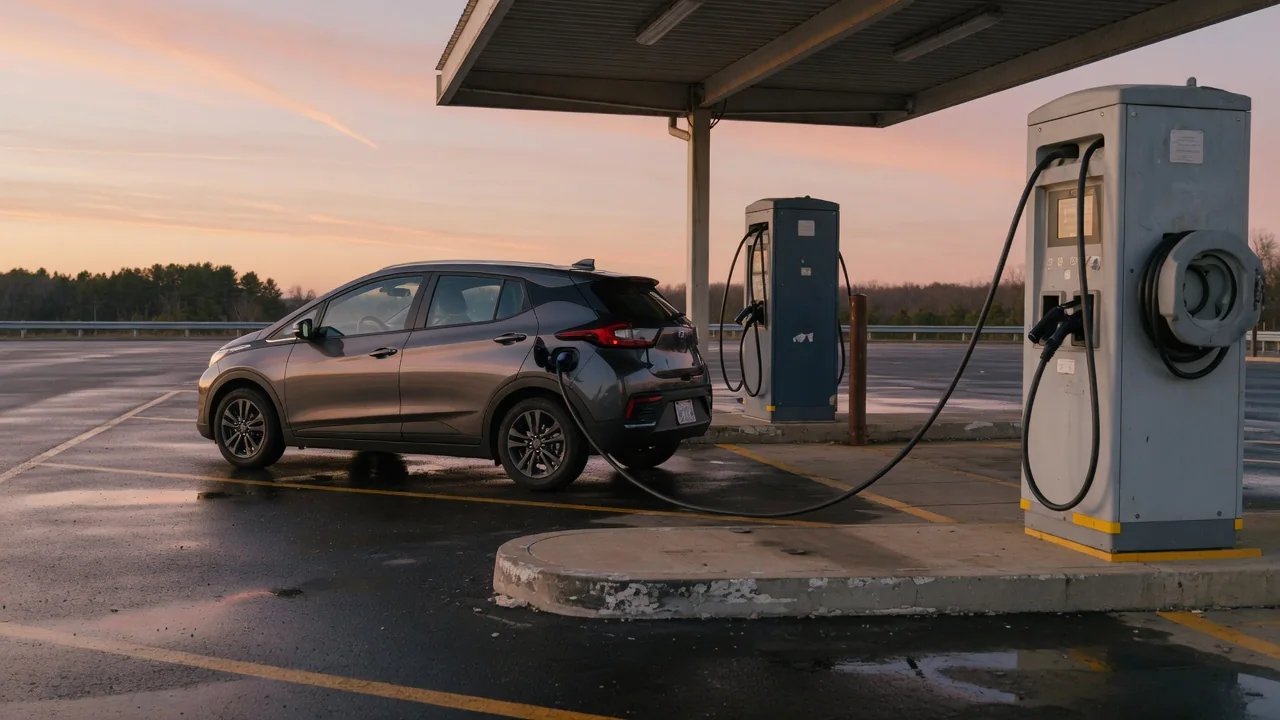
At one DC fast charger the power figure climbs quickly. At another, the same car seems to crawl. A difference like this rarely comes from a single fault. The station and the vehicle's battery management system negotiate charging power continuously, and the lower of their limits always wins. Station hardware, the battery's state when you plug in, and the conditions around the session all affect that negotiation.
Station power: what the charger can actually deliver
The power rating on a DC charger is a maximum, not a promise. Delivered power equals voltage multiplied by current, and every station has a ceiling for each. A charger may reach its headline rating only within a certain voltage range. A battery pack with a lower nominal voltage needs more current to draw the same power, so it can hit the station's current limit well before the rated kilowatts. A pack with a higher operating voltage can run into the opposite problem: if the station's maximum output voltage sits below what the pack needs, the station cannot charge it directly. Some vehicles handle this with onboard conversion hardware, which can bring its own limits. Two stations with the same advertised rating can therefore deliver noticeably different power to the same car, simply because their voltage and current envelopes differ.
Many fast-charging sites do not give each dispenser a dedicated, fixed supply. A central power cabinet may feed two or more posts and divide its output among the vehicles connected. If another car starts charging on a paired post, your share can drop partway through the session. The whole site may also face a cap from its utility connection or a load management system, and the operator can set software limits that keep output below the hardware's theoretical maximum.
Hardware condition matters too. Fast chargers are typically built from several power modules, and if one is faulty or offline, the unit can keep working at reduced output without showing an obvious error. Stations also manage their own heat. Power electronics, cables and connectors carry temperature sensors, and a charger running hot on a summer afternoon, or fitted with a cable that cannot shed heat quickly, may reduce current to protect itself.
Battery state: why the car sets the pace
State of charge is often the biggest single factor. Lithium-ion batteries accept their highest power when they are relatively empty. As the cells fill, the battery management system tapers current to keep cell voltages within safe limits. A plot of power against state of charge is usually called the charging curve. Its exact shape varies by vehicle, but the general pattern of strong power early and declining power later is common. If you arrived at one station with a low charge and at another with the battery already half full, the second session will almost certainly look slower, even if both stations are identical.
Battery temperature is the next major variable. Cells accept fast charging best within a moderate temperature window. When they are cold, high current increases the risk of lithium plating on the anode, which can permanently reduce capacity, so the vehicle limits power until the pack warms up. When the cells are already hot, the system may also reduce power to slow heat buildup and protect long-term health. Many EVs offer battery preconditioning, which heats or cools the pack before arrival, often when a fast charger is set as the navigation destination. Whether and how this works depends on the specific vehicle.
Other internal factors can shape the session in less visible ways. Imbalance between cells, battery aging and recent heavy use can all lead the management system to apply more conservative limits. The strategies differ widely between manufacturers and are not usually published in detail. That is one reason general rules can explain trends but cannot predict a particular car's exact numbers.
Conditions around the charging session
Ambient conditions affect both the battery and the station at once. A car that has been parked overnight in freezing weather starts with cold cells. The same car arriving after a long highway drive in mild weather may have a pack already near its preferred temperature. Direct sun on the charger, high outdoor temperatures or poor airflow around the cabinet can push the station toward thermal limits. Comparing a winter morning session with a spring afternoon session mixes several variables together.
DC charging depends on digital communication between the vehicle and the station. The two exchange voltage, current and temperature limits throughout the session. A failed or partial handshake, a software incompatibility, or an adapter between connector standards can lead to lower negotiated limits or an interrupted session. A worn or dirty connector can raise contact resistance, which creates heat at the pins and may trigger derating on either side. A session that restarts after an error does not always return to its previous power level.
Timing plays a part as well. A site that is quiet at midnight may be fully occupied in the late afternoon. Shared cabinets and site-wide caps then spread the available power across more vehicles. Neither the car nor the driver can see these constraints directly, so a session can look unexpectedly slow even when the station and battery are both healthy.
Practical implications and limits
To judge whether one station is genuinely slower, compare like with like. Note the starting state of charge, the weather and how far you drove beforehand. Average power across the session, or the time needed to add a set amount of charge, tells you more than a brief peak figure. The station display and the vehicle display may also show slightly different power values, because they can measure at different points in the system and may or may not account for conversion losses. Small discrepancies between them are normal.
Several habits can help when time matters. Use your vehicle's preconditioning feature if it has one. Pick a post that is not paired with an occupied neighbor when the site makes that clear. Try another stall if a session stays unusually low, and report persistent faults to the network operator. Plugging in at a lower state of charge and unplugging once power drops sharply often shortens stops, although the best stopping point depends on your route and the next available charger.
These mechanisms explain why results vary, but they cannot tell you exactly how a given car will behave. Charging curves, temperature thresholds and preconditioning logic are vehicle-specific, so the owner's manual and the manufacturer's guidance are the authoritative references. If charging stays slow across many different stations in favorable conditions, the cause is more likely on the vehicle side, and a qualified service center is the right place to diagnose it.