Why Does Suspension Alignment Shift When Loaded?
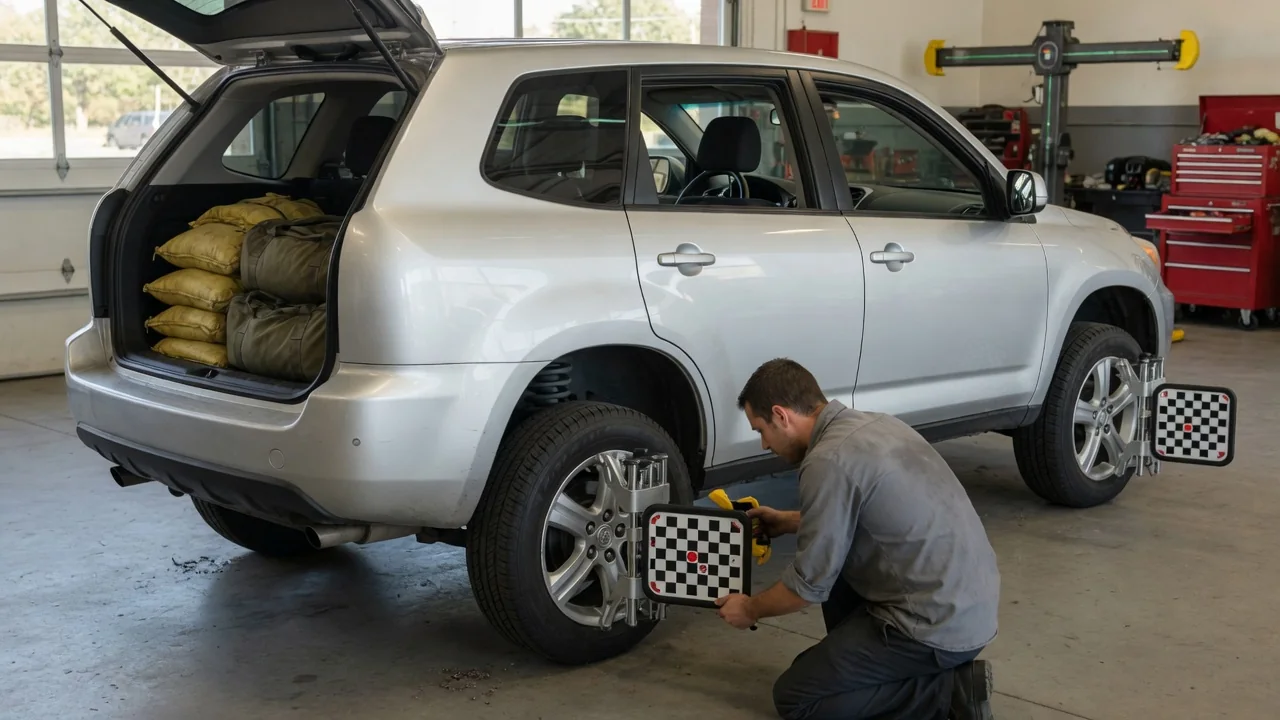
Wheel alignment is usually measured on an empty vehicle sitting still, yet the car you drive is rarely in that state. Add passengers, a loaded trunk or a trailer, and the suspension compresses, rubber bushings deflect and the wheel angles move. Why suspension alignment shifts when loaded comes down to three connected factors: how bushings flex, how ride height changes suspension geometry, and how those changes show up on your tires over thousands of miles.
Bushing Movement: Built-In Flex at Every Pivot
Most road car suspensions locate the wheels with control arms, links and subframes mounted through rubber or polyurethane bushings rather than rigid metal joints. Rubber isolates noise and vibration, but it also compresses and twists. When weight is added, the springs carry more force and every cornering and braking load becomes larger, pushing the arms harder against their bushings. Each bushing deflects a small amount, and because the arm pivots on that bushing, the wheel's camber and toe shift slightly. Engineers call this compliance and account for it during design. Some rear suspensions use bushings with deliberately different stiffness in different directions so that the wheel steers in a predictable, stabilizing way under load.
Bushing condition matters as much as bushing design. As rubber ages, it can crack, take a permanent set or separate from its metal sleeve. A worn bushing allows more movement than the engineers intended, so an alignment that looked correct on the rack can wander further once the car carries weight or brakes hard. There is also an installation factor: many service procedures call for tightening control arm pivot bolts with the vehicle at its normal ride height. If those bolts are tightened with the suspension hanging, the bushing is pre-twisted at rest, which affects how the arm sits, adds stress to the rubber and can shorten its life.
Ride Height and the Geometry of Suspension Travel
Every suspension arm moves in an arc around its mounting points, not in a straight line. When load lowers the body, those arcs change the angle of the wheel relative to the road. In double wishbone and many multi-link designs, the upper arm is typically shorter than the lower arm, so the top of the wheel is pulled inward as the suspension compresses. This is called camber gain, and it means a heavily loaded car usually runs more negative camber than it did when empty. MacPherson strut suspensions also change camber through their travel, though the amount and direction depend on the specific geometry.
Toe can change too. The steering tie rod and the lower control arm each swing through their own arc, and if those arcs are not matched, the wheel steers slightly as it moves up and down. This effect, known as bump steer, is minimized by design but rarely eliminated. Caster responds to load as well, because weight in the cargo area or on a hitch squats the rear and lifts the front, tilting the whole chassis. That pitch change alters the steering axis angle and, combined with less weight on the front tires, can change steering feel and stability. On a solid rear axle, camber stays largely fixed relative to the axle, but the axle itself can shift or steer slightly as its locating links or leaf springs move.
Ride height does not change only with cargo. Springs gradually sag with age, and replacement springs, lift kits or lowering kits change the baseline height. Because alignment specifications assume a particular ride height, a vehicle sitting too low or too high will show different angles even when nothing has been adjusted. This is why a proper alignment typically begins with checking ride height and tire pressures before any angle is measured.
How Load-Related Alignment Changes Affect Tire Wear
Tires are sensitive to small angle changes because they repeat them with every revolution. When added weight pushes camber more negative, the inner portion of the tread carries a greater share of the load, and over time the inner shoulder wears faster than the outer one. Toe changes are often more damaging. A wheel that toes in or out even slightly is dragged sideways as it rolls, scrubbing rubber off the tread and often producing a feathered pattern you can feel by running a hand across the tread ribs.
Load also affects wear independently of alignment. A heavily loaded tire flexes more, and if inflation is not adjusted for the load as the vehicle's tire placard or owner's manual directs, the shoulders carry extra stress and heat. This can produce wear on both edges that looks like an alignment problem but is actually a pressure problem. Reading the wear pattern is therefore useful but not conclusive. Wear concentrated on the inner edge of the rear tires on a vehicle that regularly carries weight points toward load-induced camber, while an unusual pattern on one tire only suggests a damaged or worn component at that corner.
Practical Implications and Limits
Some alignment shift under load is normal and designed in, so the goal is not to eliminate it but to keep it within the range the suspension was engineered for. Staying within the vehicle's rated payload and towing capacity, distributing cargo evenly, and using a weight-distributing hitch where the towing setup calls for one all keep ride height closer to the condition the alignment was set for. Replacing sagging springs or worn bushings before an alignment also matters, because adjusting angles around worn parts only produces numbers that will not hold.
If a vehicle spends most of its life carrying a consistent heavy load, such as a work truck with a permanently installed body or toolbox, mention that to the alignment technician. Some manufacturers' procedures specify how the vehicle should be loaded during measurement, and following the service manual for that specific model is more reliable than any general rule. Aligning a vehicle for its typical loaded state may be a sensible compromise in some cases, but it can leave the angles off when the vehicle runs empty, so the trade-off should be a deliberate choice.
General principles explain why car alignment under load changes, but they cannot predict exact angles for a given vehicle. Suspension designs, bushing materials and adjustment ranges vary widely, and only measurement on that vehicle shows the real numbers. Watch for practical warning signs instead: a pull that appears only when loaded, a steering wheel that sits off center with cargo aboard, or uneven tire wear that returns soon after an alignment. Those symptoms suggest the change exceeds normal behavior and that a component inspection is due.