Why Does Regen Disappear When an EV Battery Is Full?
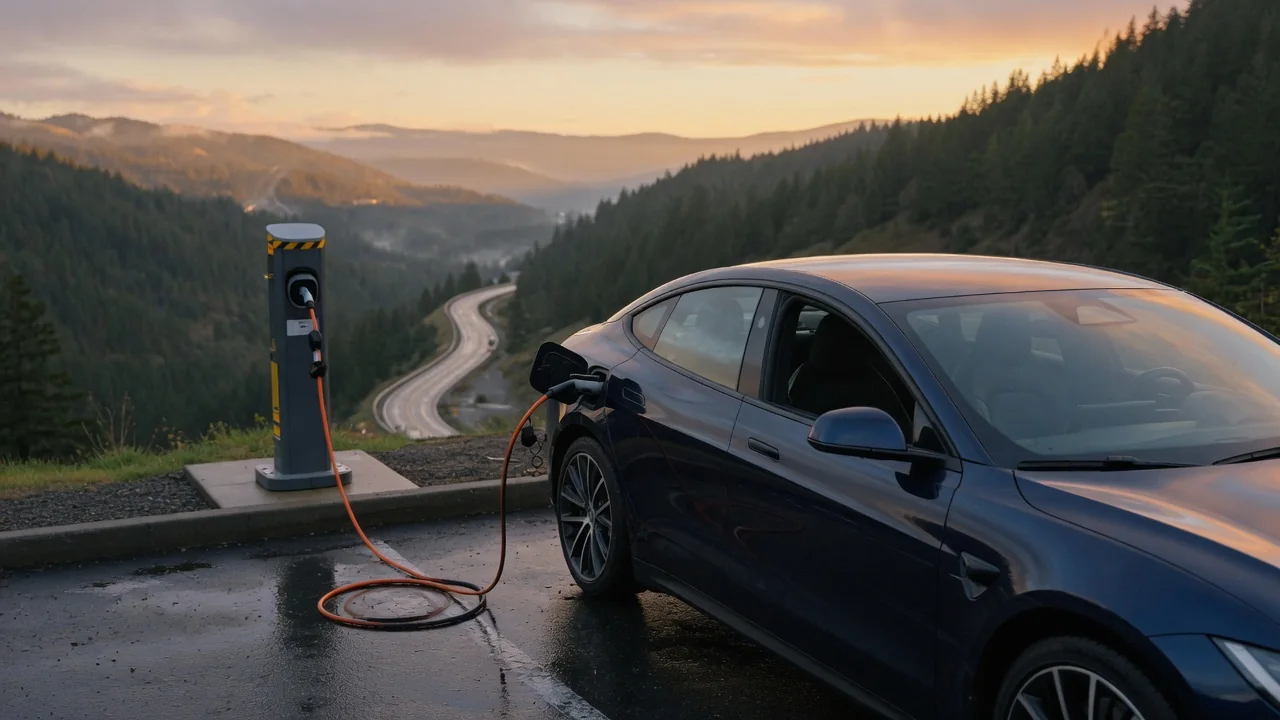
Many electric vehicle drivers notice that the car feels different right after a full charge. Lifting off the accelerator slows the car less than usual, and the dashboard may show a dashed power bar or a message saying regenerative braking is limited. This is normal behavior, not a fault. Regen is unavailable on a full battery because recovered energy needs somewhere to go. Three things explain why regen disappears when an EV battery is full: the battery's storage limit, the role of friction braking, and a few simple driver adjustments.
Storage limit: why a full battery can't take regen energy
Regenerative braking works by running the traction motor as a generator. The vehicle's kinetic energy is converted into electricity, and that electricity is sent back into the high-voltage battery as charging current. From the battery's point of view, every regen event is a short burst of charging, and during hard deceleration that burst can be substantial. If the battery cannot accept charge at that moment, the energy cannot be stored, and the motor controller has to reduce or stop regeneration.
Lithium-ion cells have a maximum safe voltage. As state of charge rises, cell voltage rises with it, and the amount of current the battery can safely absorb falls. The battery management system continuously monitors cell voltages and temperatures and calculates how much charging power is allowed at any given moment. Near full charge, that allowance becomes very small or drops to zero, so regen is limited to match it. Forcing large currents into nearly full cells could push them past their voltage limits, accelerate wear, and, particularly when the cells are cold, encourage lithium plating, a form of internal damage that reduces capacity.
The gauge reading does not tell the whole story. Many manufacturers keep a reserve that the driver never sees, and regen may begin tapering before the display reads 100 percent. It usually returns gradually as the first miles use up some charge. A cold battery restricts charge acceptance in a similar way, so the two effects can combine after a car charges overnight in cold weather. Exactly where the limit starts and how quickly it fades depends on the vehicle and its software.
Friction braking fills the gap
Losing regen does not mean losing brakes. Electric vehicles keep conventional hydraulic friction brakes that are designed to stop the car fully without any help from the motor. When the driver presses the brake pedal, a brake control system typically blends regenerative and friction braking. If regen is unavailable, pads and rotors simply do more of the work, or all of it. Many systems aim to keep the pedal feel consistent, so the change may go unnoticed during ordinary pedal braking.
The difference is most obvious when the driver lifts off the accelerator. One-pedal and strong regen modes depend on the motor to slow the car once the pedal is released. With regen limited, some vehicles let the car coast more freely than usual. Others automatically apply the friction brakes to imitate the normal lift-off deceleration, which keeps the driving feel predictable but discards the energy that regen would have recovered. Which approach a particular car uses is a design choice, and the owner's manual usually describes it.
Either way, the energy that would have gone back into the battery becomes heat at the brakes. In normal driving that is harmless. On long, steep descents, however, the friction brakes can heat up more than a driver used to strong regen might expect, because they are now handling work the motor would normally share.
Driver adjustment after a full charge
The first step is to watch the indicators. A dashed or shortened regen segment on the power meter, or a message about limited regen, means lift-off deceleration will be weaker than usual. For the first few minutes after leaving with a full battery, it helps to allow a little more following distance and be ready to use the brake pedal earlier, especially at the first stop sign or traffic light.
Charge limit settings are the most effective tool. Many EVs let owners set a maximum charge level below 100 percent for daily driving, and manufacturers often recommend this for battery longevity. Stopping short of full also leaves headroom for regen. Charging to 100 percent then becomes something to do before trips that need the extra range. Where available, scheduled charging that finishes shortly before departure, or battery preconditioning, can reduce the cold-battery part of the limitation, though it does not create room in a battery that is already full.
Location matters too. If the trip starts with a long downhill, such as leaving a home at the top of a hill, the first descent after a full charge will rely mostly on the friction brakes. Setting a lower charge limit for that routine avoids the problem. On a descent with limited regen, avoid dragging the brakes lightly for long stretches, and keep the strongest regen setting selected so the car uses regen as soon as capacity returns.
Practical implications and limits
The energy lost to limited regen is confined to the short period while the battery is near full, so on most trips the effect on overall efficiency is small. It matters more when a drive begins with significant elevation loss, since that is exactly when regen would recover the most energy and exactly when the battery has the least room to accept it.
Extra friction braking after a full charge is not a maintenance concern in itself. EV friction brakes are often used less than those on conventional cars, and occasional use helps keep rotor surfaces in good condition. Brake service should still follow the manufacturer's schedule, since infrequent use carries its own risks, such as corrosion. On a long mountain descent that starts with a full battery, a driver should pay attention to how the brakes feel, because sustained friction braking generates heat that regen would otherwise have avoided.
There are also firm limits on what the driver can change. No setting forces full regen into a full battery, because the restriction protects the cells and is enforced by the battery management system. How strongly regen is reduced, at what charge level, and whether the car compensates with automatic friction braking all vary between vehicles and software versions. If regen stays limited at moderate charge in mild temperatures, or appears alongside warning lights, that is outside normal full-battery behavior and the vehicle should be inspected.