Why Does Metallic Car Paint Change in Different Light?
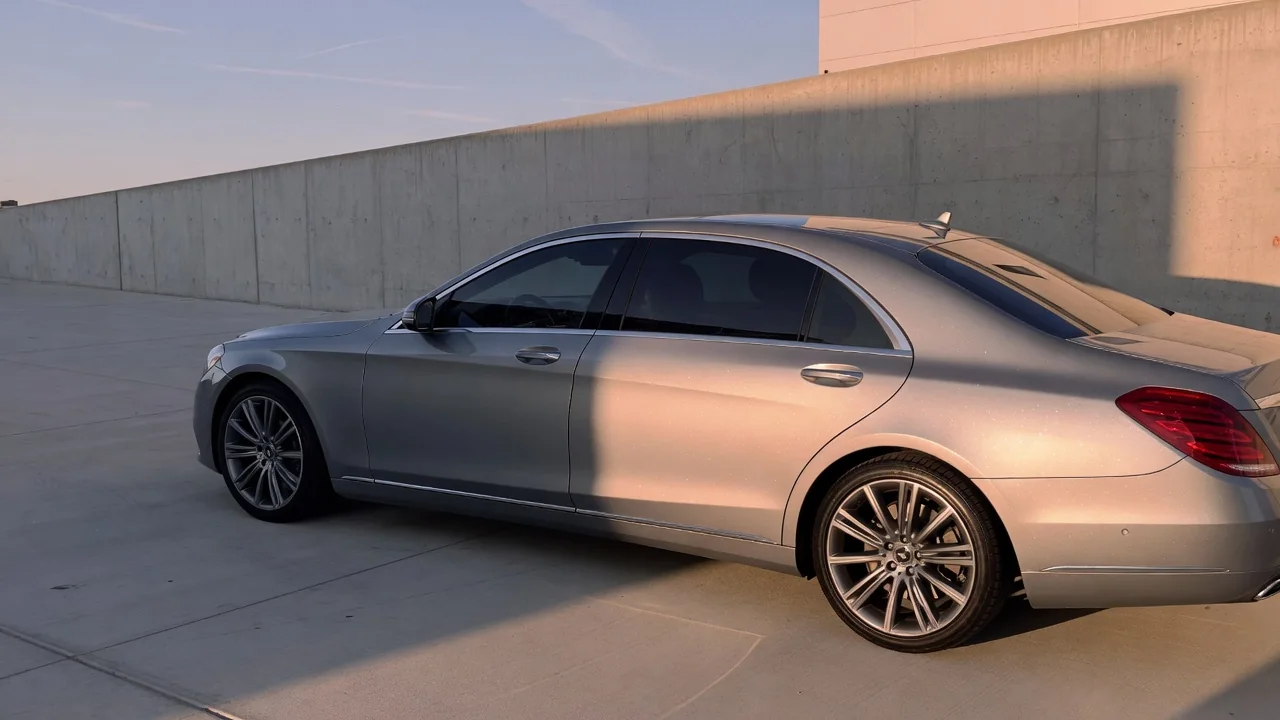
If you have ever seen a silver or gray car look bright in afternoon sun and then dark and flat under a parking garage light, you have seen the metallic car paint light effect. The shift is not a defect. It comes from tiny metal particles in the paint, the angle at which light reaches them, and the angle from which you look. The same mechanisms explain why repairing metallic paint so that it blends invisibly is harder than it seems.
Metal flakes: tiny mirrors inside the paint
Most modern automotive finishes use a basecoat and clearcoat system. In a metallic finish, the basecoat contains very fine flakes of metal, most commonly aluminum, alongside the colored pigments. A solid color scatters light fairly evenly in all directions, so it looks similar from most viewpoints. Metal flakes behave differently. Each flat particle reflects light much like a miniature mirror, sending it mainly in one direction instead of spreading it around. The clearcoat on top adds gloss and protection, but the flakes beneath it create most of the sparkle and the change in brightness.
How the flakes are arranged matters as much as their presence. When the paint is applied and dries properly, most flakes settle roughly parallel to the panel surface, so they reflect light in a fairly consistent direction. Flake size and shape also vary between formulations. Coarser flakes tend to give visible glitter, while finer flakes give a smoother, satin-like sheen. Pearl or mica finishes use coated mineral particles that create color partly through light interference, so they can shift in hue as well as brightness. The exact recipe behind any particular factory color is specific to that paint and cannot be predicted from general principles.
Light angles: face, flop and the light source
Because the flakes reflect light directionally, what you see depends on geometry. When you view a panel close to the direction of the reflected light, many flakes send light toward your eyes and the surface looks bright. Painters often call this the face or near-specular view. At a steeper angle, fewer flakes reflect toward you and the panel looks darker, which is commonly called the flop. The difference between face and flop is often described as the travel of a metallic color. It is why a curved fender, a flat hood and a vertical door can appear as slightly different shades on the same car at the same moment.
The light source adds another layer. Direct sun is a small, intense source that produces strong highlights and shadows across body curves, emphasizing the flake effect. An overcast sky lights the panels from many directions at once and flattens that contrast. Artificial light differs again. Streetlights, fluorescent tubes and LED fixtures emit different mixes of wavelengths, and the colored pigments respond to those mixes. Two paints can match under one light and differ under another, an effect called metamerism. So the reason metallic car paint changes in different light is a combination of flake reflection, viewing geometry and the spectrum of the light itself.
Matching a repair on metallic paint
These same mechanisms make metallic repairs demanding. A body shop typically starts with the vehicle's paint code, but the code identifies a color standard, not a single fixed mixture. Factory paint can vary between production batches, and paint suppliers often provide variant formulas for the same code to account for this. The existing finish has also aged and weathered. As a result, mixing the standard formula may not match the car in front of the painter. Many shops therefore spray candidate mixes onto test cards, sometimes with help from a multi-angle color measuring instrument, and compare them against the car from several viewpoints.
Application technique matters as much as the mix. Spray gun setup, distance, air pressure, coat thickness, how wet the paint goes on and how long each coat flashes all influence how the flakes settle. A wetter application can let flakes orient differently than a drier one, changing face brightness and flop even with identical paint. To hide small differences, painters commonly blend the new basecoat into adjacent panels, fading it out gradually so the eye finds no sharp edge, and then clearcoat the blended area. A well-executed blend is often less noticeable than a carefully mixed color sprayed edge to edge on a single panel.
Checking the result also requires more than one viewpoint and more than one light. A repair that looks invisible head-on under shop lighting may show up at a steep angle in sunlight, or the reverse. Inspecting the panels in daylight from both face and flop angles is a common way to catch a mismatch before the job is finished.
Practical implications and limits
For owners, the most useful takeaway is to judge metallic paint in more than one setting before drawing conclusions. A color seen in a showroom, in an online photo or under a parking structure light may look noticeably different at home in daylight. Cameras and screens apply their own processing, so photos are a weak basis for choosing or evaluating a metallic shade. When looking at a used car, walking around it in daylight and viewing each panel from a low, raking angle can help reveal refinished areas, because differences in flop are often easier to notice than differences in face color.
Small touch-ups have clear limits. Brush or pen touch-up products cannot reproduce the flake orientation of sprayed paint, so even with the correct paint code a chip repair may look darker or blotchy from some angles. That is usually acceptable for protecting exposed metal, but not for an invisible cosmetic result. Larger repairs depend on the painter's skill, the available formula variants and whether blending into neighboring panels fits the repair scope and budget, which is worth discussing with the shop before work begins.
Finally, the effect varies by color and finish. Light silvers and grays tend to make flop very visible, while darker metallics can make sparkle stand out in direct sun, and individual factory colors differ widely. Some vehicles also use multi-stage or tinted clearcoat finishes that add complexity. General principles explain the behavior, but the exact appearance of a particular car, and the best way to repair it, depends on its specific finish and condition.